
Analysis of Key Points in Criminal Complaints for the Crime of Infringing on Trade Secrets
Analysis of Key Points in Criminal Complaints for the Crime of Infringing on Trade Secrets
Attorney Gao Peijie, drawing on the Criminal Law Amendment (XI) and the latest judicial interpretations, systematically analyzes the key practical points for criminal complaints regarding the crime of infringing on trade secrets. The article points out that China's trade secret protection regime has become stricter, the threshold for criminalization has been lowered, and criminal case filings no longer require actual substantial losses as a prerequisite. Complaints must focus on four core elements: First, the identification of trade secrets, which requires simultaneous satisfaction of secrecy, commercial value, and reasonable confidentiality measures. Second, the determination of identity, which can be proven through judicial appraisal or the "contact + similarity" principle to demonstrate that the infringing information is substantially identical to the trade secret. Third, the identification of conduct, encompassing acquisition through improper means such as theft, bribery, electronic intrusion, etc., as well as disclosure, use, or authorization of use in violation of confidentiality obligations. Fourth, the calculation of losses and prosecution standards. The current filing threshold is losses or illegal gains of at least 300,000 RMB, which can be established through reasonable licensing fees, profit losses, or system remediation costs, supported by professional appraisal reports. Clarifying these key points helps improve the success rate of criminal filings, effectively combat infringement, and strengthen intellectual property protection and innovation ecosystem development.

Introduction:
In 2020, China and the United States signed the “Economic and Trade Agreement.” Based on the Agreement’s requirements, China’s criminal procedures and penalties should at least prohibit acts of trade secret infringement through theft, fraud, physical or electronic intrusion for illegal purposes, as well as unauthorized or improper use of computer systems. Against this background, China’s Criminal Law Amendment (XI) expanded the forms of conduct for trade secret infringement, particularly adding bribery, fraud, and electronic intrusion. Based on the Agreement’s requirements, China eliminated any requirement that the trade secret rights holder must have suffered actual losses as a prerequisite for initiating a criminal investigation into trade secret infringement. On September 17, 2020, the Supreme People’s Procuratorate and the Ministry of Public Security issued the “Decision on Amending the Standards for Filing and Prosecuting Criminal Cases of Trade Secret Infringement,” which clearly stipulates that where trade secrets are obtained by improper means and have not yet been disclosed, used, or authorized for use by others, the amount of loss may be determined based on the reasonable license fee for the trade secret.
Thus, whether in terms of the scope of crackdown on trade secret infringement crimes or the lowering of the threshold for criminalization, China’s trade secret protection system is bound to align with international standards, gradually improving and becoming stricter. Correspondingly, acts of trade secret infringement, especially those suspected of being criminal, should also be severely cracked down on in line with policy trends. Although in past judicial practice, the difficulty in determining the calculation standard for losses caused by trade secret infringement often hindered criminalization, with the implementation of the Criminal Law Amendment (XI) and related judicial interpretations, the requirement of causing “substantial losses” to the rights holder as a prosecution standard has been removed. Even the prerequisite of actual losses incurred by the rights holder for initiating a criminal investigation is no longer required. This means that severely cracking down on criminal acts of trade secret infringement, lowering the threshold for criminalization, and maximizing the protection of intellectual property rights of rights holders to create a favorable IP environment is the current state of China’s IP protection.
Although from the policy background and current regulations, the threshold for filing a criminal complaint for trade secret infringement has been greatly lowered, in judicial practice, the traditional standard of “consequential offense” still exists as the filing standard.
Taking cases handled by the author as examples, even if it can be determined that trade secrets were obtained by improper means and losses are determined by evaluating the license fee, without any infringing product being produced or clear loss results occurring, it is still difficult to get a criminal case filed according to the law. In this regard, the author intends to combine case experience with legal provisions to clarify the prosecution standards for the crime of infringing on trade secrets. By clarifying the key points for criminal complaints of this crime, the goal of successfully filing a criminal case can be achieved.
Key Point One for Criminal Complaints of Trade Secret Infringement: Identification of Trade Secrets
“Trade secrets” refer to technical information, operational information, and other commercial information that is not known to the public, has commercial value, and for which the rights holder has taken corresponding confidentiality measures.
1. Types of Trade Secrets
Trade secrets include technical information, operational information, and other commercial information.
(1) Technical Information
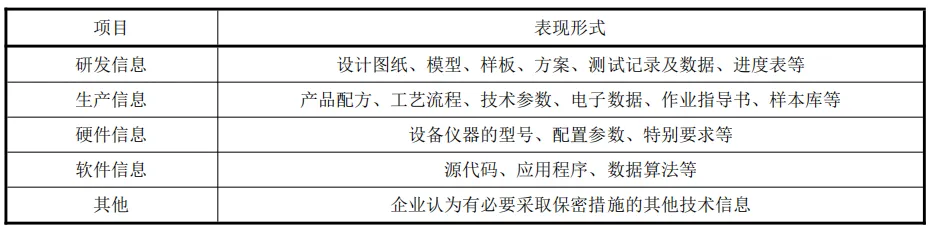
Technical information refers to information related to technology, such as structures, raw materials, components, formulas, recipes, materials, samples, styles, plant new variety propagation materials, processes, methods or steps thereof, algorithms, data, computer programs, and related documentation.
Referring to Shenzhen’s “Enterprise Trade Secret Management Standards,” the scope of technical information protected as trade secrets is as shown in the following table:
(2) Operational Information
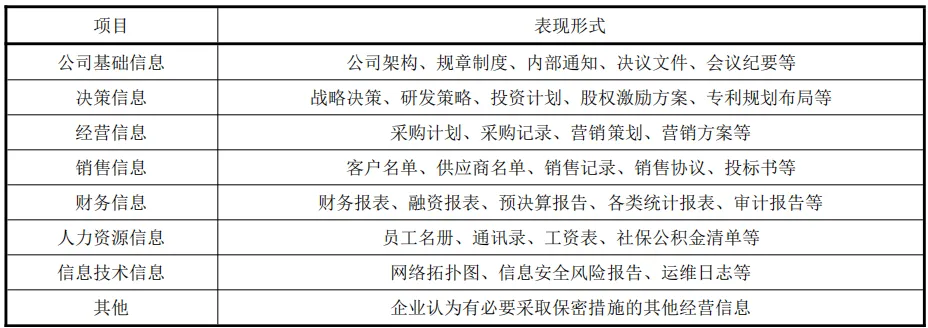
Operational information refers to information related to business activities, such as creative ideas, management, sales, finance, plans, samples, bidding materials, customer information, and data. Among them, customer information includes the customer’s name, address, contact information, as well as trading habits, intentions, content, etc.
Referring to Shenzhen’s “Enterprise Trade Secret Management Standards,” the scope of operational information protected as trade secrets is as shown in the following table:
2. Constituent Elements of Trade Secrets
The identification of a trade secret requires three elements: (1) not known to the public; (2) having commercial value; (3) taking corresponding confidentiality measures.
(1) Not Known to the Public
“Not known to the public,” i.e., “non-public knowledge” or “secrecy,” requires that the information as a trade secret was not generally known to or readily accessible by relevant personnel in the relevant field at the time of the infringing act.
Conversely, information known to the public refers to information generally understood or easily accessible by people ordinarily engaged in the field of work concerning such information. This includes the following types of information: (1) information that is common knowledge or industry practice in the relevant field; (2) information that involves only simple combinations of product dimensions, structures, materials, components, etc., which can be directly obtained by relevant personnel in the field through observing the marketed product; (3) information that has been publicly disclosed in open publications or other media; (4) information that has been made public through open seminars, exhibitions, etc.; (5) information that relevant personnel in the field can obtain from other public channels. However, new information formed by organizing, improving, or processing information known to the public shall be deemed not known to the public.
First,
Determining whether technical information is not known to the public may rely on professional opinions from technical experts, technical investigation officers, or other persons with specialized knowledge, as well as scientific and technical novelty search reports. When necessary, technical appraisal and other means can be used to resolve the issue.
Second,
In determining whether customer information is not known to the public, attention should be paid to examining the uniqueness of the customer information, whether the rights holder has invested labor, money, and effort in forming the information, and whether the information is publicly available or easily obtainable from normal channels. Generally, it should be examined whether there is a relatively stable transactional relationship between the rights holder and the customer. One-time, occasional transactions, and customers with whom no actual transaction has occurred generally do not constitute customer information in the sense of trade secrets.
Generally, whether a trade secret possesses secrecy needs to be determined through professional appraisal. Therefore, for cases involving criminal complaints of trade secret infringement, it is first required to produce relevant appraisal documents proving the non-public nature of the trade secret in question.
Taking cases handled by the author as examples, the material for a certain project product owned by Company A constitutes technical information. After appraisal by the Guangdong Anzheng Computer Judicial Appraisal Institute and the Beijing Guochuang Dingcheng Intellectual Property Applied Technology Research Institute, the three secret points involved in this project product material were found to be non-public. The chip R&D data owned by Company B constitutes technical information. After appraisal by the China Electronics Information Industry Development Research Institute, the three secret points involved in this chip product were found to be non-public.
(2) Having Commercial Value
“Commercial value” means that because a trade secret is not known to the public, it has actual or potential commercial or economic value, can bring the rights holder a competitive advantage in the market, and can generate economic benefits for the rights holder.
Generally, the following circumstances can be considered as having commercial value: (1) it can bring certain economic benefits to the rights holder; (2) it can be implemented, achieving certain innovation purposes and effects; (3) it can have a significant impact on the rights holder’s production and operations; (4) the rights holder has made corresponding investments, R&D costs, or operational costs to obtain the information; (5) the information can bring the rights holder a competitive advantage in other ways; (6) interim results formed during production and operation activities can also be deemed to have commercial value.
In addition, when evaluating the value of a trade secret, “practical applicability” is often also considered together. Practical applicability requires that, on one hand, the trade secret has relative identifiability, distinguishing it from general knowledge, experience, and skills, and can be used in practice; on the other hand, it has relative completeness, allowing it to be used or implemented by others through self-use, licensing, or assignment, generating and realizing value through practical application and operation.
The value of a trade secret is determined objectively and cannot be based solely on the subjective “belief” of the rights holder. Therefore, for cases involving criminal complaints of trade secret infringement, the value can be determined in the following ways: First, by evaluating the market value of the trade secret in question, i.e., through a value appraisal report issued by a professional appraisal institution. The value appraisal report should demonstrate that the trade secret can bring economic benefits to the rights holder and has practical applicability. Second, by presenting the actual operational situation of the product, such as R&D investment and product sales, listing inputs and outputs, to prove that the product utilizing the trade secret has value.
Taking cases handled by the author as examples, Company B commissioned Shenzhen Zhonghengxin Asset Appraisal Co., Ltd. to appraise the value of the three secret points of technical information, the value of the license fee for the full source code, and the value of remedial measures for chip trade secret infringement, resulting in corresponding “Asset Appraisal Reports.” The core product of a certain project owned by Company A is a core product independently developed and produced by the company at great expense. The entire process from project initiation and R&D, to releasing the appearance and basic functions, to mass production, to official sale demonstrates that the product has direct economic value, can bring economic benefits to the company, and has practical applicability.
(3) Taking Corresponding Confidentiality Measures
“Taking corresponding confidentiality measures,” i.e., confidentiality, means that the trade secret rights holder or lawful holder has adopted reasonable confidentiality measures appropriate to the trade secret information. Specifically, whether the rights holder has taken corresponding confidentiality measures should be comprehensively determined based on factors such as the nature of the trade secret and its carrier, the commercial value of the trade secret, the identifiability of the confidentiality measures, the degree of correspondence between the confidentiality measures and the trade secret, the rights holder’s intent to maintain confidentiality, and the difficulty for others to obtain the information through legitimate means. Confidentiality measures do not need to be foolproof; it is sufficient if, under normal circumstances, they can prevent the disclosure of the trade secret, typically prevent others from obtaining the trade secret, and make the counterparty bearing the confidentiality obligation aware that the relevant information needs to be kept confidential.
Generally, taking corresponding confidentiality measures refers to the following circumstances: (1) signing a confidentiality agreement or stipulating confidentiality obligations in a contract; (2) imposing confidentiality requirements on employees, former employees, suppliers, customers, visitors, etc., who can access or obtain trade secrets, through articles of association, training, rules and regulations, written notices, etc.; (3) restricting visitors or implementing differentiated management of production and operation sites such as confidential workshops and factories; (4) distinguishing and managing trade secrets and their carriers through marking, classification, isolation, encryption, sealing, restricting the scope of persons who can access or obtain them, etc.; (5) adopting measures such as prohibiting or restricting the use, access, storage, and copying of computer equipment, electronic devices, network devices, storage devices, software, etc., that can access or obtain trade secrets; (6) requiring departing employees to register, return, clear, or destroy the trade secrets and their carriers they have accessed or obtained, and continue to bear confidentiality obligations; (7) adopting other reasonable confidentiality measures.
The adoption of corresponding confidentiality measures is examined from the perspective of the overall company system. Therefore, in determining whether a company has adopted corresponding confidentiality measures, the company’s rules and regulations, personnel management, contract management, public relations management, etc., should be comprehensively considered.
For example, regarding trade secret information management, whether the company has classified trade secrets, regulated archiving, storage, circulation, backup, copying, publishing, encryption and decryption, destruction, traceability, etc. Regarding information system management, whether appropriate confidentiality measures have been taken for permission management, accounts and passwords, information export control, etc.
For another example, regarding employee management, whether there are onboarding management procedures, confidentiality education, and relevant provisions for information protection during employment, resignation, and management of external personnel.
As another example, regarding physical area management, whether corresponding confidentiality measures, security measures, and internal/external network restrictions have been implemented for confidential areas. Regarding item and carrier management, whether corresponding usage regulations have been set for mobile phones, computers, paper documents, products, removable storage media, etc.
In summary, the determination of confidentiality mainly involves a comprehensive assessment of whether the company has adopted both technical confidentiality measures and institutional confidentiality measures. The establishment of confidentiality measures is an important element in evaluating whether a trade secret is constituted. For cases involving criminal complaints of trade secret infringement, consolidating the confidentiality measures adopted by the company is very important and necessary.
Taking cases handled by the author as examples, to better protect R&D security, Company A adopted technical confidentiality measures including software encryption and system settings, as well as institutional confidentiality measures including signing confidentiality agreements and establishing confidentiality systems. Company B adopted technical confidentiality measures including building internal servers, setting access permissions, and installing encryption software, as well as institutional confidentiality measures including signing confidentiality agreements and establishing confidentiality systems.
A special note on confidentiality agreements: Generally, for employees who possess trade secrets, companies should try to have them sign a dedicated “Confidentiality Agreement.” However, in practice, a considerable number of companies, due to inadequate legal systems, may only include general confidentiality clauses in labor contracts.
Regarding the determination of general confidentiality clauses, the content of the trade secrets to be kept confidential should, in principle, be specific and clear. However, the law does not categorically negate confidentiality measures that only impose general requirements for keeping trade secrets confidential without specifying the specific content of the information, such as confidentiality agreements, confidentiality clauses, labor contracts, and rules and regulations. Instead, a comprehensive judgment is made by considering factors such as whether the prosecuted person subsequently actually knew that the information they accessed or obtained was a trade secret, whether they used improper means, and the possibility of actual information leakage. For example, the following circumstances may be considered as effective and reasonable confidentiality measures for general confidentiality clauses: the rights holder explicitly informed the prosecuted person in subsequent work that the relevant information was a trade secret; based on the principle of good faith and the nature, purpose, contract formation process, and trading practices of the contract, the prosecuted person knew or should have known that the information they accessed or obtained constituted a trade secret; the prosecuted person intentionally used improper means to obtain the information claimed to be protected by the rights holder, or disclosed, used, or authorized others to use the information obtained by improper means, and there is no evidence that the information was already publicly available before.
Although general confidentiality clauses are not entirely invalidated, to better demonstrate that the company has taken reasonable confidentiality measures, it is recommended that the company separately confirm the confidentiality agreement in writing, such as signing dedicated confidentiality documents like a separate “Confidentiality Agreement,” “Undertaking Not to Infringe Trade Secrets,” “Non-Competition Agreement,” “Business Cooperation Confidentiality Agreement,” etc.
Key Point Two for Criminal Complaints of Trade Secret Infringement: Determination of Identity
If the information in question is identical or substantially identical to the rights holder’s trade secret, or identical to the part of the trade secret that plays a key role in achieving the technical purpose or effect, the two can be deemed to have identity.
First, in specifically determining whether substantial similarity exists, the following factors may be considered: (1) the degree of similarity or difference between the information in question and the trade secret; (2) whether relevant personnel in the field would readily think of the difference between the information in question and the trade secret at the time of the infringing act; (3) whether there are substantive differences in the use, method of use, purpose, effect, etc., between the information in question and the trade secret; (4) the status of information related to the trade secret in the public domain; (5) other factors to be considered.
Second,
In determining the identity of trade secrets involving computer software, the assessment focuses on the protected object of the trade secret, typically comparing the source code of the prosecuted person and the rights holder. If the protected object is the unpublished object code or the technical solution embodied in the source code, the comparison is made accordingly.
If the prosecuted person’s source code cannot be obtained, comparison can be made through the decompiled code of the object code to determine whether they are identical or substantially identical. If the decompiled code of the prosecuted person’s computer software’s object code is identical or substantially identical to the corresponding code segments of the algorithm’s core functional modules in the rights holder’s program code, the two can be deemed to have identity.
Third,
The “contact plus similarity” principle from civil litigation can be referenced for determination. In civil litigation, to prove that the commercial information possessed, disclosed, or used by the defendant originates from the plaintiff’s trade secret, the plaintiff typically uses the “contact + similarity + lawful source” method to make a prima facie showing that the commercial information possessed, disclosed, or used by the defendant originates from the plaintiff’s trade secret and is identical. On one hand, it is shown that the defendant has had contact with the plaintiff’s trade secret, for example, the defendant was once a developer, custodian of the plaintiff’s trade secret, or a licensee of the plaintiff’s trade secret; or the defendant had the conditions or opportunity to access the plaintiff’s trade secret, such as having been a technical manager of the plaintiff’s company or having visited the plaintiff’s production line. On the other hand, the commercial information possessed by the defendant is identical or similar to the plaintiff’s trade secret.
Of course, in criminal cases of trade secret infringement, the determination of identity is generally achieved directly through professional judicial appraisal. Especially for the identification of computer-related trade secrets, it is directly determined by comparing whether the code is substantially identical.
Taking cases handled by the author as examples, according to the “Appraisal Opinions” issued by Anzheng and other institutions, the trade secrets of Company A were substantially identical to certain codes extracted from data files in the mobile phones and computers of Mu and others.
Key Point Three for Criminal Complaints of Trade Secret Infringement: Identification of Conduct
1. Obtaining the rights holder’s trade secrets by theft, bribery, fraud, coercion, electronic intrusion, or other improper means.
(1) Theft
Theft refers to the act of obtaining trade secrets by secretly stealing the carrier of the trade secret or by means such as unauthorized photography, videography, copying, or eavesdropping. The object of theft includes the tangible carrier of the trade secret or the electronic information contained within the tangible carrier. Reproducing a trade secret from memory after surreptitiously reading it is also deemed an act of theft.
In addition, acts of stealing trade secrets by means such as illegal copying, unauthorized use, or exceeding authorized use of computer information systems are also deemed “theft.” For acts of stealing trade secrets through computer information systems, evidence of illegal copying or illegal use can be fixed through related appraisals, such as access traces.
Note: Theft requires a subjective intent to steal trade secrets. If the intent is to steal ordinary property but trade secrets are actually obtained, it does not constitute the crime of infringing on trade secrets. If the person did not know it was a trade secret at the time of theft but later discovers it is a trade secret and still discloses, uses, or authorizes others to use it, it can be deemed as obtaining by improper means.
Taking cases handled by the author as examples, Company A, from both technical and institutional levels, explicitly prohibited its employees from illegally copying all materials related to company projects. Knowing the company’s confidentiality regulations, Mu and others illegally copied materials related to a certain project, including the project’s source code, circuit diagrams, schematic diagrams, product appearance, and product bill of materials (BOM), through means such as screenshots, photographs, videos, and manual input. The actions of these two employees both constituted acts of stealing trade secrets by means such as illegal copying, unauthorized use, or exceeding authorized use of computer information systems.
According to Company B’s server management permissions and company management regulations, only the company’s general manager had the authority to access all company R&D data and make copies and backups. However, Li, knowing that he did not have the authority to access or download the company’s source code and other trade secrets, still engaged in extensive access and downloading of source code-related data, stealing chip R&D data through illegal copying and exceeding authorized access. For this conduct, Company B commissioned Guangdong Anzheng Computer Judicial Appraisal Institute to analyze the company’s server data, detecting traces of Li’s user accessing confidential files and using USB devices.
(2) Bribery
Bribery refers to the act of obtaining trade secrets by offering property, high salaries, stock, or promising promotions, etc., whether property interests or non-property interests.
Where bribery leads to a concurrence between the crime of infringing on trade secrets and the crime of commercial bribery, specific conviction and sentencing should be determined based on the specific circumstances of the case and according to the theory of concurrence.
(3) Fraud
Fraud refers to the act of obtaining trade secrets by fabricating facts or concealing the truth, causing another person to have a mistaken understanding and deliver the trade secret.
(4) Coercion
Coercion refers to the act of obtaining trade secrets by harming, threatening, or blackmailing with respect to life, health, privacy, property, reputation, etc.
(5) Electronic Intrusion
Electronic intrusion refers to the act of obtaining trade secrets by using technical means such as hacking or Trojans to destroy another person’s technical prevention measures, intruding into computer information systems, etc. This typically involves means such as cracking, stealing identity authentication information, or forcibly breaking through security tools. In addition, obtaining trade secrets by means such as unauthorized use or exceeding authorized use of computer information systems is also considered electronic intrusion.
Where electronic intrusion leads to a concurrence between the crime of infringing on trade secrets and the crime of illegally obtaining computer information system data, specific conviction and sentencing should be determined according to the theory of concurrence.
(6) Other Improper Means
Other improper means require that their nature and severity be equivalent to acts such as theft, bribery, fraud, coercion, and electronic intrusion, and the act itself must be unlawful. Generally, obtaining the rights holder’s trade secrets in a manner that violates legal provisions, contractual basis, the principle of good faith, or generally accepted business ethics, such as deception, snatching, commercial espionage, etc., are all considered obtaining trade secrets by other improper means.
In addition, where a prosecuted person, due to job convenience, can access the rights holder’s trade secrets but ordinarily does not need to know or master them, and actively collects and obtains the trade secrets using job convenience, this is also considered obtaining trade secrets by improper means.
Obtaining trade secrets by improper means constitutes a crime without requiring use; it only requires obtaining the trade secret. The notable characteristic of this criminal act is the impropriety of the means, which puts the rights holder’s trade secret at risk. Obtaining the carrier of a trade secret by improper means without yet extracting relevant information from the carrier also constitutes obtaining the trade secret.
The subject of improper means may be a unit or an employee, an internal employee of the unit, an external person, or a joint criminal act of internal and external persons.
2. Disclosing, using, or allowing others to use the rights holder’s trade secrets obtained by the means mentioned in the preceding paragraph.
(1) Disclosure
Disclosure refers to informing others other than the rights holder of the trade secret, or making the content of the trade secret public. The degree of openness of the disclosure or the number of recipients generally does not affect the establishment of the disclosure act.
(2) Use
Use refers to directly using the trade secret in production or business activities, or modifying or improving the trade secret and then using it, or adjusting, optimizing, or improving relevant production or business activities based on the trade secret.
(3) Allowing Others to Use
Allowing others to use refers to providing the trade secret owned by the rights holder to others, whether for compensation or for free, or guiding others to use it in production or business activities, etc.
Taking cases handled by the author as examples, Mu and others formed a team with non-Company A employees like Jun, established a WeChat group, and published the confidential information of Company A that Mu had obtained in the group. Knowing that the information was a trade secret obtained by Mu through theft, they still disclosed and shared it in the WeChat group. This act constitutes “disclosing, using, or allowing others to use the rights holder’s trade secrets obtained by the means mentioned in the preceding paragraph,” i.e., disclosing a trade secret obtained by theft.
3. Disclosing, using, or allowing others to use the trade secrets in their possession in violation of confidentiality obligations or the rights holder’s requirements for keeping trade secrets confidential.
(1) Confidentiality Obligations and Requirements
Confidentiality obligations refer to agreements between the rights holder and the obligor concerning keeping trade secrets confidential. Confidentiality requirements refer to the rights holder’s unilateral requirements for the obligor to keep trade secrets confidential. In addition, confidentiality obligations may arise from confidentiality agreements or the rights holder’s confidentiality requirements, or from statutory confidentiality obligations.
First, in determining whether the prosecuted person had channels or opportunities to access the rights holder’s trade secrets, the following factors may be considered: (1) position, duties, and authority; (2) the nature of the job or tasks assigned by the unit; (3) specific circumstances of participation in production and business activities related to the trade secret; (4) whether the person kept, used, stored, copied, controlled, or otherwise lawfully accessed or obtained the trade secret and its carrier; (5) other factors to be considered.
Second, regarding implied confidentiality obligations. Parties who, although not explicitly agreeing to confidentiality obligations, know or should know that the information they access or obtain is a trade secret based on the principle of good faith and the nature, purpose, contract formation process, and trading practices of the contract, shall also bear confidentiality obligations. This includes the rights holder’s employees, former employees, transaction counterparts, and other units or natural persons.
(2) Unlawful Disclosure of Another’s Trade Secret
Unlawful disclosure of an acquired trade secret refers to the prosecuted person, in violation of confidentiality obligations, disclosing the rights holder’s trade secret to others.
Generally, this includes the following circumstances: (1) informing a specific third party, making the trade secret known to that specific third party. Whether the third party continues to disclose it to others or uses the rights holder’s trade secret does not affect the establishment of the discloser’s infringement. (2) Disclosing to a specific group, meaning the prosecuted person discusses another’s trade secret in private settings or discloses it at meetings attended by specific persons. Although the result does not reach the level of making the trade secret known to the public, it becomes difficult to control further dissemination and use by others. (3) Making it public, meaning the prosecuted person disseminates the trade secret to society through information media such as newspapers, magazines, radio, television, etc., or makes it public in public places. This type of public disclosure destroys the secrecy of the trade secret, bringing it into the public domain.
(3) Unlawful Use or Authorization of Use
First, the unlawful use or authorization of use of a trade secret generally includes the following circumstances: (1) after unlawfully obtaining another’s trade secret, using it oneself; (2) after unlawfully obtaining another’s trade secret, allowing others to use it; (3) after lawfully obtaining another’s trade secret, using it without authorization or beyond the scope authorized by the rights holder; (4) after lawfully obtaining another’s trade secret, authorizing others to use it without the rights holder’s authorization.
Second, the specific methods of unlawful use or authorization of use of a trade secret include, but are not limited to, directly using another’s trade secret in production or business activities, such as for product manufacturing, sales planning, business management, etc.; indirectly using another’s trade secret for production or business purposes, such as for employee training, developing new products based on the trade secret, formulating new marketing strategies, etc.
Note: Whether the prosecuted person provides the acquired trade secret to others for use with or without consideration does not affect the establishment of infringement.
4. Obtaining, disclosing, using, or allowing others to use a trade secret obtained by improper means.
If a third party, knowing or having reason to know that the trade secret was obtained by improper means, still engages in obtaining, disclosing, using, or allowing others to use it, this also constitutes an act of infringing on trade secrets.
“Knowing” is a necessary condition for such acts to constitute a crime, i.e., clearly knowing that the source of the trade secret is illegal. For example, knowing that another person has previously borne civil liability, received administrative penalties, or even criminal punishment for trade secret infringement; knowing that another person is a professional commercial spy.
Key Point Four for Criminal Complaints of Trade Secret Infringement: Determination of Loss
1. Changes in Prosecution Standards for Trade Secret Infringement
The prosecution standards for the crime of infringing on trade secrets have undergone several amendments, with the main changes divided into the following two phases:
(1) From the “Provisions on Standards for Prosecuting Economic Crime Cases” issued by the Supreme People’s Procuratorate and the Ministry of Public Security on April 18, 2001, to the “Interpretation on Several Issues Concerning the Specific Application of Law in Handling Criminal Cases of Infringement of Intellectual Property Rights” issued by the Supreme People’s Court and the Supreme People’s Procuratorate on December 22, 2004, to the “Interpretation (II) on Several Issues Concerning the Specific Application of Law in Handling Criminal Cases of Infringement of Intellectual Property Rights” issued on April 5, 2007, and to the “Provisions (II) on Standards for Filing and Prosecuting Criminal Cases under the Jurisdiction of Public Security Organs” issued on May 7, 2010, four amendments were made through judicial interpretations. For individual crimes, the prosecution standards did not show significant numerical changes and remained relatively stable. However, for unit crimes, with the issuance of the 2007 judicial interpretation and the implementation of the 2010 provisions, unit crimes and individual crimes are subject to the same prosecution standards, meaning that the criminal risk for units committing this crime has increased.
The comparison of changes is as follows:

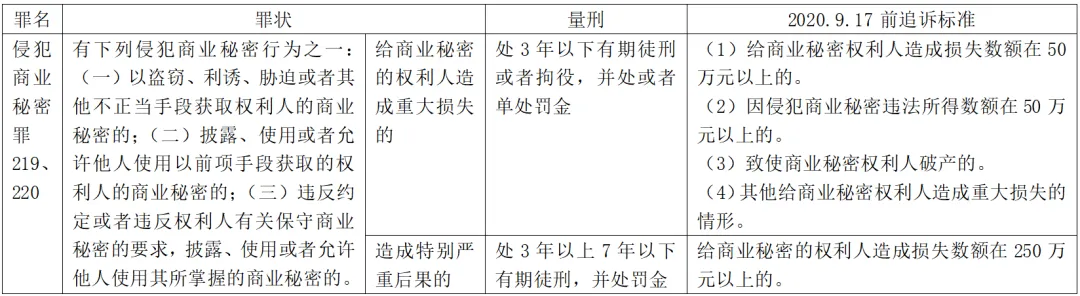
(2) The “Decision on Amending the Standards for Filing and Prosecuting Criminal Cases of Trade Secret Infringement,” implemented on September 17, 2020, by the Supreme People’s Procuratorate and the Ministry of Public Security, amended the prosecution standard for trade secret crimes from the original loss amount or illegal gains amount of 500,000 RMB or more to a loss amount or illegal gains amount of 300,000 RMB or more for prosecution.
(3) The “Interpretation on Several Issues Concerning the Application of Law in Handling Criminal Cases of Infringement of Intellectual Property Rights,” implemented on April 26, 2025, by the Supreme People’s Court and the Supreme People’s Procuratorate, amended the aggravated penalty standard from the original loss amount of 2.5 million RMB or more to a loss amount or illegal gains amount of 3 million RMB or more. The 2020 judicial interpretation directly lowered the prosecution standard from 500,000 RMB to 300,000 RMB. Of course, this decision was issued in the context of the 2020 Sino-US Economic and Trade Agreement, so lowering the threshold for this crime is an inevitable result of China’s increasingly strict trade secret protection system. Among all intellectual property crimes, only the prosecution standard for trade secret crimes was amended, a product of this special context. The 2025 judicial interpretation, however, is a comprehensive amendment and improvement of all intellectual property crimes. The increase in the aggravated penalty standard for trade secret crimes is also intended to maintain consistency within the overall system.
The changes in prosecution standards for the crime of infringing on trade secrets are as follows:
2. Determination of Loss under Current Prosecution Standards
The crime of infringing on trade secrets is a circumstantial offense, requiring “serious circumstances” to constitute the crime. According to the current judicial interpretation on prosecution standards for trade secret infringement, any of the following circumstances constitutes “serious circumstances”: (1) causing loss of 300,000 RMB or more to the trade secret rights holder; (2) illegal gains from trade secret infringement amounting to 300,000 RMB or more; (3) having been subjected to criminal punishment or administrative penalty for acts under Article 219 or Article 219-1 of the Criminal Law within two years, and committing the act again, causing loss or illegal gains of 100,000 RMB or more; (4) other circumstances of serious nature. Therefore, determining “serious circumstances” primarily relies on two standards: one is the amount of loss; the other is the amount of illegal gains.
(1) Amount of Illegal Gains
The amount of illegal gains from trade secret infringement refers to the value of property or other property interests obtained from disclosing or allowing others to use the trade secret, or the profits obtained from using the trade secret. Such profits can be determined based on the sales volume of infringing products multiplied by the reasonable profit per infringing product.
(2) Amount of Loss
The amount of loss from trade secret infringement can be determined in the following ways:
First, where the rights holder’s trade secret is obtained by improper means and has not yet been disclosed, used, or authorized for use by others, the amount of loss may be determined according to the reasonable license fee for that trade secret.
Second, where the rights holder’s trade secret is obtained by improper means and subsequently disclosed, used, or authorized for use by others, the amount of loss may be determined according to the rights holder’s loss of profits due to infringement. However, if this amount is lower than the reasonable license fee for the trade secret, it shall be determined according to the reasonable license fee.
Third, where a person, in violation of confidentiality obligations or the rights holder’s requirements for keeping trade secrets confidential, discloses, uses, or allows others to use the trade secret in their possession, the amount of loss may be determined according to the rights holder’s loss of profits due to infringement.
Fourth, where a person, knowing that the trade secret was obtained by improper means or that it was disclosed, used, or authorized for use in violation of confidentiality obligations or the rights holder’s requirements, still obtains, discloses, uses, or allows others to use it, the amount of loss may be determined according to the rights holder’s loss of profits due to infringement.
Fifth, where the trade secret has become known to the public or has been lost due to the act of infringement, the amount of loss may be determined according to the commercial value of the trade secret. The commercial value of the trade secret may be determined comprehensively based on factors such as the research and development cost of the trade secret and the income from implementing the trade secret.
Sixth, the rights holder’s loss of profits due to infringement may be determined based on the total decrease in product sales volume caused by the infringement multiplied by the reasonable profit per product of the rights holder. If the total decrease in product sales volume cannot be determined, it may be determined based on the sales volume of infringing products multiplied by the reasonable profit per product of the rights holder. If the trade secret is used for services or other business activities, the amount of loss may be determined according to the reduction in the rights holder’s reasonable profit caused by the infringement.
Seventh, the remedial expenses incurred by the trade secret rights holder to mitigate losses to business operations, business plans, or to restore the security of computer information systems or other systems shall be included in the losses caused to the trade secret rights holder.
In summary, for cases involving criminal complaints of trade secret infringement, reaching the threshold of “serious circumstances” is a necessary condition for successful case filing. Therefore, to determine whether the amount of loss or illegal gains reaches 300,000 RMB or more, a professional institution is generally commissioned to produce a corresponding “Appraisal Report” to verify that the rights holder’s loss amount or the prosecuted person’s illegal gains amount meets the filing standard.
Taking cases handled by the author as examples, Li’s criminal method was stealing trade secrets, i.e., obtaining the rights holder’s trade secret by improper means, which had not yet been disclosed, used, or authorized for use by others. Therefore, the amount of loss could be determined based on the reasonable license fee for that trade secret. Accordingly, Company B commissioned Shenzhen Zhonghengxin Asset Appraisal Co., Ltd. to conduct a corresponding assessment. According to the “Asset Appraisal Report”: the appraised value of Company B’s three secret points of technical information was 8.29 million RMB; the appraised value of the chip source code license fee was 4.2 million RMB; the appraised value of the remedial measures for chip trade secret infringement was 7.65 million RMB. Based on the appraised value of the license fee, the loss caused to Company B by Li was 4.2 million RMB.
In the case of Company A, to prevent the recurrence of data theft incidents similar to Mu’s and to reduce economic losses, Company A invested 800,000 RMB to purchase a security management system as a remedial measure for economic losses caused by trade secret leakage. According to the relevant provision that “the remedial expenses incurred by the trade secret rights holder to mitigate losses to business operations, business plans, or to restore the security of computer information systems or other systems shall be included in the losses caused to the trade secret rights holder,” the loss caused to Company A by Mu and others was 800,000 RMB.
Conclusion
Compared to tangible property with clear value, trade secrets, as intangible property, have uncertain value and are affected by multiple factors. Therefore, the calculation standard for losses incurred by the rights holder due to trade secret infringement has always been difficult to determine. In past judicial practice, actual incurred losses were generally required as a prerequisite for initiating criminal investigations, which greatly raised the threshold for criminalization and the difficulty of proof for this crime. However, with the tightening and improvement of China’s intellectual property protection system, especially its alignment with international standards for trade secret protection, this crime has transformed from a consequential offense to a potential danger offense. As long as there is a risk of trade secret infringement, criminal proceedings may be initiated. Of course, this also means that the criminal risk for relevant persons to trigger this crime has greatly increased.
Such a level of protection is certainly necessary. If trade secret infringement cases are not severely cracked down upon and stopped, it will inevitably send a signal to infringers: trade secrets that companies have spent millions or tens of millions of R&D investment on can be stolen and used by infringers at zero cost without bearing any responsibility. If this continues, China’s intellectual property protection will become empty talk, the intellectual property system will be difficult to improve, and China’s core competitiveness in intellectual property will be gradually weakened. No company will dare to invest in R&D for its own intellectual property. This will certainly fall into a vicious circle, seriously damaging the healthy development of China’s intellectual property. Therefore, based on policy considerations, infringers in trade secret infringement criminal cases should also be severely punished to maintain China’s intellectual property protection system.
Contact Lawyer
Submit your contact details and consultation question. We will follow up ASAP.