
Insights into New Trends of Strengthened Judicial Protection of Trade Secrets — Comment on the Supreme People's Court's First Case on New Energy Vehicle Technical Secrets
Insights into New Trends of Strengthened Judicial Protection of Trade Secrets — Comment on the Supreme People's Court's First Case on New Energy Vehicle Technical Secrets
Lawyer Qiu Shaoming believes that on June 15, 2024, the Supreme People's Court issued a second-instance judgment in a new energy vehicle technical secret infringement case, with a total compensation amount of approximately 640 million yuan, setting a historical high. This judgment clarifies two core rules for strengthening judicial protection of trade secrets: first, optimizing the allocation of the burden of proof. Pursuant to Article 32 of the Anti-Unfair Competition Law, the court adopts holistic analysis and comprehensive judgment, significantly reducing the burden of proof on the right holder and directly presuming infringement; second, improving the determination of damages. Where the actual losses of the right holder are difficult to calculate, the court uses the gross profit margin of representative enterprises in the same industry as a reference, calculates the infringer's gains based on the R&D costs saved by the misappropriation of technology, and applies punitive damages in accordance with the law. Additionally, the judgment innovates the form of liability for cessation of infringement by clearly specifying a daily penalty for delayed performance. This case fully reflects the continuous intensification of trade secret protection in China's judicial practice and has important guiding significance for maintaining industrial chain security and incentivizing technological innovation.
Introduction:
On June 15, 2024, the Intellectual Property Tribunal of the Supreme People’s Court released information regarding the case it heard under (2023) Zui Gao Fa Zhi Min Zhong No. 1590, titled “The First Major Case on New Energy Vehicle Technical Secrets Finalized: Record Compensation Amount and New Measures for Cessation of Infringement,” which attracted widespread attention in the industry.
The judgment in the above case, as published by the Supreme People’s Court, is rich in content and highlights, covering aspects such as the rules of evidence for adjudicating technical secret infringement, the rules for determining the amount of damages, and specific forms of liability for cessation of infringement. As a professional who has long followed the legal trends and practices of trade secret protection in China, I now focus on the rules of evidence for technical secrets and the rules for determining damages in this case, sharing insights on the new trends in strengthening trade secret protection, with a view to contributing to the legal practice of trade secret protection.

I. Key Elements of the Case
Timeline: In 2018, the right holder became aware of relevant facts of infringement and subsequently filed a lawsuit; on September 5, 2022, the Shanghai Higher People’s Court issued a first-instance judgment; on June 15, 2024, the Supreme People’s Court issued the second-instance judgment in this case.
Claims and Judgment: The right holder claimed economic losses of 2.1 billion yuan and reasonable expenses for rights enforcement of 13,275,298 yuan; the first-instance judgment awarded economic losses of 5 million yuan and discretionary reasonable enforcement costs of 2 million yuan; the second-instance judgment awarded the right holder over 630 million yuan in compensation plus 5 million yuan in reasonable enforcement expenses, totaling approximately 640 million yuan.
II. Key Points of the Supreme People’s Court Judgment
From the content of the judgment, the key points of the Supreme People’s Court’s second-instance decision can be briefly summarized as follows:
-
Characterization: The Supreme People’s Court characterized the case as an organized and planned use of improper means to poach talent and technical resources triggered by massive employee resignations.
-
Burden of Proof and Allocation: At the evidentiary level, the Supreme People’s Court emphasized holistic analysis and comprehensive judgment, reducing the burden of proof on the right holder, directly presuming the infringement, and considering it unnecessary to compare each alleged technical secret point individually.
-
Record Compensation Amount: Previously, the highest compensation amount in a trade secret infringement case decided by the Supreme People’s Court was the “Vanillin” technical secret case, publicly announced on February 26, 2021, with a compensation amount of 159 million yuan.
-
Active Exploration of Liability Forms for Cessation of Infringement: Enhancing the enforceability, effectiveness, and deterrence of orders to cease infringement.
-
Clarification of Late Payment Penalty for Non-Monetary Obligations: For example, setting the late payment penalty at 1 million yuan per day.
III. Focus: Burden of Proof in Technical Secret Infringement Cases
On November 4, 2017, the Anti-Unfair Competition Law was amended. In April 2019, only about a year later, the law was amended again. In the 2019 amendment, a critical addition was Article 32: In civil trial proceedings for trade secret infringement, where a trade secret right holder provides preliminary evidence that it has taken confidentiality measures for the asserted trade secret and reasonably indicates that the trade secret has been infringed, the alleged infringer shall prove that the trade secret claimed by the right holder does not fall within the trade secrets defined by this Law.
Where a trade secret right holder provides preliminary evidence reasonably indicating that the trade secret has been infringed and provides one of the following pieces of evidence, the alleged infringer shall prove that it did not engage in trade secret infringement:
-
Evidence showing that the alleged infringer had access or opportunity to access the trade secret, and the information it uses is substantially identical to the trade secret;
-
Evidence showing that the trade secret has been disclosed, used, or is at risk of being disclosed or used by the alleged infringer;
-
Other evidence showing that the trade secret has been infringed by the alleged infringer.
Under this provision, the trade secret right holder’s burden of proof is limited to establishing ownership of the trade secret, the adoption of protective measures, reasonable indication of infringement, and access.
In terms of legal effect, this allocation of the burden of proof significantly reduces the evidentiary burden on trade secret right holders, shifting the allocation in trade secret infringement disputes from the principle of “he who asserts must prove” to a near-reversal of the burden of proof, essentially allocating to the infringer the burden of proving whether trade secret infringement has occurred. Data indicates that, based on information published on the China Judgments Online website, between 2013 and 2017, among cases concluded by judicial authorities, the right holder’s loss rate was as high as 63.19%, partial victories accounted for 27.54%, and full victories only 9.27%. In my view, after 2019, the success rate of right holders in trade secret infringement cases has significantly improved, which is not unrelated to the above Article 32.
Comparing this provision with the previous Anti-Unfair Competition Law and relevant judicial interpretations reveals that in terms of burden of proof allocation, the previous legal standard adopted was “ownership of trade secret + adoption of confidentiality measures + substantial identity + access - lawful source,” whereas after the amendment, Article 32 adopts a standard of “ownership of trade secret + adoption of protective measures + reasonable evidence of infringement + access - lawful source / no substantial identity.”
Under the above two standards, the right holder must prove ownership of the trade secret, adoption of protective measures, substantial identity (before amendment) / reasonable evidence of infringement (after amendment), and access; the infringer must prove lawful source, i.e., that the accused information is not identical or substantially identical to the trade secret, independent development, lawful transfer, or reverse engineering.
The key change in the standard of proof before and after the amendment is whether the trade secret right holder needs to prove substantial identity or merely provide reasonable evidence of infringement. As the holder of the trade secret information, proving ownership and the adoption of confidentiality measures is not a difficult point; the difficulty mainly lies in obtaining the corresponding information from the infringer to establish identity or substantial identity between the two.
Notably, whether it is business operational information or technical information, such information, being treated as a secret by the right holder, is naturally a valuable resource for the infringer and a guarantee of its market competitive advantage. Requiring the infringer to disclose such information merely to prove its innocence would be difficult for the infringer to accept. Therefore, even if the infringer knows that failing to provide relevant evidence will result in adverse legal consequences, it still refuses to provide such evidence. On one hand, this is partly because current compensation amounts are relatively low, so refusing to provide evidence does not lead to adverse consequences beyond losing the case; on the other hand, the infringer’s unwillingness to let the case dispute affect its normal production and operation, or to disclose trade secrets, is also an important factor to consider.
As mentioned, before the amendment, the burden of proof primarily fell on the right holder. If the right holder could not prove that the accused information was identical or substantially identical to the trade secret, its claim was hard to sustain. Under the amended standard, the right holder only needs to provide reasonable evidence that the trade secret has been infringed, showing the possibility of infringement. Then, the burden of proving the absence of a trade secret or the absence of infringement shifts to the infringer.
Comparing before and after, it is evident that through this reallocation of the burden of proof, the right holder, previously at a disadvantage, now gains a significant legal advantage. It only needs to bear a relatively easier evidentiary burden to secure a favorable litigation position, clearly demonstrating the increased protection of trade secret right holders’ lawful rights under Chinese law.
This legal amendment, as seen in the Supreme People’s Court case discussed herein, has demonstrated significant practical value. We note that in this case, the infringer waived the defense of “lawful source.” In this context, the right holder proved “ownership of the trade secret, adoption of protective measures, reasonable evidence of infringement, and access.” Based on this, the Supreme People’s Court, “from the perspective of holistic analysis and comprehensive judgment, reduced the right holder’s evidentiary burden for the act of infringing technical secrets and directly presumed that the infringer had committed the act of infringing technical secrets.”
IV. Focus: Damages in Technical Secret Infringement Cases
(A) Historical Evolution of Legislation on Damages for Trade Secret Infringement
The Anti-Unfair Competition Law, adopted on September 2, 1993, provided the following rules for damages for trade secret infringement: “Where an operator violates the provisions of this Law and causes damage to the injured operator, it shall bear liability for damages. If the losses of the injured operator are difficult to calculate, the amount of damages shall be the profits gained by the infringer during the period of infringement as a result of the infringement; and it shall also bear the reasonable expenses incurred by the injured operator in investigating the unfair competition acts of the operator that infringe upon its lawful rights and interests.”
Accordingly, the formula for determining damages for trade secret infringement can be summarized as: “Damages = losses of the right holder, or, where losses are difficult to calculate, damages = profits gained from infringement + reasonable expenses for investigating the infringement.”
Article 17 of the Anti-Unfair Competition Law as amended on November 4, 2017, provides: “The amount of damages for an operator harmed by an act of unfair competition shall be determined according to its actual losses suffered as a result of the infringement. If the actual losses are difficult to calculate, the amount shall be determined according to the benefits gained by the infringer as a result of the infringement. The amount of damages shall also include the reasonable expenses incurred by the operator to stop the infringement. If the actual losses suffered by the right holder as a result of the infringement and the benefits gained by the infringer as a result of the infringement are both difficult to determine, the People’s Court may, based on the circumstances of the infringement, award damages of up to three million yuan.”
Accordingly, the formula can be summarized as: “Damages = actual losses of the right holder, or, where actual losses are difficult to calculate, damages = infringement gains + reasonable expenses for stopping the infringement,” or where both actual losses and infringement gains are difficult to determine, damages = discretionary compensation (up to 3 million yuan).
Article 17 of the Anti-Unfair Competition Law, as further amended on April 23, 2019, provides: “The amount of damages for an operator harmed by an act of unfair competition shall be determined according to its actual losses suffered as a result of the infringement. If the actual losses are difficult to calculate, the amount shall be determined according to the benefits gained by the infringer as a result of the infringement. Where an operator maliciously commits a trade secret infringement and the circumstances are serious, the amount of damages may be determined at one to five times the amount determined in accordance with the above methods. The amount of damages shall also include the reasonable expenses incurred by the operator to stop the infringement. If the actual losses suffered by the right holder as a result of the infringement and the benefits gained by the infringer as a result of the infringement are both difficult to determine, the People’s Court may, based on the circumstances of the infringement, award damages of up to five million yuan.”
Accordingly, the current formula can be summarized as: “Damages = actual losses of the right holder, or, where actual losses are difficult to calculate, damages = infringement gains + reasonable expenses for stopping the infringement;” for malicious infringement with serious circumstances, damages = infringement gains × (1 to 5 times) + reasonable expenses for stopping the infringement; or where both actual losses and infringement gains are difficult to determine, damages = discretionary compensation (up to 5 million yuan).
The “Provisions of the Supreme People’s Court on Several Issues Concerning the Application of Law in the Trial of Civil Cases Involving Infringement of Trade Secrets,” effective September 12, 2020, further stipulates the factors to consider in determining damages for trade secret infringement, with key points as follows:
Article 19: Where the infringement results in the trade secret becoming known to the public, the People’s Court may, when determining the amount of damages in accordance with the law, consider the commercial value of the trade secret.
When determining the commercial value referred to in the preceding paragraph, the People’s Court shall consider factors such as research and development costs, the income from implementing the trade secret, the benefits obtainable, and the time during which a competitive advantage can be maintained.
Article 20: Where the right holder requests that the actual losses suffered as a result of the infringement be determined by reference to the licensing fee for the trade secret, the People’s Court may determine the amount based on factors such as the nature and content of the license, the actual performance thereof, and the nature, circumstances, and consequences of the infringement.
When the People’s Court determines the amount of damages in accordance with Article 17, paragraph 4 of the Anti-Unfair Competition Law, it may consider factors such as the nature of the trade secret, its commercial value, research and development costs, degree of innovation, the competitive advantages it can bring, as well as the subjective fault of the infringer, and the nature, circumstances, and consequences of the infringement.
The “Interpretation of the Supreme People’s Court on the Application of Punitive Damages in the Trial of Civil Cases Involving Infringement of Intellectual Property Rights,” effective March 1, 2021, provides specific provisions on the scope of application of punitive damages in intellectual property civil cases, the determination of intent and serious circumstances, the calculation base, and multiples. Key points include:
Where the plaintiff claims that the defendant intentionally infringed upon its intellectual property rights enjoyed in accordance with the law and the circumstances are serious, and requests a judgment ordering the defendant to bear punitive damages, the People’s Court shall examine and handle the matter in accordance with the law. Where the plaintiff requests punitive damages, it shall specify the amount of damages, the method of calculation, and the facts and reasons on which it relies at the time of filing the lawsuit. If the plaintiff adds a claim for punitive damages before the conclusion of the first-instance court debate, the People’s Court shall permit it; if the plaintiff adds such a claim in the second instance, the People’s Court may mediate on a voluntary basis; if mediation fails, the plaintiff shall be informed to file a separate lawsuit. When determining the amount of punitive damages, the People’s Court shall, in accordance with the relevant laws, take the plaintiff’s actual loss amount, the defendant’s illegal income amount, or the benefits gained from the infringement as the calculation base. Such base does not include the reasonable expenses incurred by the plaintiff to stop the infringement; unless otherwise provided by law. When determining the multiple of punitive damages in accordance with the law, the People’s Court shall comprehensively consider factors such as the degree of subjective fault of the defendant and the severity of the infringement circumstances.
From the above series of legislative changes regarding the amount of damages for trade secret infringement, the trend of strengthening judicial protection of trade secrets is unmistakable.
(B) Rules for Determining Damages in the First Case of Technical Secret Infringement in the New Energy Vehicle Field
Based on the judgment in this case, we can summarize several rules for determining damages as follows:
-
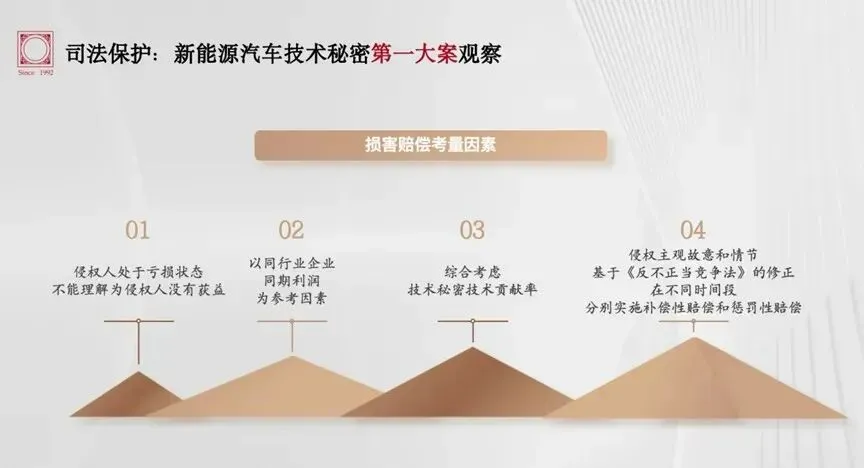
It is not appropriate to directly adopt the right holder’s R&D costs for the technical secret at issue or the assessed value of the proprietary technology as the amount of damages.
-
The benefits obtained by the infringer from selling products produced using the technical secrets obtained through improper means may be regarded as the benefits gained from the infringement. Specifically, sales data recorded in the prospectus may serve as the basis for calculation.
-
Where the right holder claims to use the infringer’s gross profit margin to calculate profits, the court considered that, based on the prospectus, the infringer was actually in a loss-making state, so it is not appropriate to directly use gross profit to calculate infringement gains. At the same time, the infringer’s actual loss does not mean it did not obtain benefits from the infringement of the technical secret. The benefits obtained from infringing a technical secret may also be reflected in the infringer’s cost reduction or loss reduction due to saved R&D expenses. The court used the contemporaneous gross profit margin of representative enterprises in the same industry as a reference to calculate the infringer’s gains. Considering that the deliberate infringement occurred during a period of significant growth and rising profitability in the new energy vehicle industry, the gross profit margin of similar representative enterprises was taken as a basis and appropriately adjusted upward.
-
Principles for applying punitive damages: The right holder explicitly requested punitive damages; the infringer had clear intent to infringe; the infringement circumstances were egregious; and the consequences were serious. Moreover, punitive damages were applied in phases based on the amendment to the Anti-Unfair Competition Law on April 23, 2019.
V. Conclusion
The vitality of law lies in its implementation, and the authority of law also lies in its implementation. The above case published by the Supreme People’s Court is a vivid manifestation of Article 32 of the Anti-Unfair Competition Law concerning the burden of proof. Strengthening trade secret protection is of great significance for enhancing the core competitiveness of enterprises, maintaining the security and stability of industrial and supply chains, and facilitating the development of new productive forces. Against the backdrop of the state’s efforts to promote the strengthening of comprehensive protection of trade secrets—namely, the integration of self-protection, administrative protection, and judicial protection—enhancing enterprises’ capacity for trade secret protection and enriching the practices of administrative and judicial protection deserve focused attention from enterprises.
Contact Lawyer
Submit your contact details and consultation question. We will follow up ASAP.