
The End of Dividend and Bonus Tax Exemption for Foreign Individuals: Are Existing Retained Profits Taxable? — A Practical Reading of Announcement No. 27 of 2026 and Its Core Controversy
The End of Dividend and Bonus Tax Exemption for Foreign Individuals: Are Existing Retained Profits Taxable? — A Practical Reading of Announcement No. 27 of 2026 and Its Core Controversy
From September 1, 2026, dividends and bonuses obtained by foreign individuals from foreign-invested enterprises will be subject to 20% individual income tax under the “interest, dividends and bonuses” category, and the relevant exemption under Caishuizi [1994] No. 20 will be repealed at the same time. For “existing profits” generated before the announcement takes effect but not yet distributed, this article sets out two interpretive paths—taxation at the time of distribution and application of the prior law by reference to the time the profits arose—analyzing them from three perspectives: non-retroactivity of law, protection of legitimate expectations, and the timing of tax liability. Drawing on the transition arrangements under the 2008 “merger of the two enterprise income tax regimes,” it offers practical responses and risk warnings.
Introduction
On September 1, 2026, the Ministry of Finance and the State Taxation Administration jointly issued Announcement No. 27, ending with a single document a tax exemption for dividends and bonuses received by foreign individuals that had lasted 32 years.
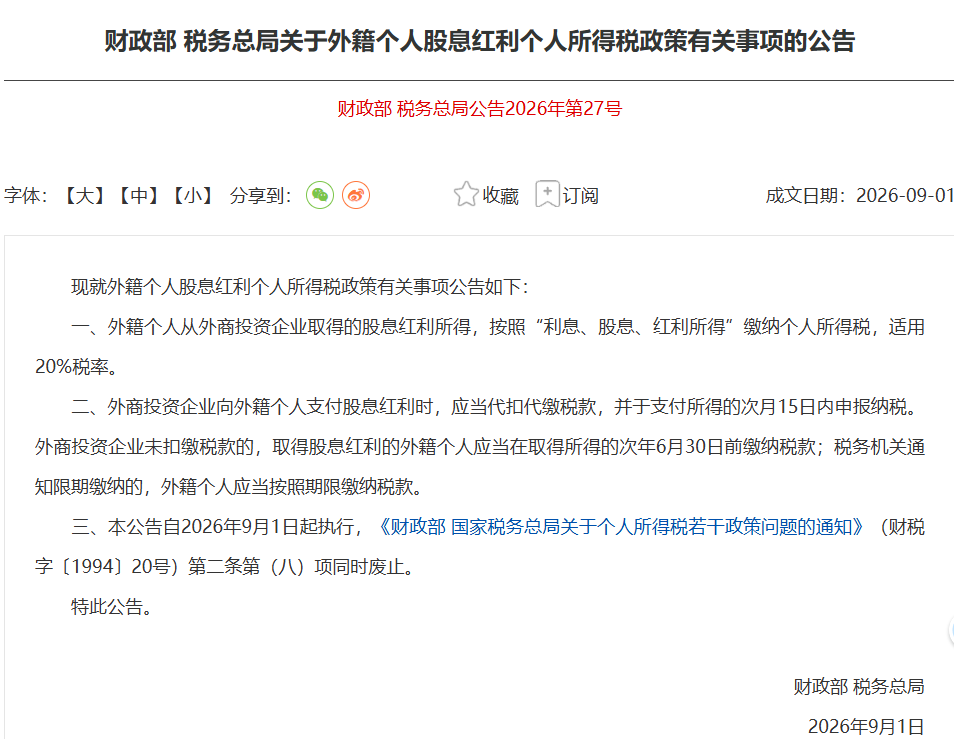
The announcement is short — only three articles. But the shorter the policy, the greater the room for ambiguity. Countless foreign shareholders, finance directors and tax advisers of foreign-invested enterprises are now asking the same question: for profits the company earned before September 1, 2026 but has not yet distributed — the so-called “existing profits” — should a future dividend be subject to the new 20% individual income tax, or continue to enjoy the original exemption?
This is not an academic question. For foreign-invested enterprises that have operated in China for many years, “existing profits” may mean tens of millions or even hundreds of millions of yuan in after-tax undistributed profits. The rate difference is 20% versus 0%.
This article examines the two interpretive paths on this core controversy from three dimensions — non-retroactivity of law, protection of legitimate expectations, and the timing of tax liability — and sets out the author’s preferred view.
01 Policy at a Glance: 32 Years of Exemption Ended Overnight
Let me first briefly set out the policy.
Announcement No. 27 of 2026 of the Ministry of Finance and the State Taxation Administration has three core articles:
First, taxation. Dividends and bonuses obtained by a foreign individual from a foreign-invested enterprise are subject to individual income tax under the “interest, dividends and bonuses” category at the 20% rate. This is a newly created rule.
Second, withholding. When a foreign-invested enterprise pays dividends or bonuses to a foreign individual, it shall withhold the tax and file the return within 15 days of the month following the payment. If the enterprise fails to withhold, the foreign individual shall file and pay on their own before June 30 of the following year in which the income is obtained.
Third, effective date and repeal. This announcement takes effect on September 1, 2026; at the same time, Article 2(8) of Caishuizi [1994] No. 20 is repealed — the old rule dating from 1994 that “dividends and bonuses obtained by foreign individuals from foreign-invested enterprises are temporarily exempt from individual income tax.”
In short: from September 1, 2026, foreign individuals receiving dividends from foreign-invested enterprises must pay 20% individual income tax.
But the real question is: how should the word “obtain” be understood?
02 The Core Controversy: Are “Existing Profits” Taxable?
Article 1 of the announcement provides that dividend and bonus income “obtained” by a foreign individual from a foreign-invested enterprise is subject to 20% individual income tax.
This gives rise to a key timing controversy: does “obtain” refer to the time the profits are generated, or the time they are actually distributed to the shareholder?
View 1: The new law applies according to the “time of distribution.”
Under this view, the individual income tax liability on dividend and bonus income arises at the time it is “actually obtained.” As long as the distribution is actually received after September 1, 2026, the 20% rate under the new announcement applies, no matter when the profits were earned. The announcement repeals the old exemption rule, and the new rule takes full effect from September 1; there is no “transition period” or “grandfathering” of existing profits.
View 2: The old law applies according to the “time the profits arose,” i.e., non-retroactivity.
Under this view — which this article prefers — a foreign shareholder had, before September 1, 2026, formed a legitimate expectation based on the old law that its investment returns would be tax-exempt. That reliance interest should be protected by law. As a tax-increasing rule, the new announcement should in principle not apply retroactively to profits that had already arisen before it took effect; otherwise, the reasonable expectations taxpayers had already formed would be abruptly changed without any transitional arrangement.
Looked at from another angle: before August 31, 2026, one important consideration for foreign shareholders in choosing to leave profits in the enterprise for continued operation was that those profits would enjoy exemption when distributed in the future. Business arrangements and investment decisions made in reliance on the old law should not be retrospectively negated by the sudden introduction of a new law. Otherwise, the stability and predictability of tax law would be lost.
03 Three Lines of Analysis: Why There Is a Strong Case for Exempting “Existing Profits”
(1) Non-retroactivity: A Basic Bottom Line in Tax Law
Article 104 of the Legislation Law expressly provides: “Laws, administrative regulations, local regulations, autonomous regulations and separate regulations, and rules shall not be retroactive, except where special provisions are made to better protect the rights and interests of citizens, legal persons and other organizations.” This is the well-known principle of non-retroactivity of law, and its exception is “favourable retroactivity” — that is, retroactive application is permitted only where the new law is more favourable to the taxpayer.
For foreign individuals, Announcement No. 27 increases rather than reduces tax, so it clearly does not fall within the “favourable retroactivity” exception. Therefore, as a matter of legal principle, the announcement should not apply retroactively to profits already generated before September 1, 2026.
Here a strong counterargument must be addressed: one might say that “although the profits arose before September 1, you only obtained them after September 1, and tax liability arises only upon receipt, so applying the new law is unproblematic.” Textually, there is indeed a basis for this view — the Individual Income Tax Law does take “actual receipt” as the time when tax liability on dividend and bonus income arises. But the point is that the core of the non-retroactivity principle is not only to restrain the application of law to “completed acts” before it takes effect, but also to protect the reasonable expectations taxpayers form in reliance on the old law. If the mere fact that the “triggering point” of tax liability falls after the new law takes effect allows the “background” in which the income arose and the taxpayer’s “reliance interest” to be entirely ignored, then the non-retroactivity principle would be hollowed out in the income tax field — because almost all tax liabilities on income could be designed to be “triggered” after a new law takes effect.
(2) Timing of Tax Liability and Applicable Law: Two Different Questions
As noted above, under the Individual Income Tax Law framework, the time when tax liability on “interest, dividends and bonuses” arises is generally determined by “actual receipt,” pursuant to Guoshuihan [1997] No. 656. This is the direct basis for taxation at the time of distribution, and it is an undeniable positive-law rule.
But two distinct questions must be distinguished: first, “when is tax liability triggered” (a procedural timing rule); second, “which law should apply to that income” (a substantive transitional rule). The “actual receipt” rule answers the first question, while the non-retroactivity principle answers the second. They are not on the same plane, and the former cannot be used directly to negate the latter.
From the basic principles of tax law, the legal character of income should be linked to the legal framework in force when it arose. For example, the profits a company earned in 2025 were generated, accumulated and retained under the legal environment before September 1, 2026. If, merely because the shareholders’ meeting resolved on a distribution in August 2026 but the distribution was actually made to the foreign individual investor in September 2026, a tax-increasing law that did not exist when the profits arose were applied to them, taxpayers would be unable to form stable expectations about the tax consequences of their business decisions. That result is contrary to the principle of tax law stability required by a rule-of-law state.
(3) Legislative Precedent: The Five-Year Transition Under the 2008 “Merger of the Two Tax Regimes”
China’s tax legislation is not without precedent for dealing with the cancellation of existing preferential treatment for foreign investment — the 2008 “merger of the two tax regimes” is the best reference.
On January 1, 2008, the Enterprise Income Tax Law came into force, unifying the enterprise income tax regimes for domestic and foreign-invested enterprises, and the low tax rates, periodic tax holidays and other preferential policies long enjoyed by foreign-invested enterprises were abolished together. Faced with the same “existing benefits” problem, the State Council issued Guo Fa [2007] No. 39, which specifically created transitional arrangements: from January 1, 2008, enterprises previously enjoying low tax rate preferential treatment would gradually transition to the statutory rate within five years after the new tax law took effect. Specifically: enterprises enjoying the 15% enterprise income tax rate were taxed at 18% in 2008, 20% in 2009, 22% in 2010, 24% in 2011, and 25% in 2012; enterprises previously subject to the 24% rate were taxed at 25% from 2008. From January 1, 2008, enterprises previously enjoying periodic tax holiday preferences such as “two exemptions and three half reductions” and “five exemptions and five half reductions” would continue to enjoy the preferences and periods prescribed by the original tax laws, administrative regulations and related documents until expiry, save that where an enterprise had not yet enjoyed the preference because it had not made a profit, the preference period would be counted from 2008.
In other words, when the legislature abolished existing tax preferences for foreign investment, its usual practice was to establish a transition period so that existing preferences continued until expiry — this “old enterprises under old rules, new enterprises under new rules” approach is precisely the concretization of the non-retroactivity principle in tax legislation.
Announcement No. 27 contains no transitional provision at all. But this should be understood as a gap in legislative technique, and cannot be read backwards as “the legislature intended to deprive existing profits of the exemption.” Under the principle of statutory taxation (Article 3 of the Tax Collection and Administration Law: the introduction and cessation of taxes, and tax reductions, exemptions, refunds and supplementary payments shall be carried out in accordance with the provisions of law), retroactive application that increases a taxpayer’s tax burden requires even clearer express support. The announcement makes no retroactive statement at all about “dividends and bonuses already generated but not yet distributed”; its Article 3 merely states that it “shall be implemented from September 1, 2026.” Where the default rule is non-retroactivity, such silence indicates precisely that the legislature did not intend retroactivity.
One comparative-law point: protection of a taxpayer’s “reasonable reliance” is a common legal principle in civil law systems. The principle of protection of legitimate expectations (Vertrauensschutz) in German tax law was established through Federal Constitutional Court case law — transactional arrangements undertaken by a taxpayer in reasonable reliance on existing tax law are not retrospectively deprived by later changes in law. Although this principle is not expressly provided for in Chinese tax law, its legal core is closely aligned with Article 104 of the Legislation Law and may serve as a reference in interpreting the treatment of existing profits.
04 Conclusion: The Missing Transitional Provision Should Not Be Paid for by Taxpayers
The issuance of Announcement No. 27 marks a further move of China’s tax preferential policies toward “national treatment”; this is the general trend and is not in itself objectionable. But the policy designers appear to have overlooked a key problem: for foreign-invested enterprises that have operated in China for many years and lawfully accumulated profits under the old law, a one-size-fits-all effective date is equivalent to abruptly changing the “rules of the game” without any transitional protection.
From a legislative-technique perspective, Announcement No. 27 could easily have added a transitional provision to Article 3, for example: “For dividends and bonuses already generated but not yet distributed before September 1, 2026, the original provisions shall continue to apply.” One simple supplementary sentence would have eliminated all practical controversy. Regrettably, the announcement did not do so.
In the absence of a transitional provision, what taxpayers can rely on is the fundamental rule-of-law principle of non-retroactivity and the legal principle that reasonable expectations formed in reliance on the old law should be protected. In the author’s view, however the tax authorities ultimately implement the policy, this principle should be respected in individual cases. There is a solid legal basis for the conclusion that there are strong grounds to claim continued exemption for “existing profits.” The coming months will be a critical period in which the implementation approach becomes clearer. The author will continue to follow local tax authorities’ practice and typical cases and update readers in a timely manner.
Disclaimer: This article is only an academic discussion and practical analysis of current tax policy and does not constitute legal or tax advice for any specific case. The application of tax law is highly case-dependent, and specific tax treatment should be based on the determination of the competent tax authority. If you need professional advice on a particular transaction or matter, please consult a qualified lawyer or tax adviser.
Contact Lawyer
Submit your contact details and consultation question. We will follow up ASAP.