
A Control and Ownership Dispute Involving a Former ‘Shoe King’: Brief Comments on Nominee Shareholding and Offshore Control of a Hong Kong Company
A Control and Ownership Dispute Involving a Former ‘Shoe King’: Brief Comments on Nominee Shareholding and Offshore Control of a Hong Kong Company
Using Zhong Da Mining Holding Limited v Lam Wo Ping & Ors, this article examines the relationship among nominee shareholding, beneficial ownership, and procedural defects in company resolutions and offers practical advice for cross-border asset structures.
Introduction
In cross-border investment and multinational corporate governance, many actual controllers establish nominee-shareholding arrangements through informal written agreements to simplify offshore holding structures or meet confidentiality needs. When the actual controller or its operating entity faces a debt crisis, or trust breaks down between the controller and the nominee shareholder, however, the nominee-held offshore assets become exposed to risk. Insufficiently precise nominee arrangements and equity or control structures often lead to later disputes, corporate deadlock, and even the loss of substantive interests.
The decision of the Hong Kong High Court, Court of First Instance, in Zhong Da Mining Holding Limited v Lam Wo Ping & Ors [2024] 3 HKLRD 365 has attracted considerable attention and offers a useful precedent for enterprises with nominee-shareholding arrangements. The decision shows that, although the Hong Kong courts have adopted a test centered on whether the ultimate resolution was inevitable when reviewing procedural compliance, an actual controller and the company may still be drawn into protracted litigation if the underlying beneficial ownership of the shares is itself genuinely disputed, even where the procedure for the company resolution appears flawless.
Background of the Case
According to the judgment, the dispute was a typical conflict over control of a Hong Kong holding company, with a cross-border ownership dispute at its core:
• The plaintiff, Zhong Da Mining Holding Limited, was a British Virgin Islands company (the “BVI Parent”) that wholly owned the third defendant, Hong Kong Tin Peng Mining Company Limited (the “Hong Kong Subsidiary”), which held mining assets in mainland China. The first defendant, Lam Wo Ping, had previously been the sole director of the BVI Parent and had full responsibility for the relevant business.
• Around 2016, Lam Wo Ping’s family business in mainland China encountered a debt crisis. To prevent the domestic debt risk from reaching the offshore assets, Lam signed a share-transfer agreement on March 1, 2017 transferring the shares of the BVI Parent to his son, Lam Kin Chung, the second defendant, but the transfer was not registered. Eight days later, Lam signed another share-transfer agreement transferring the shares of the BVI Parent to his business partner, Chen Jian Yun, who completed the registration.
• The first and second defendants, the Lam father and son, argued that the March 9 transfer was subject to an oral “Common Understanding”: Chen Jian Yun held only the legal title to the shares, while the beneficial interest remained with the Lam family and was to be returned after the domestic risks had been resolved.
• The parties’ relationship of trust later broke down. Lam used his position as a director of the Hong Kong Subsidiary, from which he had not yet been removed, to sign a series of written resolutions. He forcibly removed dissenting directors, changed the company secretary and registered office, and issued a large number of new shares to his son, Lam Kin Chung, diluting the BVI Parent’s interest in the Hong Kong Subsidiary.
• After Chen Jian Yun obtained control of the BVI Parent, he issued an Originating Summons in the Hong Kong courts under Section 42 of the Hong Kong Companies Ordinance (Cap. 622), asking the court to declare the director changes and share-allotment resolutions invalid for procedural violations and to order the Companies Registry to delete the relevant registration records.
The Court’s View
(1) Applying inevitability under the Irregularity Principle
The plaintiff argued that earlier decisions of courts at the same level—such as Lohas Holding Ltd v Registrar of Companies [2022] 5 HKLRD 653 and Re Bluetroz Technology Limited [2022] HKCFI 3645—treated the absence of meeting notice as a serious procedural defect that could not be cured by the Irregularity Principle. In this case, the Lam father and son had not issued special notice and had used written resolutions to remove directors and allot shares. The plaintiff argued that these were substantive violations and that the resolutions were invalid.
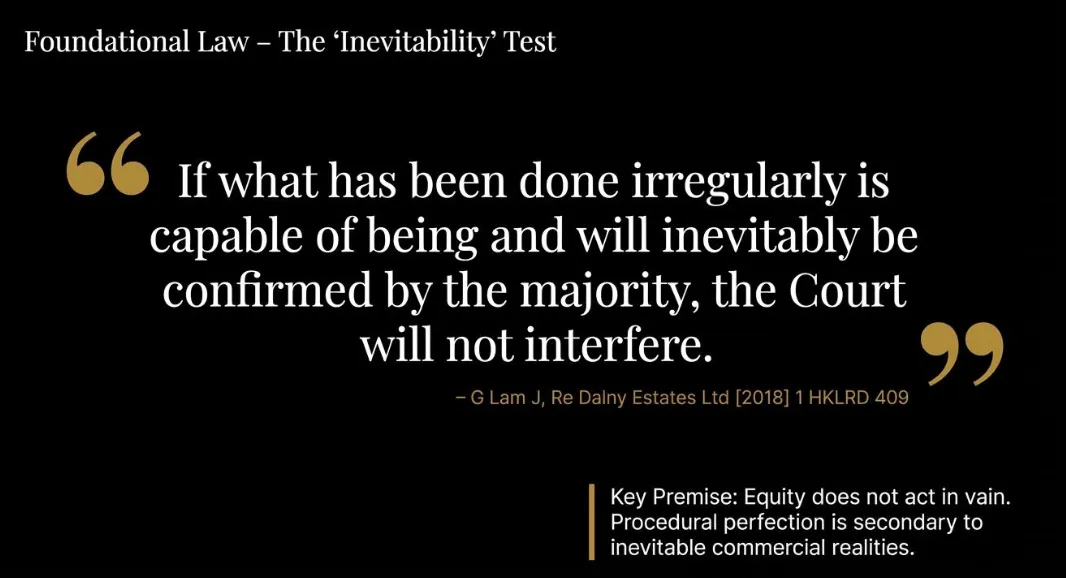
The deputy High Court judge, Deputy Judge Lisa Wong SC, clarified the applicable standard and expressly declined to distinguish procedural defects as “substantive” or “minor.” The core standard is the Inevitability Test: if the voting result of the majority shareholders with lawful voting rights was inevitable—meaning that the same result would necessarily have been reached through the correct procedure—the court will generally not intervene in the majority’s decision solely because of a procedural defect.
(2) How a beneficial-interest dispute obstructed expedited determination
The dispute in substance concerned ownership itself. The court emphasized that an Originating Summons, as a summary procedure, is suitable only where the legal and factual issues are clear and there is no substantial dispute. Because the Lam family had relied only on an informal oral arrangement during the early restructuring, the underlying ownership of the beneficial interest became a central factual dispute.
Where the status and voting rights of the supposed majority shareholders themselves were seriously disputed, the court refused to determine the inevitability of the resolutions solely on affidavit evidence. It ultimately ordered that the case be converted into a Writ Action involving full cross-examination. The dispute would therefore develop into prolonged litigation.
Practical Recommendations
This case illustrates not only litigation strategy but also potential corporate-governance blind spots when an actual controller designs an offshore asset-isolation structure. To prevent an asset-protection mechanism from undermining the shareholder’s intended control, enterprises should consider the following three preventive measures.
(1) Formalize nominee arrangements
When adjusting the shareholding structure of a Hong Kong company, an actual controller should carefully assess the legal risks of oral promises or incomplete nominee agreements. Any cross-border nominee arrangement should be documented formally under Hong Kong law, for example through a trust deed, clearly separating legal title and beneficial interest and specifying exit and return mechanisms. It should also establish a clear route for the actual controller to recover the rights, preventing disputes caused by a breakdown of trust.
(2) Improve the articles of association of the Hong Kong company
Standard Hong Kong articles templates may not address an extreme adversarial environment. When establishing an offshore structure in Hong Kong or introducing a nominee shareholder, an enterprise should ask professional lawyers to tailor the articles. For example, it may optimize the conditions for written resolutions and the mechanisms for waiving notice, ensuring that the actual controller has a compliant basis for adjusting the board in a special dispute and reducing the risk of governance paralysis caused by procedural defects.
(3) Update statutory records promptly
When conducting an offshore share transfer or structural reorganization in Hong Kong, the company secretary should promptly update the statutory registers of members and directors so that substantive ownership does not diverge from legal records. The parent company should also retain a complete written decision trail for major governance decisions concerning the Hong Kong Subsidiary, such as changing the company secretary or registered office, so that evidence is available if the underlying ownership is later challenged in court.
Conclusion
Enterprises are often highly alert to the risks posed by external creditors but overlook the secondary risks that may be created by an internal nominee shareholder. The case shows that the Hong Kong courts are taking a more practical approach to disputes arising from procedural irregularities. The benefit of the Irregularity Principle, however, is generally available only to enterprises whose top-level structures clearly identify ownership and whose underlying title is not genuinely disputed.
Contact Lawyer
Submit your contact details and consultation question. We will follow up ASAP.