
Are You a “Controlling Person” of a Trust? Self-Assessment Under the New CRS Rules
Are You a “Controlling Person” of a Trust? Self-Assessment Under the New CRS Rules
This article explains how Hong Kong’s tightening CRS compliance requirements and mainland China’s new rules on individual income tax administration for offshore trusts affect a trust’s “Controlling Persons,” covering identity tests, reporting and record-keeping duties, the 90-day transitional window, and practical steps for self-assessment and document preparation.
Mainland China has recently further clarified the individual income tax administration requirements for offshore trusts. At the same time, major financial centres such as Hong Kong and Singapore continue to tighten compliance requirements under the Common Reporting Standard (CRS). If you hold a trust in your own name, or you are a member of a family trust — even if you are only a beneficiary who has not yet received any distribution — it is worth reading this article carefully to understand the reporting obligations you may bear.
A Trust Is Not a “Stealth Tool”: Transparency Is Now the Norm
Many people believe that placing assets into a trust is equivalent to putting a “stealth lock” on their wealth. That is not how it works in practice. Major financial centres around the world have implemented the CRS, which in simple terms means that banks and trustee institutions must automatically exchange account information to the jurisdiction where the account holder is tax resident.
A trust is classified differently depending on its nature. Where a trust is managed by a professional trustee company and its assets consist mainly of investment assets such as shares and bonds, the trust is generally treated as a “Financial Institution,” that is, a Reporting Financial Institution, unless it falls within an exception such as a “Trustee-Documented Trust” that is not a Reporting Financial Institution. That exception requires both an “asset test” and a “management test” to be satisfied at the same time. Where a trust meets the conditions of a Trustee-Documented Trust, the trustee performs the relevant reporting obligations on its behalf, and the trust itself may not need to register separately. Where, however, family members act as trustees and the assets derive mainly from business profits, a bank may “look through” the arrangement and directly identify and report the individuals behind the trust — the so-called “Controlling Persons.”
This distinction is not a technical detail: it determines who reports the information, when it is reported, and which persons may be identified as reportable.
Who Counts as a “Controlling Person”? Five Categories to Check One by One
Whatever category a trust falls into, if a person holds any of the following roles, that person’s tax information may fall within the scope of reporting:
- the settlor of the trust;
- the trustee responsible for administering the trust;
- a protector with substantive control over the trust;
- a beneficiary entitled to receive distributions from the trust;
- any other natural person with ultimate effective control over the trust.
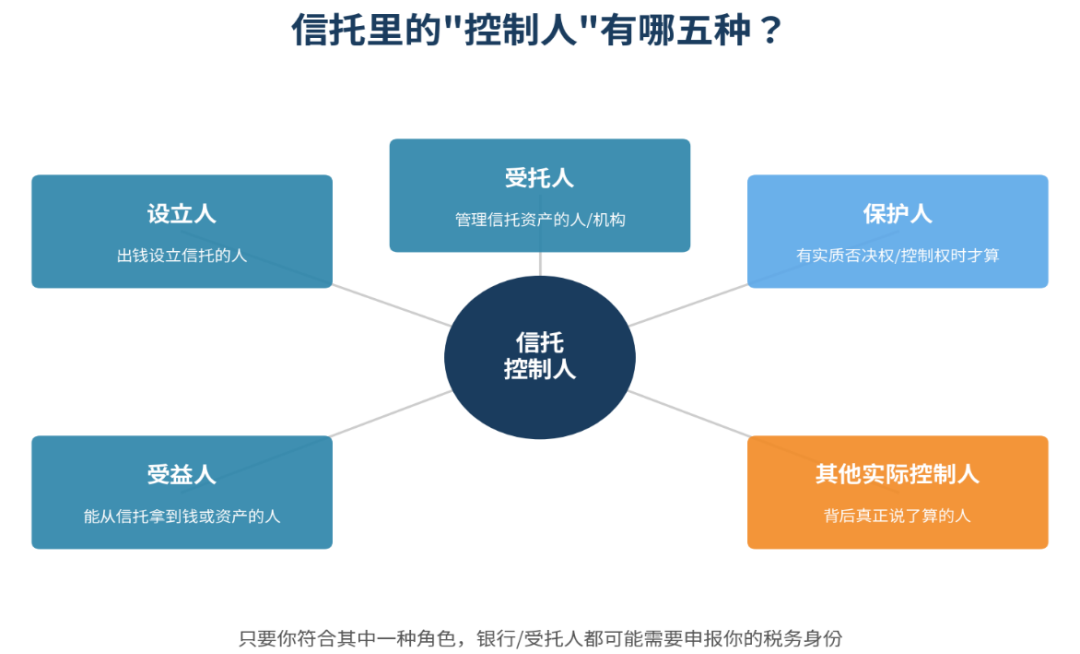
Particular attention should be paid to the following: where the trust is a Financial Institution, discretionary beneficiaries are generally reportable only in the year in which they actually receive a distribution; where the trust is a Passive Non-Financial Entity, however, the bank must look through the trust, and even if a beneficiary receives no distribution in that year, that person’s status may still need to be reported annually. The assumption that “no money received means no reporting” therefore does not hold in many situations.
Where a Controlling Person is itself a company, a family office or another entity, the institution will usually go further and identify the ultimate natural persons behind it. What arrangement the effective control derives from, whether the protector’s powers amount to substantive control, and whether the beneficiaries are fixed or discretionary may all affect the conclusion.
Compliance Requirements Are Tightening Across the Board: Personal Liability Cannot Be Ignored
Hong Kong’s recent CRS amendments — the Inland Revenue (Amendment) (Automatic Exchange of Information) Ordinance 2026 (the “2026 Amendment Ordinance”) — have raised the requirements for registration, record keeping and due diligence. For trusts that are not covered by a “trustee reports on behalf” arrangement, the registration status and applicable deadlines deserve particular attention; the registration milestone for existing relevant Financial Institution trusts is 31 March 2027.
Record-keeping duties have also clearly increased. Under the 2026 Amendment Ordinance, a Reporting Financial Institution must keep records for six years after the due date of the Financial Account Information Return (BIR80). Even if the trust has been terminated, wound up, or no longer falls within the relevant category, the record-keeping obligation does not necessarily fall away. Where a Reporting Financial Institution has been dissolved, the directors of the institution immediately before dissolution (or the trustee, where there are no directors) are personally responsible for ensuring that the records are kept in full until the six-year period expires. Trustees and the persons responsible should ensure that trust documents, asset information, income and distribution records, and tax residence information can be retained in full and corroborate one another.
Penalties have also become stricter. Providing incomplete or inaccurate information, or failing to carry out due diligence properly, may lead to fines that accumulate by reference to the number of accounts; in serious cases, the persons involved may even face criminal liability. It is worth emphasising that the 2026 Amendment Ordinance expressly provides that none of the following constitutes a “reasonable excuse”: (1) the complexity of the legislation; (2) reliance on others without taking reasonable steps to ensure compliance; and (3) the cost of compliance.
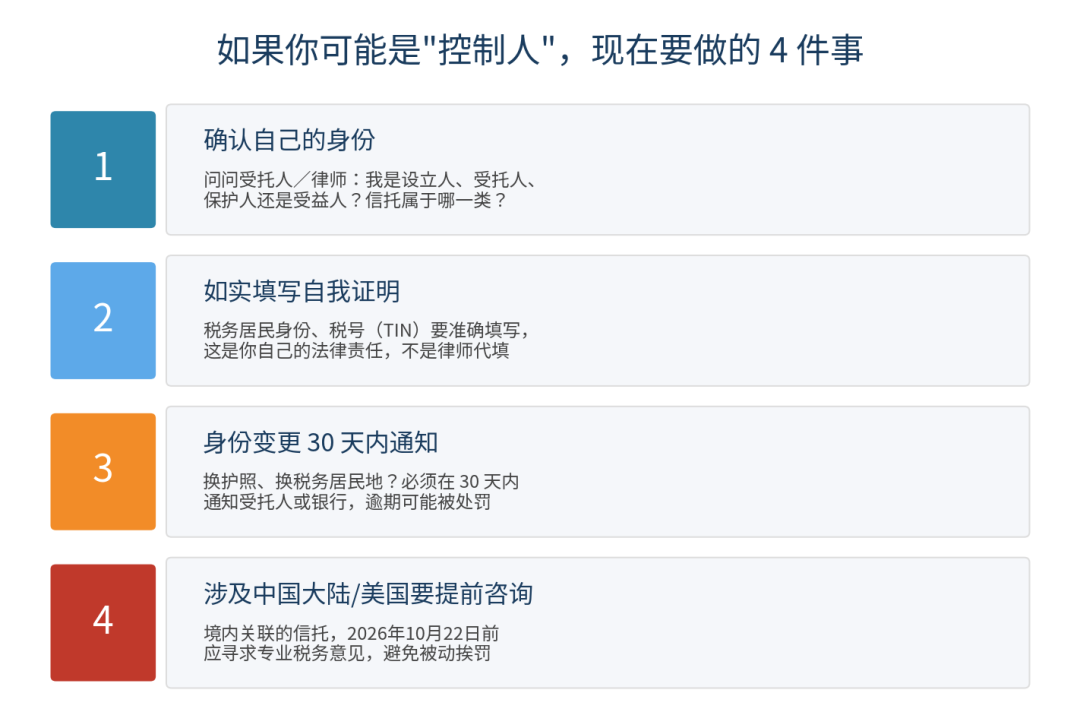
For persons who may be Controlling Persons, the most important step is to confirm their own role as early as possible, provide their tax residence status and taxpayer identification number truthfully, and notify the trustee or the bank promptly after any change in tax residence or related information. In some cases the notification period for a change may be as short as 30 days, so it is unwise to wait until an enquiry arrives before starting to organise the documents.
Where Mainland China Residents Are Involved, Reassessment Should Not Be Delayed
Where the settlor, a beneficiary, a protector or any other person with effective control of a trust is a tax resident of mainland China, the relevant risks should no longer be viewed only through the lens of CRS reporting.
On 24 July 2026, the Ministry of Finance and the State Taxation Administration issued new rules on individual income tax for offshore trusts, and the State Taxation Administration simultaneously clarified the tax administration arrangements. The new framework extends the tax focus to the different stages of a trust, including establishment, income arising during its existence, distributions, termination and liquidation, changes in status, and succession. Mainland tax authorities may also examine whether the source of trust assets, the trust documents, the underlying structure, and the income and distribution arrangements are consistent with one another.
For trusts involving mainland residents, it cannot be assumed that there will be no mainland tax consequences simply because the assets are held offshore, no distribution has yet been made, or a professional trustee manages the trust. The legal arrangement of an offshore trust and its tax consequences are not necessarily fully aligned, and the actual analysis needs to take into account the tax residence of the persons involved, when the trust was established, the nature of the assets contributed, historical income and distributions, and the allocation of powers under the trust deed.
Particularly noteworthy is that the new rules set a 90-day transitional window for individual income tax matters concerning existing offshore trusts. For mainland residents who may have unaddressed historical tax matters, if they meet the requirements and complete the relevant steps within 90 days from the date the announcement takes effect, the late payment surcharge may be waived. The announcement took effect on 24 July 2026, and the market generally reads the window as running to 22 October 2026; the specific scope of application, the way the period is counted, and the enforcement practice of the competent tax authorities still need to be analysed carefully on a case-by-case basis.
This is not simply a question of a “tax top-up deadline.” The legal documents of a trust, the history of asset contributions, the trustee’s powers, the beneficiary arrangements, and past income and distribution records may all affect the assessment of risk. The closer the window comes to closing, the less advisable it is to make hasty decisions before the documents have been fully reviewed.
Where US Persons Are Involved, the Reporting Path May Be More Complex
Where a trust involves persons with US status, the position is usually more complex. The United States has not joined the CRS; instead it operates its own information reporting and tax rules. Settlors, beneficiaries, protectors or other relevant persons with US connections may face compliance considerations under both Hong Kong’s CRS regime and US tax reporting rules.
Different combinations of US factors, the trust’s place of establishment, the source of assets, the identity of the trustee and the rights of beneficiaries may produce different reporting and tax consequences. Cross-border issues of this kind should not be judged on general information alone; targeted legal and tax advice should be obtained as early as possible.
How Our Legal Team Can Assist
Trust compliance is not a matter of simply filling in a form. It requires first clarifying the facts, determining the nature of the trust, identifying the persons involved, and ensuring that there are no obvious inconsistencies between the trust documents, the bank records and the tax residence information. Our legal team can assist at the legal and trust-structuring level as follows:
- Reviewing the trust deed, letters of wishes, protector power documents, corporate structure information and related supporting documents, and helping to identify who may be a “Controlling Person.”
- Providing legal advice on the classification of a trust under the CRS, the reporting conditions that apply, and the scope of disclosure.
- Assisting you in understanding and completing self-certification and related compliance materials in a reasonable and accurate manner; we cannot make a tax residence declaration on a client’s behalf, but we can explain the legal meaning of different statements and the points to note.
- Assessing whether a change in tax residence, a change of Controlling Person, a trust distribution, a change of trustee or a restructuring may trigger updated information, reporting or other compliance considerations.
- Preparing a phased legal compliance plan for an existing trust, including supplementing documents, organising information, arrangements for communication with the trustee and the bank, and prioritising risks and follow-up timing.
- Providing legal advice on trust documents, corporate resolutions, trustee arrangements, protector clauses, asset contributions and related supporting documents, and coordinating, where necessary, with tax professionals in mainland China, the United States or other jurisdictions.
Conclusion: Clarify First, Then Act
The core value of the trust system lies in wealth succession, asset protection and family governance, not in circumventing reporting obligations. In a regulatory environment of high transparency, attempts to conceal assets through trust structures may give rise to substantive compliance and tax risks.
If you consider that you may be a Controlling Person of a trust, or if your family trust involves mainland China, the United States or other cross-border factors, an early professional assessment is advisable. This is especially so for existing offshore trusts involving mainland China residents, where the 90-day transitional window is generally understood to expire on 22 October 2026; documents should be reviewed and the applicable arrangements determined as early as possible.
On document preparation, it is advisable to build a complete “defensive file” as early as possible, including but not limited to: the settlor’s statement of wishes, trustee meeting minutes, investment decision records, distribution history, tax residence declarations of each Controlling Person, asset valuation reports, and legal or tax advice previously obtained. Complete records not only help in responding to enquiries from tax authorities but can also demonstrate that reasonable care was taken if a dispute arises.
This article is provided for general information only and does not constitute any legal, tax or investment advice. The legal and tax consequences of each trust depend on its specific documents, the facts, and the circumstances of the persons involved; where tax residence or tax reporting is concerned, please also consult professional tax advisers in the appropriate jurisdictions.
Contact Lawyer
Submit your contact details and consultation question. We will follow up ASAP.