
Zhang Chi: Rethinking the Regulation of Private Digital Currencies
Zhang Chi: Rethinking the Regulation of Private Digital Currencies
Attorney ZHANG Chi systematically outlines the concepts, attributes, and developmental context of private digital currencies, and reviews the evolution of China's regulatory policies from relative laissez-faire to strict limitation, and then to the 'separation of blockchain and cryptocurrency'. The article points out that while the existing strict supervision has effectively curbed speculative chaos and illegal crimes, maintaining financial stability, it has also stifled financial innovation, led to inconsistent judicial adjudication standards, weakened substantive protection for investors, and may cause China to lose its voice in formulating international rules in the digital asset field. To this end, the article proposes that regulatory policies should conform to technological, economic, and legal logic, adopting a differentiated regulatory path based on functional classification, applying different policies to payment-oriented and asset-oriented economic behaviors. It suggests prioritizing the relaxation of controls on asset-oriented businesses, leveraging special economic zones like Shenzhen and Hainan to pilot the establishment of centralized digital asset trading platforms, in order to promote financial technology innovation and healthy industry development under the premise of building a solid risk baseline.
I. Introduction
(I) The Concept of “Private Digital Currencies”
1. Definition
“Private digital currencies” in this article, also known as “virtual currencies,” refer to encrypted digital currencies generated based on encryption technologies such as blockchain, issued by private organizations or institutions, represented by Bitcoin.
2. Overview of Digital Currency Development
Digital currency is a branch of research in cryptography. In 2008, the mysterious “Satoshi Nakamoto” published the classic paper Bitcoin: A Peer-to-Peer Electronic Cash System, proposing a brand-new electronic payment concept: establishing an electronic cash system completely realized through peer-to-peer (P2P) technology. Compared to the previous electronic cash systems based on the three-party transaction model of “bank-individual-merchant” (David Chaum, E-cash, 1982), the decentralized peer-to-peer transaction model and network architecture are of revolutionary significance. In January 2009, Bitcoin was born. Bitcoin features a fixed total amount (an algorithmically preset issuance limit of 21 million), fully public transaction records, decentralization, and anonymity of traders’ identity information.
The cutting-edge technology adopted by Bitcoin is called “blockchain technology.” Bitcoin is a distributed P2P network system without a central server, central control point, or central services. All nodes in the network are equal to each other, interconnected, and observe common protocol rules to collaboratively process transactions. Each node provides services to the outside world while also utilizing the services provided by other nodes in the network. (Andreas M. Antonopoulos, Mastering Bitcoin [R], 2015)
Bitcoin is also an open bookkeeping system of mutual verification, which breaks down the usual centralized bookkeeping into a distributed bookkeeping process that occurs every 10 minutes. The right to bookkeeping is selected through competition across the entire network, and the bookkeeping data is connected in chronological order and broadcast to the whole network. Any node can synchronize all bookkeeping records on the network and invest computing resources to compete for the bookkeeping right. Attackers cannot attack this bookkeeping (linking) system unless they control more than 50% of the entire network’s computing resources.
On June 18, 2019, social media giant Facebook announced that it would lead the issuance of Libra and simultaneously released the Libra White Paper, announcing the establishment of “a simple, borderless currency and financial infrastructure that serves billions of people.” Libra would be pegged to a basket of assets and backed by a 100% asset reserve. The introduction of Libra attracted high attention and even deep concern from central banks and financial regulatory agencies in various countries. On April 16, 2020, the Libra Association released the Libra 2.0 White Paper, stating that “in addition to the multi-currency coin, we will offer single-currency stablecoins,” and that they would “enhance the safety of the Libra payment system with a robust compliance framework.” The emergence of Libra also directly accelerated the advancement of central bank digital currencies in various countries.
Currently, based on innovations in asymmetric encryption, distributed ledgers, consensus mechanisms, and smart contract technology, digital currency technology has achieved new leaps. Thousands of digital currencies such as Ethereum and Litecoin have appeared one after another, and there are tens of thousands of digital currency exchanges.
3. Attribute Analysis
(1) Private digital currency is an emerging phenomenon, and there is no definitive conclusion yet on whether its attribute is a currency, payment tool, commodity, security, or digital asset. Private digital currencies are titled with the word “currency” (or “coin”) and can serve as alternative means of cash payment in certain scenarios, but they still lack the three major functions necessary to truly become a currency: medium of exchange, unit of account, and store of value, as well as monetary attributes like legal tender status and coerciveness. At most, they are considered “quasi-digital currencies” or “pseudo-digital currencies.”
In current practice, the asset attributes of private digital currencies are becoming increasingly prominent, mainly for three reasons: First, private digital currency itself is virtual, and its price fluctuates too wildly to be used as a unit of measurement. Second, even if a private digital currency has fiat currency or asset collateral endorsement, its exchange value is still restricted by the recognition and consensus of specific groups. Third, in reality, private digital currencies are currently used more for investment (speculation) than for payment.
(2) Governments around the world have different attitudes toward private digital currencies, classifying them into various attributes such as special commodities, payment tools, securities, or digital assets. They regulate their trading, use, and circulation from various aspects, respectively including asset trading, payment, taxation, ICOs, anti-money laundering, counter-terrorist financing, financial stability, and consumer protection.
4. Conceptual Differentiation
There are many standards for describing and classifying money. For example, the “Money Flower” of the Bank for International Settlements (2017) or the “Money Tree” of the International Monetary Fund (2019).
(1) From the perspective of the issuing entity, private digital currencies differ from central bank digital currencies (CBDCs) issued by central banks. Statutory digital currencies are supervised by the government and endorsed by national sovereign credit. They are the digital form of the monetary authority’s fiat currency. Based on characteristics such as unlimited legal tender status, zero interest, anonymous payment, and non-assumption of social and administrative functions other than the proper functions of money, they are mainly used to replace and supplement paper money. (“Peer-to-peer + electronic payment system + central bank credit”)
(2) From the perspective of technical characteristics, private digital currencies differ from electronic deposit money, or electronic money, which exists in commercial bank cards, online banking, and third-party payment tools when traditional computer information technology is applied to process payment business. (“Electronic payment system + central bank credit”)
5. Important Classifications
(1) From the perspective of whether the currency value is anchored, they can be divided into purely endogenous digital currencies on the network whose value is unanchored (such as Bitcoin), and stablecoins that are pegged at parity to a single fiat currency or structurally pegged to a basket of fiat currencies (such as USDT, JPM Coin, Libra, etc.).
(2) From the perspective of specific functions, they can be divided into: transactional private digital currencies used as exchange tools to purchase goods and services; security-type private digital currencies that represent the issuer’s debt or equity and promise holders a share of future company profits or cash flows; and utility-type private digital currencies that support or create blockchain products through ICOs. (e.g., as classified in the UK).
(II) The Concept of “Regulation”
China’s economic law circles generally divide the state’s intervention and interference activities in the socio-economic sphere into two main categories: “macro-control” targeting the macroeconomic field and “regulation” targeting the micro-market field. Specific legal norms are correspondingly classified into “market regulation law” and “macro-control law.” This article collectively refers to various intervention behaviors and activities by the state in the private digital currency market—such as supervision, guidance, incentivization, and promotion—as “regulation.” The scope of regulation is broader than mere administrative supervision measures, encompassing various state intervention actions, measures, and means including legislation, judicature, guidelines, warnings, and propaganda.
II. The Development Process of China’s Regulatory Policies
1. 2008-2013: “Relative Laissez-Faire” Stage
This stage mainly relied on existing laws, administrative regulations, and normative documents as legal infrastructure to play a general regulatory role. The main laws and regulations included the General Principles of the Civil Law, Property Law, Contract Law, Electronic Signature Law, Criminal Law, Law on the People’s Bank of China, Commercial Bank Law, Anti-Money Laundering Law, Securities Law, Telecommunications Regulations, Administrative Measures on Internet Information Services, and Measures for Banning Illegal Financial Institutions and Illegal Financial Business Activities.
The Reply of the State Administration of Taxation on Issues Concerning the Levy of Individual Income Tax on Income Derived by Individuals from Buying and Selling Virtual Currencies Online (Guo Shui Han [2008] No. 818) stipulated that individual income tax would be levied on the income obtained from selling virtual currencies after markup. This provision serves as the documentary basis for China’s taxation on encrypted digital currency transactions.
2. 2013-2018: “Strict Limitation” Stage
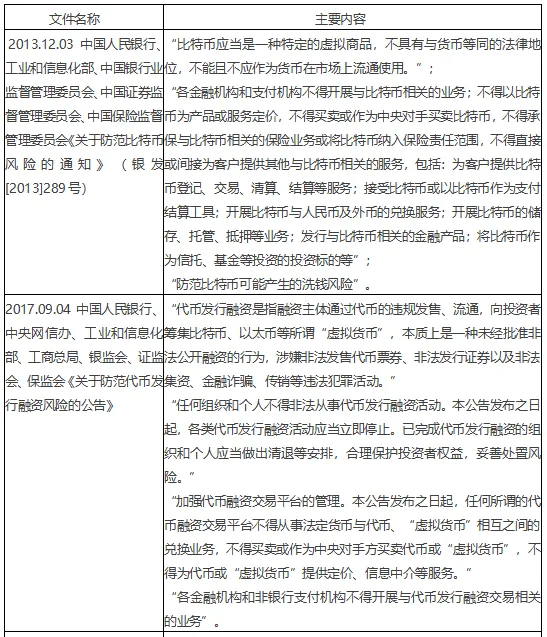
The main foundational law of this stage was the Cybersecurity Law, promulgated on November 7, 2016, and implemented on June 1, 2017. During this period, multiple departments jointly issued documents three times, establishing specific and clear regulations and guidelines on issues related to Bitcoin and virtual currencies, fully reflecting the policy orientation of “strict supervision and strict limitation.” The National Internet Finance Association of China also issued industry-related self-regulatory documents. The main contents are as follows:
3. 2018-Present: “Separation of Blockchain and Cryptocurrency” Stage
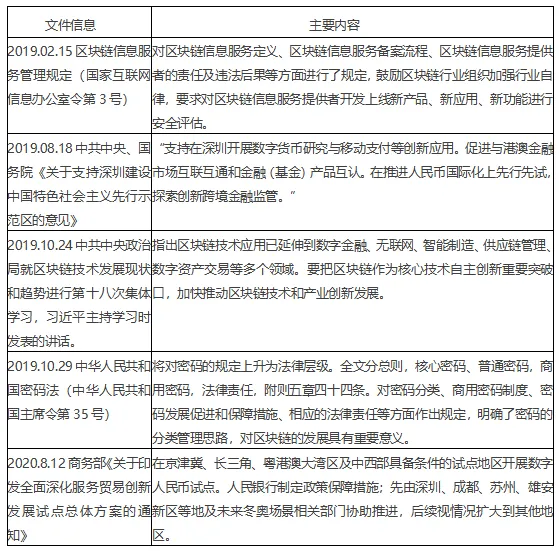
Marked by the Provisions on the Administration of Blockchain Information Services issued on January 10, 2019, and implemented on February 15, 2019, China’s first legal norm regarding the specific application of blockchain technology was introduced. The regulatory strategy is to strictly limit private digital currencies while encouraging the development of blockchain technology and central bank digital currencies.
III. Analysis of the Pros and Cons of Existing Regulatory Policies
China’s current regulatory policy characterizes virtual currencies like Bitcoin as specific virtual commodities. The private holding and transferring of such items are personal rights and freedoms and are not prohibited. However, the policy prohibits virtual currencies from being used and circulated as currency in the market; prohibits financial institutions and payment institutions from carrying out businesses related to Bitcoin and others; prohibits token issuance financing activities (ICOs); and prohibits token financing trading platforms from engaging in trading activities. These policies essentially restrict major business activities such as the creation, issuance, storage, trading, and circulation of private digital currencies.
(I) Advantages
-
Strictly controlling various industry chaos such as insider trading, market manipulation, excessive speculation, and Ponzi schemes, protecting the interests of small and medium investors and financial consumers;
-
Severely cracking down on illegal and criminal acts such as illegal fundraising, pyramid schemes, fraud, and money laundering conducted under the guise of digital currency and blockchain;
-
Maintaining the stability of the financial system and creating a favorable market environment for the launch of China’s statutory digital currency.
(II) Disadvantages
1. Suppressing Financial Innovation, Detrimental to Uncovering Business Opportunities and Industry Development
(1) Deprivation of the Operational Rights of Enterprises and Entrepreneurs
The regulatory policy of “strict limitation” may lead to an imbalance between protecting the rights of financial consumers and protecting the financial technology innovation rights of enterprises and entrepreneurs. As of now, the total market capitalization of cryptocurrencies has risen from $187 billion at the beginning of 2020 to $360 billion, nearly doubling. According to a report released by Fidelity Digital Assets in June 2020, more and more US institutional investors recognize the appeal of digital assets. In a survey of nearly 800 US and European institutional investors, 36% currently invest in digital assets, and 60% believe digital assets should have a place in their investment portfolios. Especially against the backdrop of the declining credibility of the US, US Treasuries, and the US dollar, and the intensifying competition and even signs of “decoupling” between China and the US in technology and finance, enormous business opportunities are brewing both in the field of digital asset investment and in the global payment field attempting to bypass the Society for Worldwide Interbank Financial Telecommunication (SWIFT).
Sun Guofeng, former head of the Monetary Policy Department of the People’s Bank of China, wrote in 2020: “So far, China has explicitly prohibited or restricted financial activities involving non-sovereign digital currencies, banned ICOs of non-sovereign digital currencies within China, and shut down domestic non-sovereign digital currency exchanges. … However, this does not fundamentally solve the problems of an undetermined regulatory framework, missing regulatory laws, and an unclear regulatory path in the field of non-sovereign digital currencies. The lack of an effective and feasible regulatory system hinders the development of financial innovation and often places regulatory agencies in a dilemma of having no laws to follow.”
(2) Inability to Form Ultimate Effective Protection for Financial Consumers
The regulatory policy of “strict limitation” also leads to the absence of normal business activities in fields related to digital assets, making it impossible to form a deeper understanding of the essence of the industry. Consequently, judicial practice and consumer rights protection will inevitably lag. According to statistics from the Zhong Lun Institute, as of the end of May 2018, there were 855 domestic judgments concerning virtual currencies related to Bitcoin, of which 198 classic cases were selected. Adjudicators have divergent attitudes toward virtual currencies, with several main determinations: first, specific virtual commodities; second, virtual currencies; third, non-circulatable currencies; fourth, computer information system data; fifth, property. The extreme differences in the determination of the nature of private digital currencies in China’s judicial practice will inevitably lead to differences in the protection of relevant rights.
2. China’s Statutory Digital Currency Lacks Effective Competition from Private Digital Currencies, Which May Affect Its Implementation Effect
Historically, there are precedents of official currency and private currency competing with and mutually promoting each other. In reality, central bank digital currencies focus more on the monetary function, mainly establishing and sorting out the relationships among various entities from the perspectives of the issuance, exchange, storage, and use of the digital RMB. Private digital currencies focus more on regulating and managing from the perspectives of the creation, trading, circulation, and investor protection of digital crypto-assets. However, in aspects such as storage security during digital asset trading and circulation, personal data and information protection, and the application and development of corresponding regulatory technologies, both face the same subjects. Allowing both to coexist in the market is conducive to learning from each other’s strengths to offset weaknesses.
3. Absence from Global Financial Technology Innovation Practices and Lack of Regulation and Leadership in the Digital Asset Industry May Lead to a Loss of Industry Discourse Power and Participation in Rule-Making to a Certain Extent.
Compared to domestic regulatory policies, Hong Kong, China has made breakthrough attempts and innovations in the regulation of virtual assets.
IV. The Logic and Approach for Adjusting Regulatory Policies
(I) Potential Consistency Among Technological, Economic, and Regulatory Logic
1. Technological Logic
“A P2P network is a distributed network model that allocates tasks and workloads among peers. The P2P network protocol ensures that every computer in the same network is equal to each other. Various nodes interact and process collaboratively to jointly provide network services. There are no ‘special’ nodes. Each node provides services to the outside world while also using the services provided by other nodes in the network.”
2. Economic Logic
Private digital currencies reflect dynamic, complex mesh connections and peer-to-peer transactions directly conducted between individuals. Supporting these connections and transactions are powerful algorithmic technologies and algorithmic rules such as big data, cloud computing, blockchain, and artificial intelligence. Algorithms can be viewed as “universal contracts” applicable to every participating entity. They must also adhere to incentive compatibility based on the principle of voluntariness (i.e., having an institutional arrangement that makes the behavior of an actor pursuing personal interests coincide exactly with the goal of maximizing collective value) to achieve Pareto improvement (making at least one person better off without making anyone worse off).
3. Regulatory Logic
(1) The Essence of Regulation
Regulating private digital currencies is essentially exploring to what extent the social production mode of relying on centralized institutions/hierarchies to exert organizational synergy within an industry (or even an enterprise) can be replaced by the emerging organizational synergy mode of algorithmic economy and consensus mechanisms characterized by “decentralization.” Furthermore, in this process, how public power, through regulatory means such as supervision, education, guidance, and judicial adjudication, guides various transaction entities and the market to adapt to innovation and transition smoothly. This achieves a balance and coordination among interests such as protecting the rights of tech entrepreneurs and financial consumers, encouraging financial tech innovation, and maintaining financial order stability, so as to maximize the overall interests of society and realize substantive fairness and justice.
(2) Core Issue
The author believes that the core issue in regulating private digital currencies is how to determine the boundaries and timing of public power intervention and involvement. Its goal is to calculate the boundary based on the overall cost of economic and social governance and operation within the scope of a country’s economic system, ultimately achieving the purpose of reducing “institutional transaction costs” and the “operating costs of the economic system.”
(II) Approaches for Adjusting Regulatory Policies
The dilemma of private digital currency regulation and supervision stems from its endogenous nature in a “ubiquitous and universal” network while simultaneously possessing the dual attributes of currency and financial asset. The analysis of the regulatory approach from function to behavior is as follows:
1. Basic Functions
The development practice of private digital currencies shows that they have two basic functions in economic life. On the one hand, characteristics such as decentralization, anonymity, free cross-border flow, and low transaction costs enable them to serve as alternatives to cash payments in many scenarios, thereby highlighting their payment function used as “money.” On the other hand, due to their property attribute as virtual assets, they can be used as special commodities acting as investment tools against inflation and to prevent the government from abusing seigniorage.
2. Regulatory Approaches
China’s regulation of private digital currencies should proceed from their practical functions and apply different regulations based on the different natures and characteristics of economic behaviors and activities occurring around the different attributes of private digital currencies:
(1) For economic behaviors derived from their monetary attribute (“payment-oriented economic behaviors”), where they are used more as payment tools to purchase goods and services, they should be regulated more from the perspectives of cashing and settlement services with banking and financial institutions, as well as anti-money laundering and counter-terrorist financing;
(2) For economic behaviors and activities derived from their asset attribute (“asset-oriented economic behaviors”), as privately held or traded assets or asset tokens possessing the nature of specific investment products, they should be regulated more from the perspectives of commodity investment, asset trading, securities compliance, and investor protection;
(3) At the same time, based on the technical characteristics of private digital currencies, new regulatory requirements are also proposed for cybersecurity, data asset preservation, and personal information protection.
(III) Priority Matters
The author believes that proceeding from the attributes of economic activities and social needs and impacts, the control over asset-oriented economic behaviors of private digital currencies should be relaxed as a priority. China’s existing electronic payment businesses of commercial banks and third-party payment institutions are highly developed, and the central bank’s digital RMB has entered the pilot stage, taking the lead globally. The societal demand for private digital currencies to undertake payment function economic activities is not high. However, for asset-oriented economic behaviors, because the operation of digital asset trading platforms is banned domestically, many enterprises and individuals have to go overseas, leading to a series of practical problems such as difficulties in cross-border supervision and cross-border protection. The core lever for prioritizing the relaxation of control over asset-oriented economic behaviors is to establish centralized digital asset trading platforms as soon as possible. The operation and supervision experience of digital asset trading platforms are relatively mature. The establishment of digital asset trading platforms can attempt to explore the “privately-run, government-supervised” model or the “public-private partnership” model. At the same time, good and full use should be made of the legislative powers of special economic zones and the special national policies for free trade zones.
Currently, Shenzhen and Hainan have issued relevant policies as follows:
-
Shenzhen: The Opinions on Supporting Shenzhen in Building a Pilot Demonstration Area of Socialism with Chinese Characteristics issued by the CPC Central Committee and the State Council on August 9, 2019, clearly stated: “Support Shenzhen in carrying out innovative applications such as digital currency research and mobile payments. Promote interconnection with the financial markets of Hong Kong and Macao and mutual recognition of financial (fund) products.”
-
Hainan: The Department of Industry and Information Technology of Hainan Province explicitly stated in the Notice on Issuing Several Policy Measures of Hainan Province to Accelerate the Development of the Blockchain Industry issued on May 9, 2020: “Support leading enterprises in exploring the construction of digital asset trading platforms; explore standards and technical models in aspects such as asset digitization, confirmation and protection of digital asset rights, global circulation of digital assets, and digital asset trading; and promote digital asset-related business formats to conduct early pilots and trials in Hainan.”
Contact Lawyer
Submit your contact details and consultation question. We will follow up ASAP.