
How to Handle Mainland China Estate Involving a Dual Nationality Person When the Original Singapore Will is Missing — One of Longan Guangzhou's Major Business Achievements in 2025
How to Handle Mainland China Estate Involving a Dual Nationality Person When the Original Singapore Will is Missing — One of Longan Guangzhou's Major Business Achievements in 2025
Attorney Li Dingbang uses a real case where a testator made a will in Singapore, but the original document was lost and the estate was located in Mainland China, as an entry point to analyze the characterization of foreign-related wills and the standards for determining their formal and substantive validity (e.g., applying Singapore law to recognize the will's form and the separate property regime). In response to practical challenges such as disputes over dual nationality, the inadequacy of the domestic estate administrator system, and the loss of the original will, the article proposes innovative operational paths, including supplementing evidence with a "Singapore court probate + attorney opinion letter + heirs' non-dispute confirmation," transferring the authority of the administrator, and combining litigation with non-litigation (pre-litigation mediation). Finally, the article summarizes three key points for cross-border wealth succession: prudent appointment of a domestic estate administrator, high attention to the safekeeping of the original will, and awareness of the costs and compliance risks arising from differing standards for cross-border estate transfer, aiming to provide compliant and efficient succession references for high-net-worth individuals.
Abstract: As high-net-worth individuals increasingly have cross-border elements in their property allocation, identity planning, work, and life, coupled with the general trend of Chinese enterprises going global, disputes over foreign-related wills involving the handling of Mainland property are on the rise. Against this growing reality, how to properly use a will to arrange posthumous property is a complex and worthy research topic. The author uses a real case handled personally to focus on the practical issue of how to handle estate located in Mainland China when the original foreign-related will is missing. The article is structured in four parts: case introduction, legal analysis, highlights of practical operations, and insights gained. It aims to use the case as a starting point to see the bigger picture, presenting some common legal disputes in foreign-related wills, and also to further alert high-net-worth individuals regarding cross-border will-making, achieving stable, orderly, and efficient wealth succession through reasonable, compliant, and locally adapted framework design.
I. Case Introduction
A, who was de facto a dual national of Singapore and China, died in Singapore in December 2022. Before death, the decedent did not enter into any legacy-support agreement with others, but made a will in Singapore, which specified the ownership and shares of immovable and movable property, and also designated an executor. Apart from leaving assets in Singapore, Malaysia, Hong Kong, etc., A left immovable property and bank deposits in Guangdong Province valued at approximately RMB 30 million in total. However, when handling the inheritance within Mainland China, because the heirs could not find the original will, certain domestic notary public offices were unable to confirm the Singapore will and could not issue a certificate of inheritance rights. Moreover, due to the immature supporting system for the domestic estate administrator, the estate administrator designated in the will was unable to perform duties normally. Additionally, as there was no substantive dispute among the heirs, they could not directly proceed with judicial confirmation. The heirs were at a loss, not knowing where to start.
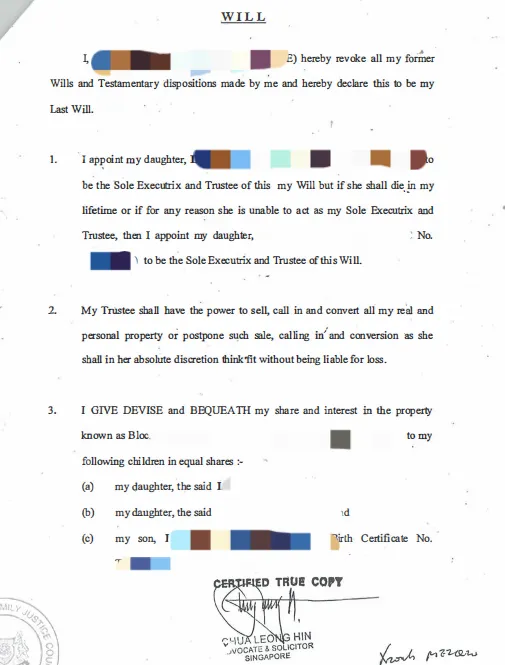
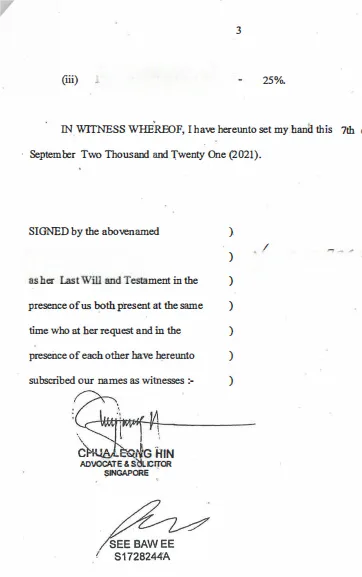
Specifically, the content of the will sequentially clarified the selection and replacement of the executor, the powers and duties of the executor, the ownership and shares of the Singapore property, the ownership and shares of global bank deposits, and the ownership and shares of other global property. A single will, a few hundred words, attempting to handle inheritance issues involving different types of property and different jurisdictions, inevitably led to numerous difficulties and challenges in subsequent implementation. However, compared to other succession tools, a will has advantages such as lower cost, flexibility and convenience, and privacy. Even in the face of increasingly developed financial instruments like trusts and insurance, it retains distinct comparative advantages.
II. Legal Analysis
Before proceeding to practical operations, we need to conduct a legal analysis of the overall situation of this case to grasp the basic direction:

1. Characterization of the Will
First, we need to resolve the characterization issue.
According to Article 8 of the Law on the Application of Laws to Foreign-Related Civil Relations, characterization is governed by the law of the forum, i.e., we can confirm the cause of action and nature of this foreign-related will under Chinese law. Further, according to Article 1 of the Interpretation (I) of the Supreme People’s Court on Several Issues Concerning the Application of the Law on the Application of Laws to Foreign-Related Civil Relations of the People’s Republic of China (hereinafter “Interpretation I of the Foreign-Related Civil Relations Law”), factors such as the nationality or habitual residence of the parties, the location of the subject matter, and the place where the legal fact occurred can determine whether a matter is a foreign-related dispute. In this case, whether considering nationality or habitual residence, or the location of the subject matter or the place where the will was made, all involve foreign elements, so this case involves a foreign-related will.
It is particularly important to note that in this case, the decedent’s nationality was de facto dual nationality, i.e., holding both Chinese nationality and Singapore nationality. However, under the nationality laws of both countries, de jure dual nationality is not recognized, and each denies the other’s nationality.
Article 9 of China’s Nationality Law provides: Any Chinese national who has settled abroad and has voluntarily acquired or obtained foreign nationality shall automatically lose Chinese nationality. However, there is a lack of factual investigation and authoritative determination by domestic and foreign immigration authorities regarding the settlement requirement. Moreover, the family in this case originally went to live in Singapore to avoid the COVID-19 pandemic at the time. The decedent also purchased multiple properties in Guangdong Province, continued to receive retirement benefits from a certain location, and occasionally participated in related business operations out of enthusiasm. The legal concept of “settlement” (定居) in academic and practical circles generally requires both the objective element (corpus) and the subjective element (animus). Fixed residence in a particular country can only serve as preliminary evidence and one link in the chain of evidence for “settlement.” Therefore, when the heirs in this case reported the matter to the domestic immigration authorities, no administrative determination was made. However, this serves as a reminder that de facto dual nationals will face compliance challenges under new administrative laws such as the Public Security Administration Punishments Law after 2026. Administrative penalties such as fines and even detention may become increasingly closer to dual nationals. The notion that completing identity planning alone ensures smooth sailing no longer has a place.
2. Formal Validity of the Will
According to Article 32 of the Law on the Application of Laws to Foreign-Related Civil Relations, the form of a will is valid if it complies with the law of the habitual residence of the testator at the time of making the will or at the time of death, the law of the state of nationality, or the law of the place where the will was made. Section 5 of Singapore’s Wills Act follows a similar legislative approach. In this case, whether applying the law of the habitual residence at the time of making the will or at death, the law of the state of nationality, or the law of the place where the will was made, the choice is between Chinese law and Singapore law. From the perspective of maximally respecting the testator’s testamentary intent, as long as one country’s law recognizes that the form of the will meets its requirements, even if other laws conclude it is invalid, it does not affect the application of the law of the specific country favorable to its validity.
Furthermore, according to Section 6 of Singapore’s Wills Act, a will must be in writing, signed by the testator at the end of the will, and signed in the presence of two non-beneficiary witnesses who are both present at the same time. The two witnesses must also sign in the presence of the testator and each other. The form of this will meets the requirements of Singapore law. In this case, the will was actually printed by two lawyers according to the testator’s wishes. Under Article 1136 of China’s Civil Code, a printed will must have two or more witnesses present, and the testator and witnesses must sign on each page and note the year, month, and day. However, this will was not signed by witnesses on every page, nor did it note the year, month, and day. If strictly applying Chinese law, the form of this will does not meet the requirements for a printed will, nor does it meet the requirements for other forms of wills; it would be invalid in form. A comprehensive analysis shows that the form of this will complies with Singapore law and is therefore valid.
3. Substantive Validity of the Will
According to Article 33 of the Law on the Application of Laws to Foreign-Related Civil Relations, the validity of a will is governed by the law of the habitual residence of the testator at the time of making the will or at the time of death, or the law of the state of nationality.
Since the formal requirements have already established the applicability of Singapore law, the substantive validity of the will can be directly tested under Singapore law. In this case, there is no clear evidence that the testator lacked civil capacity or行为能力 under Singapore law. The will disposes of assets in the testator’s own name, and there are no circumstances under Section 13 (revocation by marriage) or Section 15 (revocation by a new will) of Singapore’s Wills Act. Therefore, the will meets the substantive validity requirements under Singapore law.
However, it must be noted that because of issues concerning the matrimonial property regime and its applicable law, the validity of the will’s content cannot be generalized. In this case, there is immovable property jointly registered in the names of the testator and her husband within Mainland China. Although bank accounts are registered only in the testator’s name, they also need to be further examined and distinguished under matrimonial property relations. In Singapore, whether during marriage or at the stage of will administration, a system of separate property applies. That is, property acquired by one spouse before or during marriage remains the personal property of that spouse absent a clear intention of gift or transfer. There is no legal presumption of community property between spouses. Only when assets are registered jointly (e.g., joint bank accounts or jointly held immovable property) may they be presumed to be common property. Absent joint registration, gift, or other clear expression, the asset belongs solely to the registered owner. In the context of testamentary succession, immovable property registered solely in the name of one spouse remains that spouse’s personal property, regardless of when it was acquired (before or after marriage). The legal definition of “matrimonial assets” applies only in cases of divorce or annulment of marriage, i.e., under the relevant provisions of Part X of the Women’s Charter (1961). Therefore, after Ms. A’s death, all bank account funds and properties registered solely in her name constitute her personal estate and should be distributed according to her will. These properties are not subject to community property division rules but should be handled entirely under Singapore’s inheritance and estate administration laws. For the immovable property in Guangdong Province jointly registered between the testator and her legal husband, the testator can only dispose of her half share (provided her husband has no objection).
Another issue that needs discussion is whether, if the testator disposed of her own property but did not reserve any portion of her personal estate for her husband, and if the husband is a person lacking labor capacity and without a source of livelihood, the Singapore will could be rendered partially invalid or its content forcibly adjusted because it violates the mandatory provisions of Article 1159 of China’s Civil Code. There are differing opinions on this issue in theory and practice, broadly divided into the validity theory and the invalidity theory. In my humble opinion, mandatory provisions should also have a scope of application. From a utilitarian perspective tracing the legislative purpose of Article 1159 of the Civil Code, the order protected by this norm should be the public order and good customs within Mainland China. That is, the person to be protected should have a certain connection with Mainland China. The maintenance issue of a purely foreign person in a foreign country does not constitute public order and good customs under Chinese law.
In this case, the testator’s husband was originally a Singapore citizen who had long worked in Singapore and had Singapore social insurance. There is no special need for Chinese law to protect him, and therefore Article 1159 of the Civil Code need not be applied to partially negate the testator’s will.
III. Highlights of Practical Operations
Successful handling of a case requires not only establishing a legal foundation in theory but also close attention to practical operations. In the latter process, issues in legal theory may not be problematic and can be resolved through practical operations, but new practical problems may also arise. These need in-depth communication with relevant parties, notary public offices, etc. The highlights of practical operations in this case are summarized as follows:
(1) Proposing a new approach for inheritance by dual nationals.
Since the nationality laws of both China and Singapore do not recognize dual nationality, the testamentary inheritance of dual nationals regarding domestic estate faces certain legal obstacles and controversies. The author strategically bypassed this issue by submitting a legal opinion letter as expert testimony to the Singapore courts for probate, directly prompting the will to obtain probate from the Singapore courts first, eliminating substantive disputes over the will, and making domestic notary public offices more confident in handling the domestic estate.
(2) Innovatively transforming the role of the estate administrator commonly seen in foreign-related wills.
Foreign-related wills almost always include the appointment of an estate administrator. However, due to the inadequacy of China’s current estate administrator system, it is impossible to fully implement the points specified in the will. Moreover, the estate administrator designated in this will is a Singapore citizen living and working in Singapore, making actual performance inconvenient. The author promoted the delegation of the administrator’s powers. Along with the issuance of the notarial certificate for the estate administrator, a notarial certificate of general authorization for specific matters was also issued, partially resolving the dilemma of the originally designated administrator’s inability to perform duties.
(3) Proposing a specific and feasible new method to address the legal issue of a missing original will in foreign-related wills.
Because the original will was missing, certain domestic notary public offices were reluctant due to the legal risk. The author proactively proposed a combination of “Singapore court probate certificate + Singapore lawyer’s legal opinion + written confirmation from all heirs that there is no dispute” to fill the evidentiary chain for the missing original will, and this proposal was accepted.
(4) Making a new attempt to combine litigation and non-litigation methods in foreign-related will cases involving domestic estate.
Due to the complexity of the matters handled by this foreign-related will, the diversity of assets, and the differing locations, some notary public offices showed reluctance. The author decisively filed a case with the Guangzhou Yuexiu District People’s Court under the cause of action of confirming the estate administrator, voluntarily adding the Real Estate Registration Center, banks, etc., as defendants in the litigation. Later, with the help of the court’s pre-litigation mediation, the author represented the parties in multiple negotiations with the notary public office, the Real Estate Registration Center, and the banks. Ultimately, on the fair platform of the court, each party’s doubts were resolved, facilitating dispute resolution.
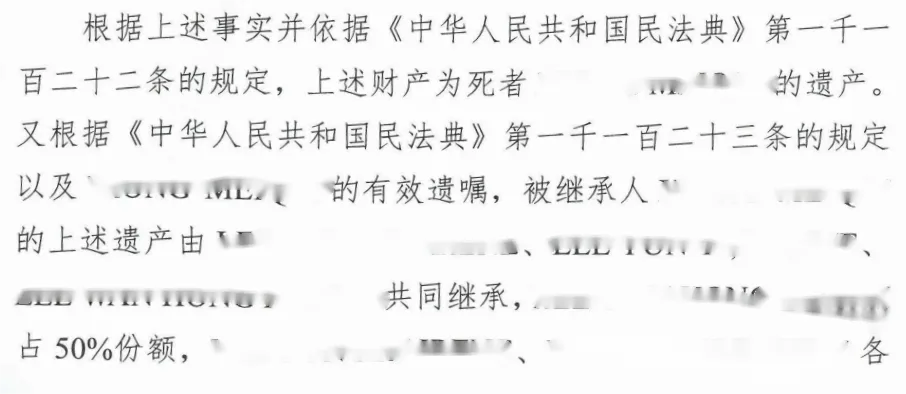
Through the above practical operations, the will inheritance matters were recognized by two notary public offices in Guangdong Province, which ultimately issued certificates of inheritance rights. The heirs were able to smoothly inherit the domestic bank deposits and immovable property.
IV. Insights and Reflections
First, the issue of appointing an executor/estate administrator in cross-border wills.
Although the will in this case includes the appointment of an executor and specifies its powers, due to the underdeveloped and evolving executor/estate administrator system in China, the executor/estate administrator cannot perform duties smoothly and cannot fully handle property according to the testator’s wishes. Therefore, caution is particularly needed when dealing with the disposition of domestic property in cross-border wills. Even when applying for a certificate of inheritance rights or transferring immovable property, the relevant entities did not pay special attention to this role. At present, the executor/estate administrator in Mainland China still feels quite powerless when facing a cross-border will. Consequently, in principle, it is not recommended for clients to adopt this arrangement. For property in different regions/legal systems, clients should be advised to make different, locally adapted, and customized considerations. For a detailed discussion of this issue, please refer to the author’s article published in the first issue of 2025 of Xiamen University Law Review, titled “From Dilemma to Innovation: The Exploration Path of a Chinese-style Estate Administrator System — Drawing Lessons from the US Uniform Probate Code.”
Second, the issue of safekeeping key and confidential documents such as wills.
In this case, if the heirs had paid attention to the safekeeping of the original will, so many new problems would not have arisen. Therefore, in cross-border asset planning and succession, special attention must be paid to the preservation of documents such as wills and trusts. Should paper or electronic versions be used? Should they be kept by a notary public or lawyer? Should multiple backups be made? How many people should know about them, or how should heirs discover specific documents, and who should notify? These issues, beyond legal design, are more often a test of human nature. If legal design can maximize the balance of interests and reconcile human nature, then legal planning stands a good chance of being smoothly implemented in the end.
Third, the lack of uniform standards for the transfer or devolution of assets involved in foreign-related wills leads to increased time and financial costs for heirs and creates room for ad hoc creativity.
Fortunately, the several heirs in this case had no substantive dispute over the ownership and distribution of the assets. Had a dispute arisen, a multi-year cross-border lawsuit would have been inevitable, consuming time and effort. Additionally, the procedures and requirements of the Real Estate Registration Center are not fully disclosed or transparent. In this case, because the heirs needed to handle multiple Hague Apostille documents involving several jurisdictions, the version of the will certified by the Singapore Academy of Law differed in the date of execution from the version of the will in the notarial certificate of inheritance rights issued by the domestic notary public. From a substantive perspective, this issue is harmless, as the will’s content is certain and unique, and the domestic notary public had already issued the inheritance certificate, which could be directly used to register the immovable property transfer. However, because the staff insisted on a version with a consistent date, and the parties could not immediately re-obtain a notarized translation, the absurd result of the back-and-forth was that the parties themselves handwritten a translation and signed and fingerprinted it. In fact, the “translation” involved the parties copying the will version certified by the Singapore Academy of Law in front of the staff, which took an hour. Finally, if the deposit account and the decedent’s social security salary account are in different branches of the same bank, some banks require going to the branch where the decedent’s social security salary account was held to handle the overall deposit inheritance (e.g., Industrial and Commercial Bank of China Guangzhou Branch). However, this requirement is not supported by clear laws or regulations and is merely an internal rule of ICBC, which is not clearly communicated at the time of account opening, thus constituting a standard term clause. This ought to be rectified and clearly regulated by authorities such as the Financial Regulatory Administration and the China Banking and Insurance Regulatory Commission.
Contact Lawyer
Submit your contact details and consultation question. We will follow up ASAP.