
From Three Olds Renovation to Urban Renewal: A Study on the Rule-of-Law Strategy for Transformation of Village-in-City Renovation Models
From Three Olds Renovation to Urban Renewal: A Study on the Rule-of-Law Strategy for Transformation of Village-in-City Renovation Models
Attorney Chen Gonghui and Luo Yunyu systematically review the evolution of Guangzhou urban renewal policies, analyzing the practical characteristics of four typical renovation models.
Abstract:
Guangzhou’s urban renewal policies have evolved through six distinct stages, each bearing the clear imprint of its era. In the current new round of village-in-city renovations, the improvement of the legal guarantee and regulatory system has become a key issue. Through the systematization and codification of policies, the aim is to enhance the standardization, transparency, and implementation efficiency of urban renewal work. Based on a systematic analysis of typical models and practical experiences of village-in-city renovation in Guangzhou, this study explores the main difficulties faced by different renovation models, which can provide guidance for the current stage of renovation work. It is necessary to further construct and improve the legal framework and policy system for urban renewal; strengthen the protection of villagers’ legitimate rights and interests, especially the implementation of their rights to participation and information; optimize supervision and accountability mechanisms to improve the fairness and transparency of the renovation process; and promote institutional innovation and pilot reforms to explore replicable experiences, providing theoretical and practical support for the efficient advancement of future village-in-city renovation work.
Keywords: Village-in-city renovation; Historical evolution; Renovation models; Governance dilemmas; Rule-of-law strategies
Introduction
With the rapid advancement of urbanization, village-in-city renovation has become a key issue in China’s urban renewal. The policy transition from “Three Olds Renovation” to “Urban Renewal” reflects the upgrading of urban governance concepts and embodies the government’s rule-of-law exploration in addressing complex socio-economic issues. In 2008, Guangdong proposed “Three Olds Renovation,” a policy that emphasized revitalizing existing land resources. In its implementation, this policy achieved significant results in promoting land intensification and economic growth. However, guided by this policy, there emerged a problem of solely pursuing economic benefits while neglecting public interests and ecological protection. Under these circumstances, the “Urban Renewal” policy emerged. Urban renewal, as a more comprehensive and sustainable policy, has gradually become an important tool for Guangzhou to promote urban development and optimize the living environment in recent years. Since 2019, Guangzhou has entered a new phase of “government-coordinated land preparation,” especially in 2023, where the path of village-in-city renovation based on the principle of “lawful expropriation, net land transfer” has been promoted by both policy and practice.
Village-in-city renovation is the most crucial part of urban renewal. However, during the renovation process, villages-in-city face multiple challenges, such as complex land ownership, intense conflicts of interest, and high pressure for social stability. Aiming at the potential problems that may arise during the renovation of villages-in-city, this paper attempts to analyze the evolutionary path of Guangzhou’s policies and practical experiences and proposes a rule-of-law-centered strategy for village-in-city renovation to address these potential problems.
I. Historical Evolution of Guangzhou’s Urban Renewal Policies
(A) Initial Exploration Phase: Policy Exploration and Construction of the Legal Framework
In 1999, Guangzhou established the “Village-in-City Renovation Leading Group,” marking the formal start of Guangzhou’s exploration of the urban renewal path. The initial phase of Guangzhou’s urban renewal policy primarily focused on government-led expropriation and environmental remediation. During this phase, urban renewal policies mainly concentrated on demolition, dilapidated building renovation, and environmental improvement. Due to the government-led model, project implementation was slow and results were not significant. Meanwhile, although legal documents such as the “Land Administration Law of the People’s Republic of China” and the “Regulations on the Administration of Urban House Demolition” existed, they did not provide a clear legal basis specifically for village-in-city renovation and lacked sufficient protection for villagers’ rights and interests, leading to continuous legal disputes during the renovation process. Despite numerous obstacles in the implementation of policies during this phase, it laid the foundation for subsequent, more systematic urban renewal. The experiences of this phase also provided important reflections and lessons for later policy formulation.
(B) Three Olds Renovation Phase: Initial Formation of the Policy System
In 2009, Guangdong Province became one of the first pilot provinces for “Three Olds Renovation” in the country and issued a series of policies concerning “Three Olds” renovation. During this process, Guangzhou gradually formed a preliminary policy system and began to incorporate village-in-city renovation into the strategic framework of urban renewal. In this phase, Guangzhou not only focused on demolition compensation but also began to introduce market mechanisms, promote intensive land use, and seek more flexible renovation models. The “Guangzhou Municipal People’s Government Opinions on Accelerating the Work of ‘Three Olds’ Renovation” (Sui Fu [2009] No. 56) and relevant guiding opinions from Guangdong Province laid the policy foundation for the in-depth implementation of “Three Olds Renovation.” In this phase, although policies gradually clarified the objectives and procedures for village-in-city renovation, disputes often arose during the implementation of renovation projects due to the incomplete legal system. For example, documents such as the “Letter from the Ministry of Land and Resources on Jointly Promoting the Construction of a Pilot Demonstration Province for Economical and Intensive Land Use with Guangdong Province” (Guo Tu Zi Han [2008] No. 816) proposed mechanisms for intensive use and guarantee but still failed to effectively resolve legal issues in land resource use. Nevertheless, the urban renewal of this phase objectively promoted the “Three Olds” renovation and provided important experiences and lessons for subsequent policy improvement and legislative adjustments.
(C) Urban Renewal Development Phase: Improvement of the Policy System and Advancement of Rule of Law
In 2015, Guangzhou established the Urban Renewal Bureau and further clarified the strategic direction of urban renewal by issuing the “1+3” policy system. At this time, Guangzhou’s urban renewal policy gradually shifted from a single “demolition and resettlement” model to comprehensive development and management. Through policy documents such as the “Guangzhou Urban Renewal Measures” (Municipal Government Order No. 134), the Guangzhou Municipal Government constructed a “1+3” policy system covering old villages, old factories, and old towns, marking the comprehensive advancement of urban renewal. With the improvement of the policy system, Guangzhou gradually strengthened the model combining government leadership with market participation, promoting the rational use of land and diversified sources of renovation funds. At the same time, relevant legal documents were gradually refined, especially the “Guangzhou Implementation Measures for the Renewal of Old Villages” and the “Guangzhou Urban Renewal Measures,” which provided a clearer legal basis for renovation. In this phase, legal documents provided in-depth details on procedural regulations and fund management for renovation projects, promoting the standardization and legalization of village-in-city renovation.
(D) Urban Renewal Acceleration Phase: Promotion of Policy Legalization and High-Quality Development
In 2020, Guangzhou’s urban renewal work entered an acceleration phase, with policy legalization and high-quality development becoming key issues. At this time, the government proposed the strategy of “fast approval, fast demolition, fast construction,” promoting the efficient implementation of urban renewal. Especially in 2021, Guangzhou issued a series of guidelines and standards to ensure that urban renewal projects, while advancing rapidly, also focused on ecological protection and social responsibility. Against the background of “high-quality development,” the “Guangzhou Urban Renewal Ordinance” was opened for public consultation, further strengthening supervision and management of village-in-city renovation. In this phase, through rule-of-law management, Guangzhou gradually established a long-term mechanism for urban renewal, promoted the standardization process of village-in-city renovation, and provided institutional guarantees for future sustainable development.
(E) Strengthened Control Phase: Policy Refinement and Enhanced Rigid Control
In 2021, Guangzhou’s urban renewal policies gradually shifted from the high-speed advancement phase to a phase emphasizing control and refinement. During this process, the government paid special attention to environmental protection, social stability, and the rational use of public resources. Therefore, in the implementation of urban renewal policies, greater emphasis was placed on rule-of-law and standardized management, committed to ensuring that various urban renewal actions could be implemented in compliance within the legal framework. In this phase, Guangzhou issued several policy documents to strengthen supervision, such as the “Notice of the Ministry of Housing and Urban-Rural Development on Preventing Large-Scale Demolition and Construction in the Implementation of Urban Renewal Actions” and the “Guangzhou Implementation Opinions on Preventing Large-Scale Demolition and Construction in Urban Renewal Actions (Trial),” emphasizing the importance of environmental protection and resource control during urban renewal. These policies specifically stressed that excessive demolition must not occur and that urban renewal must be carried out while ensuring ecological protection and cultural relic preservation. In this phase, Guangzhou’s legal control over urban renewal became more detailed, objectively promoting the improvement of the urban renewal policy system. By refining policies, especially regulations on demolition, ecological environmental protection, and social management, Guangzhou gradually established a legalized and transparent management mechanism. This shift not only promoted the efficient implementation of urban renewal but also provided a solid legal guarantee for future sustainable development.
(F) New Round of Village-in-City Renovation Phase: Enhanced Supervision and Government Coordination
In 2023, Guangzhou proposed a new model of “government-coordinated land preparation” and “lawful expropriation, net land transfer,” emphasizing social management and legal guarantees in village-in-city renovation. In this phase, the government’s role gradually shifted from a simple promoter to a coordinator and supervisor. Especially at the policy level, Guangzhou put forward stricter requirements for environmental protection and social responsibility and strengthened rigid control over urban renewal activities. Through the “Guangzhou Village-in-City Renovation Ordinance” and related implementation measures, the government clarified the specific procedures and legal framework for village-in-city renovation, providing a clearer legal path for renovation projects. The new round of renovation policies emphasizes the improvement of the legal guarantee and regulatory system, achieving efficient and transparent urban renewal work through rigorous policy codification.
II. Models and Practices of Village-in-City Renovation in Guangzhou
(A) Government Renovation Model
1. Model and Characteristics
The government-led renovation model refers to an update method directly promoted and implemented by the government. This model is centered on the government, from planning to implementation, all led by the government, and relies on municipal or district-level state-owned enterprises to carry out specific demolition and construction work, exhibiting prominent administrative leadership characteristics.
In this phase, the focus of urban renewal was mainly on the renovation of dilapidated and broken houses. Starting from 1981, Guangzhou adopted a strategy of “government-led, piecemeal renovation,” using limited financial resources to gradually improve the living conditions of dilapidated houses throughout the city. However, due to insufficient funding and scattered renovation scope, the effectiveness of this phase was somewhat limited. In 1987, to coordinate the city’s dilapidated house renovation resources, Guangzhou established the Dilapidated House Renovation Construction Management Office, further increasing capital investment and attempting a new renovation path with municipal and district-level development enterprises as the implementation entities. This shift significantly improved renovation efficiency and coverage, with typical cases including the Dongfeng Street Community and Jinhua Street Community, among other contiguous renovation projects.
2. Renovation Practice – Jinhua Street Community, Liwan District
In the 1980s, under the background of the early reform and opening-up, Guangzhou adopted a “government-led” renovation model for the Jinhua Street Community [1]. The project initiation, organization, and planning were directly promoted by the government, while municipal or district-level state-owned enterprises were entrusted with specific implementation. Overall, this renovation model exhibited clear administrative management characteristics.
In this process, the government, as the main body, was responsible for planning formulation, policy research and formulation, and defining the project scope and progress through land development contracts. At the same time, the municipal and district governments used administrative orders and coordination mechanisms to solve issues such as land approval, demolition coordination, and fund raising during project implementation. The responsible parties for the renovation were municipal and district-level state-owned real estate enterprises, responsible for demolition, resident resettlement, fund raising, and organizing the development and construction of residential and public facilities. Additionally, enterprises had to pay contract performance bonds to ensure the smooth progress of the project.
From a governance perspective, the renovation process of Jinhua Street Community embodied the typical characteristics of a government-led model. The Guangzhou Municipal Urban Construction Committee, as the main management body for the renovation, effectively promoted the renovation process through close cooperation between the municipal and district governments and state-owned enterprises. During this period, the municipal government repeatedly promoted the renovation work through meeting minutes and administrative orders, which is a distinct feature of this model.
[1] “Research on the Planning Implementation Mechanism from ‘Three Olds’ Renovation to Urban Renewal – Taking Guangzhou as an Example,” Doctoral Dissertation of South China University of Technology, 2020.
(B) Foreign-Invested-Led Government Renovation Model
1. Model and Characteristics
In the contiguous old city renovation work of this phase, the overall organizational structure remained centered on government leadership, with no significant difference in principle from the contiguous renovation methods of the mid-to-late 1980s. The difference was that a large amount of foreign capital was introduced as a funding source, allowing foreign-invested real estate development companies to firmly control the project initiative early on.
From the perspective of specific division of labor, the government was still responsible for formulating plans, organizing and coordinating renovation work, and promoting demolition. However, with the involvement of market capital, especially Hong Kong capital, enterprises gradually dominated planning and design and proposed specific requirements for development scale. Because the Guangzhou municipal government urgently needed funds to promote contiguous old city renovation at the time and lacked precise assessment capabilities for real estate profits and management tools for development scale, foreign-invested enterprises gradually became the de facto leaders. Under this model, renovation projects tended to favor the interests and needs of foreign capital. To achieve renovation goals, the government made multiple compromises in areas such as urban development intensity, historical and cultural protection, and transportation planning, to some extent making the government play the role of “auxiliary executor” for foreign-invested enterprises.
The urban renewal in this phase mainly involved contiguous dilapidated building renovation. Against the backdrop of the initial establishment of the socialist market economy, the introduction of foreign capital made the Guangzhou municipal government place greater emphasis on dilapidated building renovation, promoting more confident and vigorous renovation work.
2. Renovation Practice – Liwan Plaza Old City Renovation
The Liwan Plaza old city renovation is a typical case of cooperation between the government and foreign-invested enterprises and can be classified as a “foreign-invested-led” urban renovation model [2]. Although under this model, the government and enterprises established a market-oriented cooperation framework, and the government undertook important aspects such as demolition, the government’s weak ability to control market operations, lack of experience in calculating real estate economic benefits, and relatively weak legal control over urban planning ultimately led to foreign-invested enterprises becoming the de facto leaders.
Taking the Liwan Plaza renovation as an example, the government was mainly responsible for providing policy support, attracting foreign real estate capital, defining the renovation scope, coordinating relationships among relevant units within the renovation area, and handling land procedures. Meanwhile, the developer promoted the renovation using a typical Hong Kong real estate model, demolishing low-rise old buildings and constructing multiple high-rise buildings. Although this renovation improved the regional environmental quality and enhanced residents’ living conditions, it neglected the traditional urban fabric of the area, damaged the cultural landscape of the Xiguan arcade streets, and separated the complete Shangxiajiu Road, leading to conflicts between traditional culture and urban development [3].
[2] Zhao Nannan, Liu Yuting, Zhu Yuanzhe, Wen Hong: “Evolution of Village-in-City Renovation Models and Governance Alliances from the Perspective of Policy Evolution – Taking Guangzhou as an Example,” Urban Development Studies, Issue 5, 2024. [3] Wang Linsheng: Urban Renewal, Guangdong People’s Publishing House, 2009, p. 232.
(C) Government-Coordinated, Developer Non-Intervention Renovation Model
1. Model and Characteristics
After experiencing the large-scale introduction of foreign capital in the 1990s and reflecting on related issues, Guangzhou’s urban renewal gradually returned to a government-led model, with the advancement of urban renovation completely controlled by the government. For example, in the renovation of Nanhuaxi Street area, the district government undertook almost all aspects, including selecting renovation plots, determining the model, calculating economic costs, refining planning and design, land approval, advance financing for demolition, land transfer, and developer bidding. Developers only completed the construction of price-capped housing according to the land transfer contract and did not participate in the renovation process.
To strengthen Guangzhou’s regional characteristics and cultural protection, while meeting the urban image demands brought by the Asian Games, the focus of urban renewal in this phase shifted to historical landscape areas and public interest construction, abandoning the one-sided pursuit of economic benefits [4]. The results of this period’s renovation were significantly different from before, with basically no reconstruction of residences on the original sites. Instead, large areas were converted into public uses such as green spaces, squares, and cultural facilities, and residents were relocated to reduce urban population density, optimizing urban functions and regional characteristics.
The practice of this phase proved that after abandoning the principle of economic input-output balance, it was possible to better balance economic and social benefits. By reducing development intensity, the historical landscape was effectively preserved and inherited, avoiding the impact of modern architecture on traditional culture. At the same time, the government gradually recognized the importance of social and cultural values, and demands for public participation and social forces also increased, leading urban renewal towards a game pattern involving multiple participants.
[4] He Shenjing, Liu Zhen: “Impact of Asian Games Urban Renewal on Community Residents – Based on Empirical Investigation of Three Communities in Guangzhou,” Geographical Research, Issue 6, 2013.
2. Renovation Practice – Contiguous Dilapidated Building Comprehensive Renovation Project of Enning Road, Liwan District
Enning Road is an important part of the traditional old city “Xiguan” in Guangzhou and historically was a residential area for the middle and upper classes [5]. Before renovation, there were many dilapidated buildings in the area, and the environmental quality was poor. The arcade buildings along the street were relatively well-preserved, but the buildings behind were mostly built in the late Qing and early Republican periods, rich in Xiguan cultural characteristics. The area includes key protected cultural relics such as the Bahe Guild Hall, Zhan Tianyou’s Former Residence, and Bruce Lee’s Ancestral Home, as well as historically valuable building groups like the arcade streets and Xiguan Great Houses, forming a unique traditional neighborhood form.
The renovation plan for Enning Road underwent multiple adjustments and repeated modifications. The entire process adopted various methods such as public announcement, demolition, collection of residents’ opinions, and supervision by the People’s Congress, becoming a milestone for public participation and interest balancing in Guangzhou’s old city renovation.
[5] Xie Dixiang, Zhu Xuemei: “Social Conflicts, Interest Games, and Historical District Renewal and Renovation – Taking Guangzhou’s Enning Road as an Example,” Urban Development Studies, Issue 3, 2014.
(D) Government-Guided, Collective Investment Renovation Model
1. Model and Characteristics
The “government-guided, collective investment” model balances the renovation investment of the village collective by channeling land transfer funds, achieving an effective combination of renovation funding sources and plan execution [6]. Under this model, the government ensures that renovation work aligns with regional development goals and avoids substantial financial input. At the same time, land transfer revenue covers the village collective’s initial investment costs, forming the basic framework for Guangzhou’s “Three Olds” renovation and having a profound impact on subsequent policies and village-in-city renovation.
Under this model, fundraising is mainly achieved by auctioning the remaining land after the village’s resettlement and reconstruction. Against the backdrop of Guangzhou’s policy of “zero financial input” for village renovation, the village collective, with villagers’ consent, auctions land, and the proceeds are used for the renovation of the old village. This not only meets the requirement of the municipal and district governments to “use no fiscal appropriation” but also ensures the balance of income and expenditure for the renovation project, further promoting villagers’ income and collective economy. The government is responsible for controlling land transfer and income distribution, returning income after deducting taxes and fees to the village collective, maximizing support for village-in-city renovation, and avoiding the phenomenon of developer-led renovation destroying urban culture as seen in the 1990s.
Moreover, compared to the past, this model has made significant progress in public participation. In the process of formulating the renovation plan, the government fully protects the legitimate rights and interests of the village collective and villagers. By disclosing the renovation plan, demolition compensation plan, and measurement data, transparency is enhanced. During the implementation phase, multiple villager representative meetings were held to collect opinions widely, and plans were optimized through questionnaires and interviews, focusing on the fairness of demolition and resettlement. The villager representative meeting votes on matters involving interests, ensuring that villagers have full democratic participation and supervision rights. These experiences were later incorporated into Guangzhou’s village-in-city renovation policies, significantly enhancing the depth and standardization of public participation.
[6] “Research on the Planning Implementation Mechanism from ‘Three Olds’ Renovation to Urban Renewal – Taking Guangzhou as an Example,” Doctoral Dissertation of South China University of Technology, 2020.
2. Renovation Practice – Liede Village, Tianhe District
Liede Village is an “isolated island” type of village-in-city on collective land remaining in Guangzhou’s urbanization process, surrounded by urbanized areas [7]. Early renovations mainly focused on building farmers’ apartments and improving the village environment. However, due to inconsistencies between planning indicators and villagers’ development needs, the renovation stalled. In 2005, due to the construction of the Liede Bridge and urban development needs, the Municipal Party Committee and Municipal Government decided to promote the renovation of Liede Village in conjunction with village-in-city renovation.
The renovation plan for Liede Village was divided into two phases. The first phase involved social transformation, converting villagers’ identities to residents, village committees to neighborhood committees, land from collective nature to state-owned nature, and village collective assets to be managed by a joint-stock company. The second phase involved environmental improvement, building farmers’ apartments to resettle relocated villagers, creating conditions for renovation and gradually optimizing the environment.
The hosting of the 2010 Guangzhou Asian Games provided an opportunity for the renovation of Liede Village. Because it is located in the core area of the Zhujiang New Town CBD and close to the main venue of the Asian Games, renovating the village’s appearance became an important task for showcasing the city’s image. To accelerate the renovation process, the government significantly increased the planned floor area ratio to 5.5 to meet reconstruction needs and financing requirements. At the same time, the planning, design, and compensation plans were disclosed to villagers and decided by voting to ensure smooth implementation. During the renovation, the government clarified funding sources and strengthened attention to historical and cultural protection to avoid damaging the local cultural heritage.
The renovation of Liede Village pioneered the innovative model of “village collective land property rights exchange for developer-built resettlement housing.” The renovation officially started in 2008 and was completed efficiently in just three years, not only completing the villagers’ return on schedule but also achieving partial preservation and continuation of the village’s historical and cultural clues. The comprehensive renovation of Liede Village successfully created the “Liede Model,” becoming a benchmark for village-in-city renovation in Guangzhou.
[7] “Research on the Planning Implementation Mechanism from ‘Three Olds’ Renovation to Urban Renewal – Taking Guangzhou as an Example,” Doctoral Dissertation of South China University of Technology, 2020.
III. Legal Governance Dilemmas Arising from Different Renovation Models
(A) Government-Led Renovation Model
1. Legitimacy Issues of Land Expropriation
According to the “Land Administration Law of the People’s Republic of China” and the “Regulations on the Administration of Urban House Demolition,” land expropriation must follow the principle of “public interest first.” However, in specific implementation, the definition of public interest and the legality of the expropriation procedure are often questioned. Some local governments advance projects without fully disclosing the expropriation plan or fulfilling adequate notification procedures, violating the provisions on “publicity, notification, and hearing” in the “Administrative Licensing Law of the People’s Republic of China.” Such procedural flaws can easily lead villagers to question the legitimacy of land expropriation and even result in administrative reconsideration or administrative litigation. Taking some village-in-city renovation cases in Guangzhou as examples, some villagers filed group lawsuits due to insufficient knowledge of land acquisition information or lack of reasonable compensation, which not only delayed the project process but also damaged the government’s credibility.
Furthermore, beyond the public interest, how to balance the boundary between government-led land expropriation and market-oriented development has also become a focus of controversy. For example, in some village-in-city renovation projects, the ultimate land use was changed to commercial development, but villagers found it difficult to obtain a share of the proceeds. This phenomenon challenges the “public nature” of land expropriation [8].
2. Insufficient Protection of Villagers’ Rights and Interests
Although the law stipulates that the government must ensure reasonable compensation for villagers during the process of land expropriation and demolition, non-transparent compensation standards and “one-size-fits-all” approaches are still common. The current compensation system mainly refers to the current use value of the land, rather than the market value. This valuation method makes it difficult to reflect the actual economic losses and future development rights of villagers. For example, in some city renovation cases, after agricultural land was expropriated for urban construction, the added value from the land mainly belonged to the government or developers, while villagers could only obtain low-standard land compensation. This contradicts the spirit of “fair compensation” required by Article 48 of the “Land Administration Law of the People’s Republic of China” [9].
More notably, villagers’ rights to participation, information, and supervision in the decision-making process are often overlooked. The “Organic Law of the Villagers Committees of the People’s Republic of China” grants villagers decision-making power in collective affairs. However, under the government-led renovation model, village committees often find it difficult to contend with strong administrative power. The channels for expressing villagers’ interests are limited, easily leading to collective protests and trust crises.
[8] Yuan Yangqin, Liang Jiangli: “Analysis on the Dilemma and Path of ‘Village-in-City’ Renovation,” International Public Relations, Issue 9, 2023. [9] “Research on Comprehensive Renovation-type ‘Village-in-City’ Renewal from the Perspective of Stakeholder Theory,” Master’s Thesis of South China University of Technology, 2023.
3. Incomplete Legal Procedures and Low Transparency
The implementation of legal procedures under the government-led model often suffers from issues of non-standardization and lack of transparency. Although the “Administrative Punishment Law of the People’s Republic of China” and the “Administrative Compulsion Law of the People’s Republic of China” impose clear requirements on administrative procedures, in practice, the degree of openness of procedures for demolition and compensation is limited. Additionally, third-party institutions for demolition compensation assessment are often chosen by the government, lacking independence and credibility.
The absence of implementation standards leads local governments to operate flexibly in practice, and there may even be instances of favoring developers. For example, the compensation plans for some villages-in-city actually deviated significantly from market prices, and due to villagers’ lack of legal knowledge and ability to defend their rights, it is difficult for them to correct injustices through judicial channels.
(B) Foreign-Invested-Led Government Renovation Model
1. Insufficient Legal Guarantees
Currently, the legal framework for the foreign-invested-led model is incomplete. The existing “Foreign Investment Law of the People’s Republic of China” and the “Land Administration Law of the People’s Republic of China” fail to provide clear guidance for specific situations where foreign-invested enterprises participate in village-in-city renovation, especially concerning contract execution and investment protection. Some cases show that due to non-transparent approval processes and unclear division of legal responsibilities, foreign-invested enterprises may face issues such as policy changes and approval delays during project implementation. For example, some foreign-invested enterprises invested substantial funds in the early stages of village-in-city renovation but suffered huge losses due to policy adjustments leading to project suspension or termination. This legal uncertainty increases the investment risk for foreign-invested enterprises and affects their willingness to further participate.
2. Interest Balance and Social Equity Issues
Foreign-invested enterprises aim for profit, and this characteristic can lead to social equity issues in village-in-city renovation. For example, to quickly recoup investment costs, foreign-invested enterprises tend to use the renovated land for commercial development and high-end residential projects. While this approach drives regional economic development, it also significantly raises the cost of living in the renovated area, forcing original residents and low-income groups to relocate. This “social stratification” phenomenon results in the loss of the original social functions of the village-in-city, and the interests of vulnerable groups are not effectively protected. Moreover, the cultural rights and social adaptability of indigenous residents are often overlooked in this development model. For instance, the clan relationship networks and traditional activity venues in the original village are demolished on a large scale, and the project planning of foreign-invested enterprises often fails to provide alternatives, leading to community fragmentation and cultural discontinuity.
3. Culture and Social Adaptability
Foreign-invested enterprises typically adopt international development standards and business models, but these models are not always suitable for local realities. For example, some foreign-invested projects tend to build high-end facilities such as large shopping malls and hotels, ignoring the daily needs of villagers, such as affordable housing and community service facilities. This neglect makes it impossible for original residents to live or work in the renovated area. Cultural differences and insufficient communication also make it difficult for foreign-invested enterprises to understand and respect local traditions and social customs. This lack of adaptability often exacerbates the outbreak of social conflicts during the renovation process [10].
[10] “Research on the Planning Implementation Mechanism from ‘Three Olds’ Renovation to Urban Renewal – Taking Guangzhou as an Example,” Doctoral Dissertation of South China University of Technology, 2020.
(C) Legal Dilemmas of the Government-Coordinated, Developer Non-Intervention Renovation Model
1. Ambiguity of Rights and Responsibilities and Legitimacy Risks
Under the government-coordinated model, the decision-making and implementation powers for the entire renovation process are concentrated in the local government, but the law does not clearly define the division of responsibilities and scope of authority. For example, there is no clear regulation on which matters should be directly handled by the local government and which need to be authorized through other institutions. Especially in the land expropriation process, the involved administrative discretion is often expanded, which may raise questions about abuse of power.
Furthermore, the law lacks performance supervision mechanisms for the government-coordinated model. For instance, although the “Administrative Licensing Law of the People’s Republic of China” and the “Land Administration Law of the People’s Republic of China” impose procedural constraints on demolition activities, there are no specific regulations tailored to the government-coordinated model, making it difficult to ensure the transparency and compliance of administrative actions. This ambiguity increases public questioning of administrative actions, leading to frequent legal conflicts.
2. Legal Bottlenecks in Fund Operation
In the case of developer non-intervention, the government must bear the full renovation costs. This puts immense pressure on local finances, and the legal basis and compliance of fund raising become focal issues. Although many village-in-city renovation projects have received fiscal appropriation support, the flow of funds is not fully disclosed, lacking effective social supervision, which can easily lead to corruption risks. Moreover, local governments may resort to debt financing, but the “Budget Law of the People’s Republic of China” and related debt management regulations impose strict restrictions on local government borrowing. If the government illegally borrows for village-in-city renovation, it will face legal and credit crises. Additionally, under this model, renovation revenue mainly comes from land transfer fees. However, fluctuations in the land market and changes in transfer policies may cause project revenue to fall far below expectations, further exacerbating the government’s debt pressure [11].
[11] “Research on the Dilemmas and Countermeasures of Cooperative Governance in China’s Urban Renewal,” Master’s Thesis of Southwest University of Political Science and Law, 2022.
3. Increased Social Stability Pressure
The government is directly responsible for coordinating relations with the masses. In the absence of commercial buffers, conflicts in renovation are more likely to be directed at the government. For example, villagers protesting unfair compensation and intensified conflicts during demolition may affect social stability. Furthermore, forced demolition may trigger large-scale group incidents, which not only weakens government credibility but may also escalate legal risks.
The government-coordinated, developer non-intervention renovation model faces multiple challenges in practice, including ambiguous legal authorization, insufficient fund supervision, weak protection of villagers’ rights and interests, non-transparent procedures, and social stability pressure. To resolve these legal dilemmas, it is necessary to improve legislation to clarify the rights and responsibilities of all parties, strengthen fund supervision mechanisms, enhance the protection of villagers’ participation rights, standardize legal procedures, and establish social stability mechanisms, gradually promoting the legalization and long-term effectiveness of village-in-city renovation.
(D) Legal Dilemmas of the Government-Guided, Collective Investment Renovation Model
1. Sustainability and Legality of Funding Sources
Collective economic organizations, as the main capital providers, have their funding sources and operation methods strictly constrained by law. Some village collectives may raise funds by mortgaging land use rights or project proceeds, but this approach has legal uncertainties. The law does not explicitly allow the use of collective land use rights for financing mortgages, which poses risks to the stability of the renovation capital chain. Additionally, because village collective economic organizations are not professional development institutions, their efficiency in using funds and legal compliance are also subject to external scrutiny.
2. Public Resource Allocation Issues
During the planning and approval process, collective-led development projects often encounter legal obstacles due to inconsistency with the government’s policy objectives. For example, renovation plans may conflict with the overall urban master plan, especially when failing to fully consider the requirements for ecological environmental protection or public infrastructure provision. In recent years, national policies have strongly emphasized “ecological priority” and “economical and intensive land use,” but in local practice, some projects overly focus on economic returns while neglecting long-term public interests.
Furthermore, because collective economic organizations primarily focus on housing needs, the interests and demands of other groups, such as tenants, are often overlooked. This, to some extent, contradicts the central policy goal of “inclusive development” and becomes a potential source of legal and social conflicts. Under this renovation model, the village collective enjoys considerable autonomy, with the government mainly responsible for supervision and guidance. However, in practice, supervision mechanisms often lack rigidity. In some local projects, illegal activities occur in areas such as benefit distribution, fund management, and project tendering. Due to the lack of effective external supervision, these problems are difficult to detect and resolve in a timely manner.
IV. Legal Dilemmas and Solutions for Village-in-City Renovation
(A) Improving the Legal Framework and Policy System
Currently, in the process of village-in-city renovation, land expropriation and compensation issues remain the core of legal disputes. For example, how to define “public interest” and determine reasonable compensation standards have long lacked a clear legal framework. These issues lead to defects such as inconsistent standards and non-transparent procedures in land acquisition compensation, and excessive discretion of local governments often results in insufficient or unfair compensation. Therefore, supplementation and improvement are needed at the legislative level [12].
First, it is necessary to clarify “public interest” and compensation standards. Currently, although the “Land Administration Law of the People’s Republic of China” stipulates the principles of land acquisition compensation, the specific connotation of “public interest” and its relationship with market-oriented compensation standards are not clearly defined. It is recommended that through legal amendments, “public interest” should include not only infrastructure construction but also consider the impact on villagers’ social life quality. At the same time, compensation standards should be linked to market assessment prices, rather than using government valuation as the sole standard. In 2019, Shenzhen achieved market-based assessment of compensation prices through policy reform, increasing the average compensation amount by 15% in local renovation projects [13].
Second, long-term compensation mechanisms need to be added. In addition to immediate economic compensation for land, long-term social security mechanisms should also be established simultaneously. By providing guarantees for villagers’ employment, education, and pensions, the negative impact of land acquisition on their lives can be reduced. For example, the “Village-in-City Renovation Villager Resettlement Policy” issued by Hangzhou in 2018 proposed providing supporting enterprise training and employment opportunities through resettlement housing, thereby increasing villagers’ employment rate by 30% [14].
[12] “Research on the Dilemmas and Countermeasures of Cooperative Governance in China’s Urban Renewal,” Master’s Thesis of Southwest University of Political Science and Law, 2022. [13] Qiu Huikang, Ding Xiao: “A Preliminary Exploration of the Symbiotic Development Path between Shenzhen’s Villages-in-City and the City,” Urban Architecture, Issue 21, 2024. [14] “Research on the Planning Strategy of Hangzhou’s Villages-in-City under the Guidance of New Urbanization,” Doctoral Dissertation of Zhejiang University, 2022.
(B) Strengthening the Protection of Villagers’ Participation Rights and Interests
Village-in-city renovation projects often involve the interests of a large number of villagers. Therefore, villagers’ rights to participation and information are key to resolving interest disputes during the renovation process. Although current laws stipulate villagers’ rights to information and expression, in practice, these rights are often overlooked or weakened. Therefore, it is necessary to strengthen legal protection for villagers to ensure their active participation in the renovation.
First, an information disclosure system should be established. Information disclosure in renovation projects is the foundation for ensuring villagers’ right to information. Governments at all levels should reduce conflicts caused by information asymmetry by disclosing important information such as land acquisition compensation plans and renovation plans. Second, the villager self-governance mechanism should be improved. Villagers’ autonomy in the renovation process can be strengthened by establishing villager representative meetings and enhancing villagers’ voting rights, granting them more decision-making power. Finally, legal aid should be strengthened. In some renovation projects, villagers often find themselves in a weak position during agreement negotiations due to a lack of legal knowledge. In such cases, the intervention of legal aid agencies becomes particularly important.
(C) Optimizing Supervision and Accountability Mechanisms
Problems such as non-transparent power, benefit transmission, and corruption during the renovation process often affect the fairness of projects. Therefore, improving supervision mechanisms and accountability systems, especially establishing independent third-party evaluation institutions, is crucial for protecting villagers’ rights and interests. First, information-based supervision should be promoted. The government should use big data and information technology for real-time supervision. For example, Shenzhen launched a “Digital Land Management System” in 2018, allowing the government to track the progress of land acquisition, compensation, and resettlement in real-time, ensuring that every operation is traceable. This move significantly improved the transparency of the renovation process, reducing violations by about 30% [15]. Second, independent supervision agencies should be established: To enhance the fairness of supervision, independent third-party institutions should be introduced for review, especially in project evaluation and compensation standards. A pilot project in Guangzhou invited social organizations and legal experts to form an independent review committee to publicly review the renovation plan. The review results were widely publicized, greatly increasing project transparency. According to a report by the Guangzhou Commission for Discipline Inspection, the implementation of this model reduced corruption cases in projects by 40% [16]. Finally, legal liability accountability must be strengthened: Establish a strict legal liability accountability mechanism to ensure that violations of laws and regulations are duly punished.
[15] Qiu Huikang, Ding Xiao: “A Preliminary Exploration of the Symbiotic Development Path between Shenzhen’s Villages-in-City and the City,” Urban Architecture, Issue 21, 2024. [16] “Research on the Planning Implementation Mechanism from ‘Three Olds’ Renovation to Urban Renewal – Taking Guangzhou as an Example,” Doctoral Dissertation of South China University of Technology, 2020.
(D) Promoting Institutional Innovation and Pilot Reforms
Village-in-city renovation involves complex and diverse interests, and a single legal approach cannot effectively solve all problems. Therefore, promoting institutional innovation and pilot reforms to provide replicable experiences for renovation projects nationwide is necessary. First, promote the government-enterprise cooperation model. Through a cooperation model guided by the government, participated in by enterprises, and led by the village collective, the interests of all parties can be effectively balanced. The specific method is: the government provides land transfer fees and part of the infrastructure construction funds, enterprises provide funding and construction projects, and the village collective is responsible for coordinating the interests of villagers. Second, strengthen urban-rural integration development pilot projects: Attempt to combine village-in-city renovation with urban-rural integration development, exploring new paths for land transfer and the development of the village collective economy. This approach can promote the integration of land transfer and the collective economy, enabling sustainable growth of village collective income.
Conclusion
Village-in-city renovation is an important way to promote urban modernization and address the imbalance between urban and rural development. However, its complex interest patterns and institutional obstacles lead to numerous conflicts during the renovation process. To achieve sustainable development in this field, it is necessary to start from the legal framework and policy system, focusing on solving key issues. For example, by refining the definition of “public interest” and optimizing the compensation mechanism, conflicts over land acquisition can be effectively alleviated; by strengthening villagers’ participation rights and information disclosure mechanisms, the fairness and transparency of renovation projects can be enhanced; and through institutional innovation and pilot reforms, flexible and diversified solutions can be provided for the complex renovation process. The essence of village-in-city renovation is not only the reconstruction of urban space but also the practice of social justice and the rule of law. Therefore, in the future, multi-party collaboration and scientific planning are needed to explore a sustainable development path that can balance the interests of all parties and promote social harmony.
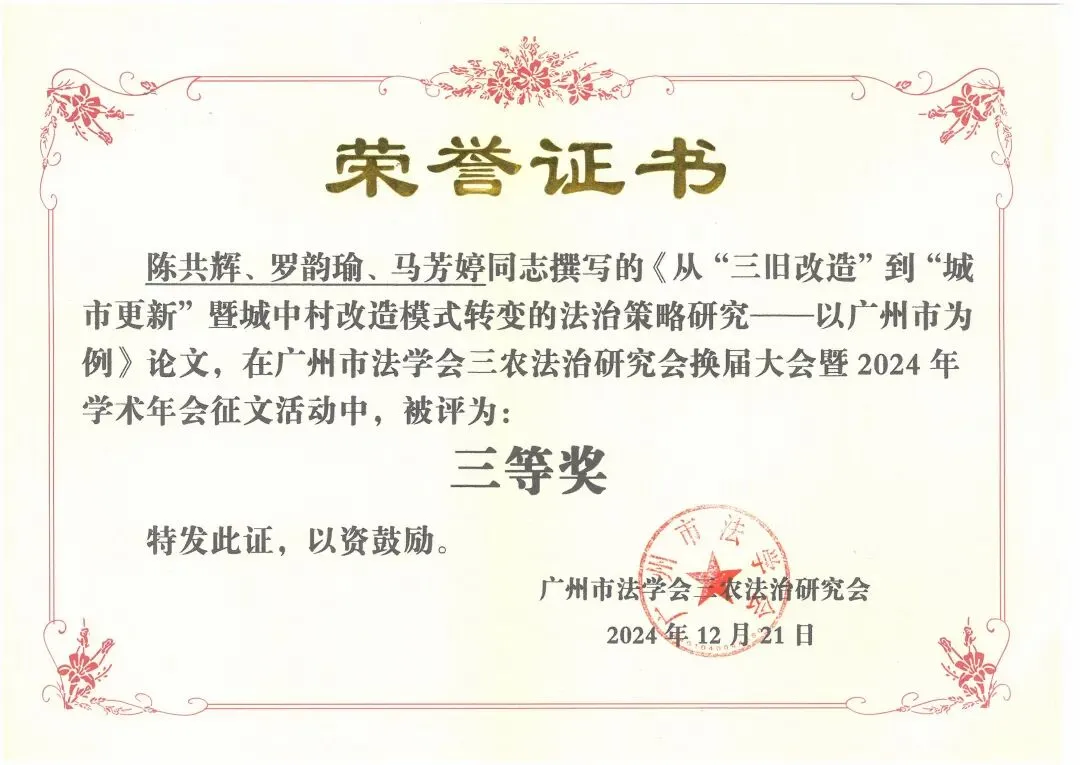
This paper was awarded “Third Prize” in the Call for Papers for the General Assembly of the Three Rural Legal Research Association of the Guangzhou Law Society and the 2024 Academic Annual Conference.
Contact Lawyer
Submit your contact details and consultation question. We will follow up ASAP.