
VAM Dispute Series (Part 1) | From the Haifu Case to the Jiumin Minutes: Ten Core Rules in the Judicial Evolution of VAM Agreement Validity (Part One)
VAM Dispute Series (Part 1) | From the Haifu Case to the Jiumin Minutes: Ten Core Rules in the Judicial Evolution of VAM Agreement Validity (Part One)
This article systematically maps the evolution of the judicial validity of VAM agreements: from the 2012 Haifu case, which established the dichotomy that 'betting with shareholders is valid while betting with the company is invalid,' to the 2019 Jiumin Minutes, which established the principle of 'separating validity from performance' and set two performance gates—capital reduction procedures and profit distribution—for company-side VAM obligations, and then to the rigid adjudicative trend since 2020 of 'dismissing claims where capital reduction has not been completed.' It also analyzes the performance deadlock in share buyback VAMs, the performance boundaries of company guarantee liability, and key practical responses for both investors and financing parties in agreement design and dispute resolution.
Introduction
In venture capital circles, the VAM agreement is a “sword of Damocles” that inspires both affection and dread. It is the investor’s talisman for betting on the future and the founder’s military pledge to stake everything on one throw. Yet when performance targets are missed and the IPO dream collapses, and the parties finally come to settle accounts, the black-and-white contract often encounters a “soul-searching interrogation” from the law.
Looking back over more than a decade of judicial review of VAM agreements in China is like reading a sweeping history of institutional evolution: from the rigid red line drawn by the 2012 Haifu case—“betting with the company is invalid”—to the breakthrough of “separating validity from performance” introduced by the 2019 Jiumin Minutes, and then to the iron rule that has taken shape since 2020—“no completed capital reduction, no claim.” The judicial attitude has repeatedly oscillated and dynamically balanced between “respecting commercial autonomy of will” and “defending capital maintenance.”
Today’s adjudicative landscape presents a cruel “Schrödinger’s” state: the agreement is valid, but the money may not be collectible. When the “capital reduction procedure” becomes an insurmountable performance gap for company-side VAM obligations, and when the founding shareholders refuse to cooperate, producing a “performance deadlock,” how can investors break through? When cash compensation is characterized as “valuation adjustment” and is no longer subject to the rules on reducing excessive liquidated damages, how can the financing party avoid the risk of losing everything?
This article begins with a panoramic view of the rule changes from the Haifu case to the Jiumin Minutes, takes a deep look at ten core rules on the judicial validity of VAM agreements, and directly addresses the most intractable “performance deadlocks” and the minefield of “equity in form but debt in substance,” offering both investors and financing parties a practical guide that covers both front-end design and back-end remedies.
I. Panorama of the Judicial Evolution of VAM Agreement Validity: Core Rules from the Haifu Case to the Jiumin Minutes
A VAM agreement, also known as a valuation adjustment agreement, is a core instrument designed in the field of equity investment to address the uncertainty of the target company’s future development, typically including performance compensation, equity repurchase and other adjustment mechanisms. Since 2012, when the Supreme People’s Court opened the curtain on judicial review of VAM agreements with the Haifu case, the rules on recognizing their validity have undergone a profound evolution—from chaos to clarity, from rejection to acceptance, and from conflating outcomes to layering procedures. This more than decade-long shift in rules clearly outlines China’s difficult exploration of how to strike a balance between respecting commercial autonomy of will and defending the capital maintenance principle under the Company Law of the People’s Republic of China.
Taken as a whole, the paradigm of judicial review of VAM agreements can be divided into three landmark stages: the 2012 Haifu case established the starting point of validity review centered on a “dichotomy”; the 2019 Minutes of the National Court Civil and Commercial Trial Work Conference (hereinafter the “Jiumin Minutes”) achieved a paradigm shift and systematic reconstruction by “separating validity from performance”; and judicial practice from 2020 to the present, within the framework established by the Jiumin Minutes, has continued to refine the rules, forming a stable adjudicative logic of “validity as the principle, performance as the exception, and procedure as the boundary.” This chapter aims to provide a panoramic analysis of the core rule nodes in this evolution, laying the foundation for understanding today’s complex picture of VAM agreement validity.
1. The “dichotomy” rule of the 2012 Haifu case
In 2012, the Supreme People’s Court’s retrial of the “Suzhou Industrial Park Haifu Investment Co., Ltd. v. Gansu Shiheng Nonferrous Resources Recycling Co., Ltd., Hong Kong Diya Co., Ltd. and Lu Bo, capital increase dispute” ((2012) Min Ti Zi No. 11) is regarded as the “milestone” and “watershed” in China’s judicial review of VAM agreements. The rule established in that case dominated judicial practice for seven years.
1. Core rule: “betting with shareholders is valid; betting with the company is invalid”
The core logic of the Haifu judgment was that the court directly linked the validity of the VAM agreement to the capital maintenance principle of the Company Law of the People’s Republic of China, and reached diametrically opposite conclusions depending on the obligor:
(1) Valid part: The performance compensation agreement between the investor (Haifu) and the target company’s shareholder (Hong Kong Diya) was held to be a genuine expression of intent by both parties, not harming the interests of the company or its creditors, and therefore valid.
(2) Invalid part: The performance compensation agreement between the investor and the target company (Shiheng) itself was held to “enable Haifu’s investment to obtain a relatively fixed return, detached from Shiheng’s operating performance, harming the interests of the company and its creditors,” thus violating the capital maintenance principle and being invalid.
2. Historical significance and limitations
This “dichotomy” rule had important historical significance under the legal environment of the time. It confronted the VAM agreement—a new type of commercial arrangement—at the highest judicial level for the first time, and sought to prevent the risk of shareholders withdrawing their capital contributions and to protect company creditors by drawing a clear prohibited zone (the target company may not serve as the VAM obligor). However, its limitations were also obvious:
(1) Conflation of logic: It directly equated the issue of contract validity with the consequences that contract performance might produce (harming capital maintenance), using a possible future result to deny the present validity of the contract, thereby excessively interfering with the parties’ autonomy of will.
(2) Commercial inhibition: Simply denying the validity of betting with the target company prevented investors from establishing contractual relations with the entity that offers the strongest repayment protection, which to a certain extent suppressed investment vitality and failed to respond to complex commercial practice needs.
(3) Rigidity of the rule: It failed to distinguish the essential legal-procedural difference between off-line repurchase (repurchase by shareholders) and capital-reduction repurchase (repurchase by the company), and failed to explore a lawful performance path for the latter.
(2) The 2019 Jiumin Minutes: the principle of “separating validity from performance”
1. Five core provisions
In the part on “trial of company dispute cases,” the Jiumin Minutes used a dedicated provision (Article 5) to clarify the trial rules for VAM agreements, the core of which can be summarized in five points:
(1) Unified definition: For the first time at the judicial level, it expressly defined a VAM agreement as a “valuation adjustment agreement,” recognizing its commercial rationality.
(2) Recognition of validity: It expressly provided that “where an investor and the target company have entered into a VAM agreement and no statutory ground for invalidity exists, the people’s court shall not support the target company’s claim that the agreement is invalid merely on the ground that it contains an equity repurchase or monetary compensation arrangement.” This completely overturned the Haifu case’s conclusion that “betting with the company is invalid,” and in principle recognized the contractual validity of such agreements.
(3) Core principle: Separation of validity and performance: this was the most critical breakthrough of the Jiumin Minutes. It separated the “contractual validity” of a VAM agreement from its “contractual performance.” An agreement being valid does not mean it can necessarily be enforced; its actual performance must pass review under the mandatory provisions of the Company Law of the People’s Republic of China.
(4) Two “firewalls” for performance review: For an investor’s request that the target company actually perform, rigid preconditions were imposed:
(i) Request for equity repurchase: The people’s court shall review the request in accordance with the mandatory provisions of the Company Law of the People’s Republic of China on “shareholders may not withdraw their capital contributions” and share repurchase. If the target company has not completed the capital reduction procedure, the people’s court shall dismiss the claim.
(ii) Request for monetary compensation: The people’s court shall review the request in accordance with the mandatory provisions of the Company Law of the People’s Republic of China on “shareholders may not withdraw their capital contributions” and profit distribution. If the target company has no profit, or has profit but not enough to compensate the investor, the people’s court shall dismiss the claim or support it in part.
(5) Balancing principle: Courts were required, in adjudication, both to uphold the principle of encouraging investment and to implement the principles of capital maintenance and protection of creditors’ lawful rights and interests, balancing the interests of all parties in accordance with law.
2. Abandoning and preserving the Haifu case rules
The Jiumin Minutes did not wholly negate the Haifu case but rather sublated it:
(1) Continuity: As to “VAM agreements entered into between an investor and the shareholders or actual controller of the target company,” absent other grounds for invalidity, they are valid and their performance is supported. This continued the Haifu case’s affirmation of the validity of betting with shareholders.
(2) Innovation: As to “VAM agreements entered into between an investor and the target company,” the approach changed from “directly finding invalidity” to “valid in principle plus restricted performance.” This respected freedom of contract while, through procedural control at the performance stage (capital reduction, profit distribution), holding the bottom line of capital maintenance, achieving logical coherence and balance.
(3) The main lines of judicial practice evolution from 2020 to 2026
After the Jiumin Minutes, judicial practice from 2020 to 2026 did not stand still; within the framework it established, practice moved further toward refinement and rigidity along three clear main lines.
1. Main line one: share buyback VAMs—no dispute on validity, increasingly rigid performance requirements
(1) Validity: Courts at all levels generally follow the Jiumin Minutes: as long as the VAM agreement does not involve “equity in form but debt in substance” (an agreed fixed return) and does not harm the public interest (for example, being linked to post-listing market value), it is found valid.
(2) Rigidification of performance requirements: “Dismissal of the claim where the target company has not completed the capital reduction procedure” has become an iron rule. Article 37 of the 2025 draft judicial interpretation on the Company Law (exposure draft) issued by the Supreme People’s Court further proposes to expressly codify this requirement, elevating it to a more rigid adjudicative norm.
(3) Dispute over the nature of the exercise right: As to the nature of the investor’s right to require shareholders to repurchase (whether it is a claim right subject to the three-year statute of limitations or a formative right subject to a period of exclusion), courts in different regions have diverged markedly (for example, Beijing tends toward a claim right while Shanghai tends toward a formative right), meaning that enforcement strategy must take regional jurisdiction into account.
2. Main line two: cash compensation VAMs—recharacterized and detached from liquidated damages rules
(1) Fundamental change in characterization: In cases such as (2022) Zui Gao Fa Min Shen No. 418, the Supreme People’s Court made clear that performance compensation is in essence a “valuation adjustment obligation,” a condition attached to a contractual obligation, rather than “liability for breach” following a party’s default. This characterization has had far-reaching effects.
(2) Updated adjudicative standard: Based on that characterization, cash compensation is in principle no longer subject to reduction under the Civil Code of the People’s Republic of China rule on “agreed liquidated damages being excessively high,” greatly enhancing the predictability of outcomes and protecting the investor’s contractual expectations.
(3) Profit-linked performance review: Where the obligor is the target company, payment of the compensation is strictly premised on the company having “after-tax profit remaining after making up losses and setting aside statutory reserves.” If profit is insufficient, the claim is dismissed or supported in part, and the investor is permitted to bring a separate action in the future when the company has profit.
3. Main line three: VAMs guaranteed by the company for shareholders—from validity disputes to a dual-track system of “procedural compliance plus performance review”
(1) Standardized validity review: The mainstream view in judicial practice has returned to the procedural provisions of the Company Law of the People’s Republic of China on a company’s external guarantees (now Article 15). As long as the guarantee resolution is lawful and the investor conducted a good-faith review, the guarantee contract is in principle valid, and it is no longer simply negated on the ground of “withdrawal of capital contributions.”
(2) Converging performance review: Where the guarantee contract is valid, the standard for reviewing its enforceability has gradually moved closer to the rules for “direct betting with the target company.” That is, if the guarantee is directed at “equity repurchase price,” its performance generally also requires the target company to complete the capital reduction procedure; if it is directed at “cash compensation,” it is limited to the company’s distributable profits. This often leaves company guarantees in practice in the difficult position of being “valid but hard to enforce.”
(4) Conclusion: evolutionary logic and the current picture
Looking across the more than decade-long evolution of the judicial validity of VAM agreements, the core logic is clearly discernible: the focus of judicial review has completed a profound transformation from “simply negating contractual validity” to “distinguishing validity from performance and controlling the boundaries of performance through procedure.” The “separation of validity and performance” principle constructed by the Jiumin Minutes has become an unshakable cornerstone.
The current judicial picture presents three distinct features:
1. At the validity level, “in principle all are valid,” respecting autonomy of will;
2. At the performance level, “capital reduction and profit distribution have become insurmountable gates,” holding the line of capital maintenance;
3. In the application of rules, “increasingly refined and rigid,” with regional adjudication diverging on details (such as the nature of the repurchase right), while the bottom line of capital maintenance is highly unified.
Yet the evolution of the rules continues. How can the “performance deadlock” of the capital reduction procedure in share repurchases be broken? Are there still exceptions to the complete separation of cash compensation from liquidated damages rules? Where is the ultimate performance boundary of company guarantee liability? These questions constitute the next “deep-water zone” of VAM agreement disputes, and they are precisely the focus that subsequent chapters will analyze in depth one by one. From the Haifu case to the Jiumin Minutes, and on to current adjudicative practice, what China’s judiciary has sketched for VAM agreements is an evolutionary history of constantly seeking a dynamic balance between innovation and regulation.
II. The 2012 Haifu Case: The Starting Point of Judicial Review of VAM Agreements and the Establishment of Basic Rules
In 2012, the judgment of the Supreme People’s Court in the “Suzhou Industrial Park Haifu Investment Co., Ltd. v. Gansu Shiheng Nonferrous Resources Recycling Co., Ltd., Hong Kong Diya Co., Ltd. and Lu Bo, capital increase dispute retrial” ((2012) Min Ti Zi No. 11) was like a watershed: for the first time at the highest judicial level it gave a clear response to the question of the validity of VAM agreements, opening a seven-year era of the “dichotomy” rule and becoming the most frequently cited “benchmark” and “starting point” for courts at all levels in adjudicating such disputes thereafter.
(1) Background and core dispute
Haifu (investor) entered into a Capital Increase Agreement with Shiheng (target company), Hong Kong Diya (a shareholder of Shiheng) and others, agreeing on performance targets for Shiheng. One of the core clauses was: if Shiheng’s actual net profit in 2008 did not reach RMB 30 million, Haifu had the right to require Shiheng to pay cash compensation; if Shiheng failed to perform the compensation obligation, Haifu had the right to require Hong Kong Diya to perform it.
Subsequently, Shiheng’s performance fell short of expectations, and the parties disputed who should bear the compensation obligation. The core legal issue in the case was direct and sharp: was the performance compensation arrangement between the investor and the target company (Shiheng) valid?
(2) The basic “dichotomy” rule established by the Supreme People’s Court
The Supreme People’s Court’s retrial judgment clearly drew two lines and established a rule with far-reaching influence:
1. Betting with shareholders is valid
The court held that the compensation agreement between Haifu and Hong Kong Diya (a shareholder of the target company) “enabled Haifu’s investment to obtain a relatively fixed return, detached from Shiheng’s operating performance, and therefore this part of the agreement was invalid for violating Article 20 of the Company Law of the People’s Republic of China (prohibiting abuse of shareholder rights) and Article 8 of the Law on Sino-Foreign Equity Joint Ventures (profits distributed in proportion to capital contributions).” However, the judgment clearly stated that the performance compensation agreement between the investor and the target company’s shareholder (that is, Hong Kong Diya) was a genuine expression of intent by both parties and did not harm the interests of the company or its creditors, nor violate prohibitive provisions of laws and regulations, and should be found valid.
2. Betting with the company is invalid
As to Haifu’s request that Shiheng (the target company itself) bear the cash compensation obligation, the court gave a clear negative assessment. The judgment held that this arrangement “enabled Haifu’s investment to obtain a relatively fixed return, detached from the company’s operating performance, harming the interests of the company and its creditors.” This in substance touched on the most core principle of the Company Law of the People’s Republic of China: capital maintenance. The court held that allowing the company to pay fixed compensation directly to the investor amounted to an improper reduction of the company’s capital without statutory procedures (such as capital reduction), constituting a disguised withdrawal of capital contributions, which not only harmed the company’s own asset base but also endangered the interests of external creditors. The arrangement was therefore found invalid.
Thus a concise yet enormously influential judicial formula was established: “betting with shareholders is valid; betting with the company is invalid.”
(3) The historical significance and inherent limitations of the rule
The Haifu judgment filled a gap in legislation and judicial practice at the time, and its historical significance cannot be overlooked:
1. It drew a judicial prohibited zone: for the first time, with the highest judicial authority, it made clear that the target company itself could not serve as the bearer of VAM obligations, providing a clear “negative list” for the then-chaotic investment and financing practice.
2. It clarified the policy orientation: the core concern of the judgment was to prevent shareholders (through the company) from withdrawing capital contributions, placing protection of the company’s capital and creditors’ interests first, reflecting the judiciary’s adherence to the basic principles of company law at the time.
3. It provided an operational standard: the “dichotomy” rule was clear and easy to understand and apply, quickly becoming a unified yardstick for courts across the country in hearing VAM disputes, ending the chaos of divergent judgments in similar cases.
However, with the development of commercial practice and the deepening of legal understanding, the inherent limitations of this rule, born in a particular historical stage, gradually became apparent:
1. Logical conflation: The judgment directly equated the possible consequences of contract performance (harming capital maintenance) with a ground for denying contract validity, confusing in legal logic two different stages: “evaluation of contract validity” and “performance of contractual obligations.” Whether an agreement is valid should first be examined by asking whether it meets the requirements for a valid legal act; whether and how it can be performed is a question at another level.
2. Commercial inhibition: The rule in substance blocked the possibility of investors directly entering into VAM arrangements with the target company—usually the entity with the strongest solvency and asset value. This forced investors to contract only with shareholders, whose personal debt-paying capacity is often limited, which may in turn weaken investors’, especially financial investors’, willingness and ability to invest in growth companies.
3. Rigidity of the rule: The judgment did not further distinguish between off-line payment of compensation and repurchase of equity through statutory capital reduction procedures—two acts of different legal nature—but instead negated the validity of all company-side VAM arrangements in a one-size-fits-all manner, leaving no lawful space for the company to perform a repurchase obligation (for example, after completing the capital reduction procedure) in accordance with the Company Law of the People’s Republic of China.
The Haifu case is like a milestone: it ended the “prehistory” in which there was no law to apply to the validity of VAM agreements, but it also opened a continuing debate on how to balance capital maintenance and autonomy of will. Although the “dichotomy” it established was later sublated, the fundamental question it raised—how to protect company creditors in VAM arrangements—became the logical starting point for all subsequent rule evolution.
III. The 2019 Jiumin Minutes: Systematic Reconstruction of the Recognition of VAM Agreement Validity
If the Haifu case drew a clear but somewhat rigid starting line for judicial review of VAM agreements, the Minutes of the National Court Civil and Commercial Trial Work Conference issued in November 2019 (hereinafter the “Jiumin Minutes”) was like a thorough “setting things right” and “paradigm shift,” constructing a brand-new, systematic review framework. It was not a simple patch on the Haifu case rules, but a fundamental change in the logic by which the judiciary examines VAM agreements. Its core contribution lies in unifying, for the first time at the judicial level, the definition and nature of VAM agreements and establishing the adjudicative principle of separating “contractual validity” from “contractual performance,” thereby achieving a leap from a “black-or-white” validity determination to a dynamic balance of “combining dredging with blocking.”
(1) Cornerstone: unified understanding and the grant of a “proper name”
Against the background of long-standing “no law to apply” and inconsistent adjudicative standards in VAM agreement disputes, the Jiumin Minutes stated at the outset and for the first time in an official document: a “VAM agreement,” also known as a valuation adjustment agreement, refers to an agreement designed by an investor and a financing party to address uncertainty about the target company’s future development, information asymmetry, and agency costs, containing equity repurchase, monetary compensation and other arrangements to adjust the target company’s future valuation.
This definition is of extraordinary significance:
1. Naming and characterization: It clarified the commercial essence of the VAM agreement as a valuation adjustment tool, recognizing it as a commercial contract reached by investors and financing parties on the basis of commercial judgment to balance risk and return, an expression of autonomy of will that should in principle be valid. This cleared theoretical obstacles for subsequent validity determinations.
2. Clarification of function: It emphasized its function of resolving “uncertainty” and “information asymmetry,” distinguishing it from simple lending or breach penalties, and laying the groundwork for the subsequent characterization of cash compensation as a “valuation adjustment obligation” rather than “liquidated damages.”
(2) Core breakthrough: establishment of the “validity and performance” dichotomy
The most revolutionary rule of the Jiumin Minutes is the principle of “separation of validity and performance” established in Article 5. It completely overturned the simple dichotomy of the Haifu era—“betting with the company is invalid”—and split the review of VAM agreements into two levels:
1. First level: review of contractual validity. Examine whether the agreement itself has any ground for invalidity under the Civil Code of the People’s Republic of China (such as false expression of intent, violation of mandatory legal provisions, or violation of public order and good morals).
2. Second level: review of contractual performance. On the premise that the agreement is valid, examine whether the investor’s performance request complies with the mandatory provisions of the Company Law of the People’s Republic of China on capital maintenance.
This means that contract validity does not equal enforceability. An agreement betting with the target company, as long as it does not offend mandatory norms going to validity, should have its contractual validity recognized. However, if the investor is to achieve the goal of “getting the money” (whether repurchase price or compensation), it must cross the “firewall” established by the Company Law of the People’s Republic of China to protect the company’s capital and creditors’ interests—namely, the statutory capital reduction procedure or the profit distribution rules. This separation is a delicate balance of judicial wisdom between respecting commercial innovation and adhering to the capital bottom line.
(3) Categorized treatment: refinement of validity determination
Based on the above principles, the Jiumin Minutes made differentiated arrangements for different VAM obligors:
1. Betting with shareholders/actual controllers: VAM agreements entered into between an investor and the shareholders or actual controller of the target company are found valid and their actual performance is supported. This part continued and confirmed the valid part of the Haifu case, and is the least disputed in practice.
2. Betting with the target company: This is the focus of the rule change. The Jiumin Minutes expressly provided: “Where an investor and the target company have entered into a VAM agreement and no statutory ground for invalidity exists, the people’s court shall not support the target company’s claim that the agreement is invalid merely on the ground that it contains an equity repurchase or monetary compensation arrangement.” This formally announced the end of the era in which “betting with the company is invalid,” opening a lawful channel at the judicial policy level for PE/VC investment to bet directly with the company.
(4) Performance boundary: rigid constraints of the capital maintenance principle
While opening the “door of validity,” the Jiumin Minutes set extremely strict and rigid procedural conditions for the actual performance of company-side VAM arrangements, and together the two form a complete system.
1. The principle of “capital reduction procedure as a precondition” for equity repurchase VAMs
Where an investor requests the target company to repurchase equity, the people’s court must review the request in accordance with the mandatory provisions of the Company Law of the People’s Republic of China on “shareholders may not withdraw their capital contributions” and share repurchase. The core rules are:
(1) Legal logic: A company’s repurchase of its own equity and payment of consideration constitutes a substantive reduction of the company’s capital, and must go through the strict capital reduction procedure prescribed by the Company Law of the People’s Republic of China (including preparing a balance sheet, notifying creditors, and making public announcements) to protect creditors’ interests.
(2) Practical impact: This provision deeply binds the investor’s repurchase claim to whether the target company (often controlled by the original shareholders) cooperates in initiating and completing the capital reduction procedure, resulting in a large number of cases in practice being dismissed at the performance level for “failure to complete capital reduction,” creating the unique phenomenon of “validity recognized, performance deadlocked.”
2. The principle of “profit distribution limit” for monetary compensation VAMs
Where an investor requests the target company to bear a monetary compensation obligation, the people’s court shall review the request in accordance with the mandatory provisions of the Company Law of the People’s Republic of China on “shareholders may not withdraw their capital contributions” and profit distribution. The core rule is: if the target company has no profit, or has profit but not enough to compensate the investor, the people’s court shall dismiss the claim or support it in part. When the target company later has profit, the investor may bring a separate action based on that fact.
(1) Legal logic: Monetary compensation is regarded as a “valuation adjustment,” and its outflow of funds can only come from the company’s operating surplus, not erode the company’s capital. Therefore, its performance is strictly premised on the company having distributable after-tax profit, and the total compensation may not exceed the total distributable profit.
(2) Characterization: This rule implies a tendency to recharacterize cash compensation from “liability for breach” to a “contractual obligation” (valuation adjustment obligation), laying the theoretical foundation for the subsequent general practice of no longer applying the rules on reducing liquidated damages.
(5) Value balance: the dual goals of encouraging investment and protecting creditors
In explaining its spirit, the Jiumin Minutes expressly required people’s courts, when hearing VAM agreement disputes, both to “adhere to the principle of encouraging investors to invest in real enterprises, especially science and technology innovation enterprises, and to implement the principles of capital maintenance and protection of creditors’ lawful rights and interests, balancing in accordance with law the interests of investors, company creditors, and the company.” This clearly reveals the deeper motivation for its systematic reconstruction: after the Haifu case leaned excessively toward creditor protection and may have suppressed investment, to seek a more flexible balance point that better promotes the combination of capital and industry.
In summary, the systematic reconstruction of the Jiumin Minutes marked the maturation of judicial regulation of VAM agreements. Through the core pivot of “separating validity from performance,” it both responded to the market’s desire for freedom of transaction and held the bottom line of the company capital system, providing a stable and clear “general charter” for the complex adjudicative practice of the following years. Since then, the focus of VAM agreement disputes has shifted comprehensively from “whether it is valid” to “how it is to be performed.”
IV. Adjudicative Trends from 2020 to 2026: Capital Reduction Procedures and Performance Obstacles in Share Buyback VAMs
The Jiumin Minutes opened the door of “validity” for company-side VAM arrangements, but also set clear barriers at the performance stage. For share buyback VAMs, where the target company is the repurchase obligor, the precondition for performance is locked in as “completion of the capital reduction procedure prescribed by the Company Law of the People’s Republic of China.” This adjudicative paradigm of “separating performance from validity” has not loosened in judicial practice from 2020 to 2026; on the contrary, it has become increasingly rigid and refined: there is almost no dispute at the validity level, while the “capital reduction procedure” has become an insurmountable hard bar for performance, directing all disputed issues toward how to cross or respond to this procedural obstacle.
(1) Rigid adjudicative standard: “no completed capital reduction, dismissal of the claim” as an iron rule
Since the issuance of the Jiumin Minutes, when courts at all levels hear cases in which investors sue the target company to perform an equity repurchase obligation, the core of their review has become highly unified and formalistic: whether the target company has lawfully completed the internal resolution and external announcement procedures required for capital reduction.
1. Core review logic: The court considers that a target company’s repurchase of its own equity is in substance an act of reducing registered capital. Under the capital maintenance principle of the Company Law of the People’s Republic of China, this act must strictly follow the statutory capital reduction procedure (including a special shareholders’ meeting resolution, preparation of a balance sheet and property inventory, notice to creditors and public announcement) to protect the interests of company creditors. Therefore, before the target company completes that procedure, an investor’s direct request for payment of the repurchase price constitutes “temporary impossibility of performance in law or in fact,” and the court will dismiss the claim outright. The Beijing High People’s Court also clearly pointed out in (2021) Jing Min Zhong No. 495 that the target company’s failure to complete the capital reduction procedure constitutes “temporary impossibility of performance in law.”
2. Corroboration by normative evolution: This rigid trend in judicial practice is seeking further normative support. Article 82 of the 2025 draft judicial interpretation on the Company Law (exposure draft) proposes to expressly provide: “Where an investor requests the target company to repurchase equity and the target company has not completed the capital reduction procedure, the people’s court shall dismiss the claim.” This marks that “no capital reduction, dismissal” is moving from judicial practice to a written adjudicative norm, and its rigidity will be further entrenched.
3. Regional adjudicative details: Although courts nationwide are highly unified on the core issue that “capital reduction is a precondition,” courts in Beijing, Shanghai, Chongqing and other regions hold different views on the legal nature of the “repurchase right” (whether it is a formative right or a claim right) and the corresponding exercise period (period of exclusion or statute of limitations). However, whatever the characterization, it does not affect the conclusion that completion of the capital reduction procedure is a precondition for actual performance.
(2) Core performance obstacle: the dual dilemma of procedural dependence and “no judicial compulsion”
The clarity of the adjudicative standard has not resolved the investor’s fundamental dilemma at the performance stage. On the contrary, it has transformed a commercial contract performance issue into a matter of internal corporate governance that depends on the counterparty’s cooperation, giving rise to a typical “performance deadlock.”
1. Difficulty in forming a resolution: the controlling shareholder’s blocking interest
Capital reduction is a matter for a special resolution of the shareholders’ meeting, usually requiring approval by shareholders representing more than two-thirds of the voting rights. When the conditions triggering the VAM repurchase are met (often performance decline or IPO failure), the investor as a minority shareholder is already in an adversarial position with the founding shareholders/original shareholders who control the company. Requiring the controlling shareholder to convene a shareholders’ meeting and vote in favor of a “targeted capital reduction” to pay a huge repurchase price is close to a commercial paradox, making it extremely difficult in practice to form a capital reduction resolution.
2. Procedure not subject to compulsory enforcement: the boundary between judicial power and corporate autonomy
A deeper obstacle lies in the modesty of judicial power. Courts generally consider that whether to adopt a capital reduction resolution falls within the scope of the company’s internal autonomy, and that judicial power has no authority to substitute for the company’s decision-making body in making commercial judgments or to compel the company to convene a shareholders’ meeting or adopt a particular resolution. Therefore, even if the investor obtains a favorable judgment confirming its repurchase claim, that judgment cannot serve as an enforcement basis to compel the target company to initiate and complete the capital reduction procedure. This leaves investors in the awkward position of having a “valid lawful right whose realization path is locked by procedure.”
3. Narrowing of the path to hold the target company liable
Some agreements attempted to provide that if the target company could not perform the repurchase obligation, it would bear liability for breach. In recent years, however, judicial practice has tended to reject this path. The spirit of Article 37 of the aforementioned draft judicial interpretation on the Company Law (exposure draft) indicates that where the parties agree that the company will bear liability for breach for failing to lawfully perform the capital reduction procedure, the court may not support it. This means that the idea of trying to bypass the capital reduction procedure by pursuing the target company’s liability for breach will be even harder to sustain judicially in the future.
(3) Judicial exploration of remedies and alternative performance arrangements
Faced with a de facto deadlock in directly requiring the target company to perform, judicial practice and investors’ litigation strategies have begun to shift the focus of liability and remedial solutions to other responsible parties and alternative arrangements.
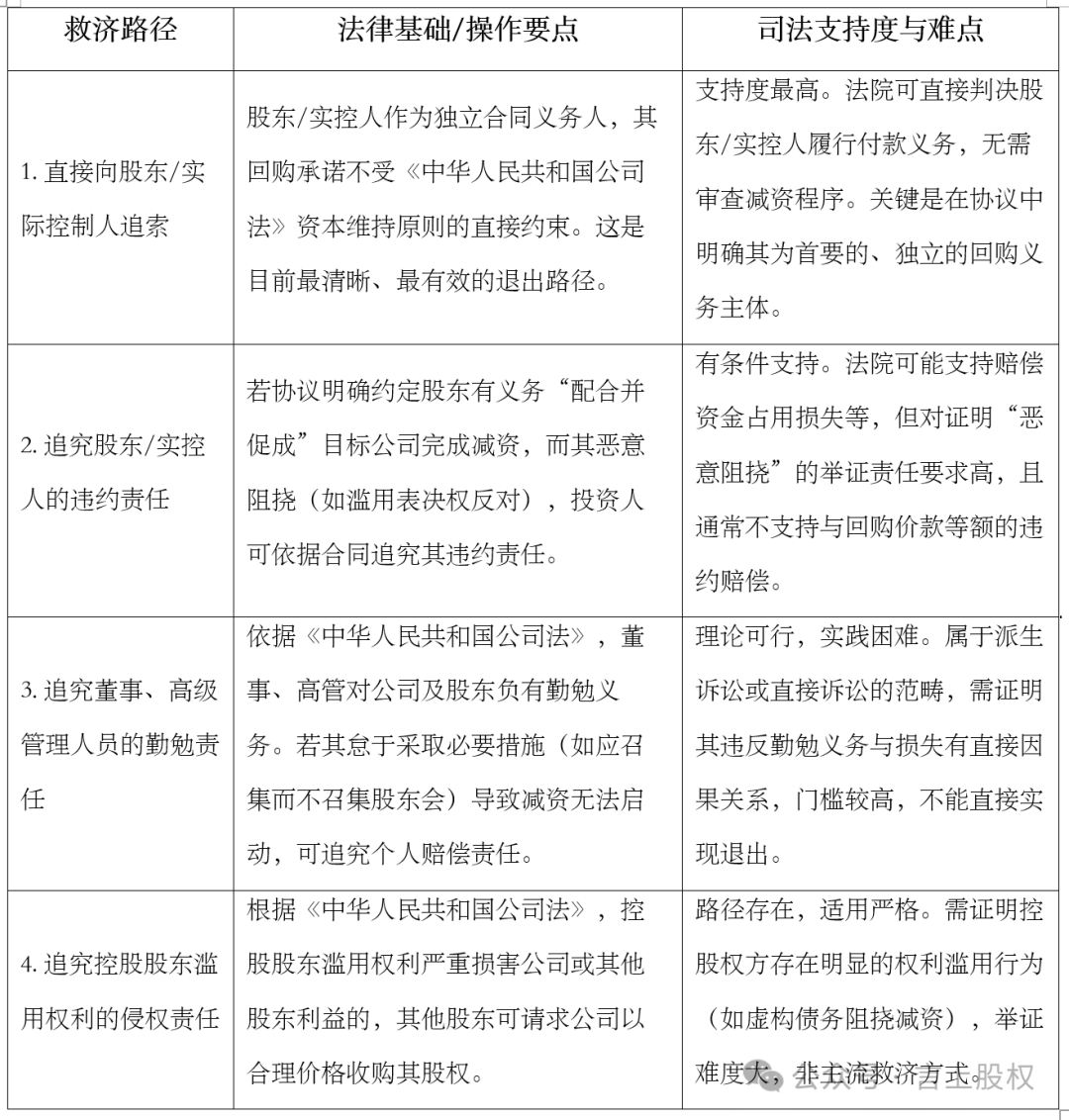
A noteworthy recent judicial development is the strengthening of the independent liability of guarantors. In cases such as (2023) Hu 02 Min Zhong No. 12817, the court clearly pointed out that the target company’s (as principal debtor) “temporary impossibility of performance” of the repurchase obligation due to failure to complete capital reduction does not affect the independent guarantee liability borne by the shareholder (founder) providing joint and several guarantee. This closes the path by which a guarantor might try to escape liability by relying on the company’s performance obstacle, providing investors with an additional layer of protection.
(4) Practical strategy: front-end optimization of agreement design and dispute resolution strategy
To address the above dilemma, ex ante agreement design and ex post dispute resolution strategy are crucial.
1. Agreement architecture design: A tiered liability structure of “shareholder/actual controller liability as the primary obligation, target company obligation as supplementary” must be established. The most core clause should be: when the repurchase conditions are triggered, the controlling shareholder/actual controller bears the primary and direct obligation to purchase the equity in cash; at the same time, it should be agreed that the target company bears the payment obligation after completing the capital reduction procedure, and that all shareholders (especially the founding shareholders) bear an irrevocable obligation to cooperate in voting.
2. Dispute resolution strategy:
(1) Accurately naming defendants in litigation: Shareholders/actual controllers should be named as the first-priority defendants bearing the repurchase payment obligation, and the target company should be named as a defendant bearing a cooperation obligation or supplementary liability.
(2) Differentiated consideration of arbitration: Some commercial arbitration institutions, while respecting mandatory legal provisions, may be more flexible than courts and sometimes provide more enforceable solutions by holding shareholders liable or setting an order of performance. It should be noted, however, that arbitral awards remain subject to judicial review, and solutions that circumvent the capital reduction procedure risk being set aside or refused enforcement.
(3) Evidence preservation: After a dispute arises, the investor should formally request the target company by written letter and other means to convene a shareholders’ meeting to consider the capital reduction matter, expressly state its approval, and thereby preserve evidence of the counterparty’s “non-cooperation,” providing a basis for pursuing liability for breach.
In summary, the adjudicative trend from 2020 to 2026 regarding performance obstacles in share buyback VAMs clearly shows the characteristics of “rigidification of the procedural gate and outward shift of remedial paths.” Protection of investors’ lawful rights and interests no longer depends on a direct claim against the target company, but on whether the agreement contains clear and rigid personal liability clauses for shareholders/actual controllers, and on whether complete contingency plans are prepared for pursuing other relevant parties’ liability for breach or tort when internal procedures are blocked. This trend forces both investors and financing parties, at the front end of the transaction, to allocate and respond to the risk of future “performance deadlocks” through more prudent clause design.
V. Conclusion
Looking across the judicial practice from the Haifu case to the Jiumin Minutes and on to the present, the adjudicative logic of VAM agreements has completely departed from the simplistic “black-or-white” approach and entered the refined deep-water zone of “validity belongs to validity, performance belongs to performance.”
One reality that cannot be ignored is this: before the insurmountable red line of the “capital maintenance principle,” the investor’s direct claim against the target company has been fitted with rigid “procedural shackles.” “Capital reduction procedure” and “profit distribution” have become two iron gates, shutting a large number of investors who otherwise held winning hands out from real money. This also means that trying to lock down risk solely through a clause “betting with the company” has become a thing of the past.
In the second half of VAM disputes, what matters is a transaction structure built on “preparing for a rainy day” and litigation strategy that “responds to each move as it comes.” For investors, the focus of risk control must be moved forward: build a tiered defense line of “shareholder/actual controller liability as the primary obligation, target company obligation as supplementary,” and secure the counterparty’s obligation to cooperate in voting. For financing parties, they must respect the contract, abandon reliance on the path of “reducing liquidated damages,” and carefully assess the extreme commercial consequences before signing.
In this business arena full of uncertainty, the best “bet” is not to hope for ex post judicial relief, but to nail future risks firmly within a compliant framework through rigorous clauses at the very moment of signing. After all, only by respecting the rules can one go steadily and far.
Contact Lawyer
Submit your contact details and consultation question. We will follow up ASAP.