
A Study on Criminal Involvement of the "Three Village Cadres" and Risk Prevention Measures
A Study on Criminal Involvement of the "Three Village Cadres" and Risk Prevention Measures
Lawyers Chen Gonghui and Chen Wentao take the "three village cadres" as the core research object, and, in light of recent criminal statistics, analyze the prominent manifestations, causes, and preventive measures of village officials' involvement in crimes. Currently, such crimes are highly correlated with official positions, exhibiting characteristics such as "interweaving of red and black," clan interest alliances, and profiteering around government projects and subsidies. The main causes include weak awareness of the rule of law and financial norms, the lingering influence of clan-based thinking, lagging legal aid in rural areas, and supervisory vacuums at the grassroots level. Accordingly, the article proposes strengthening legal education and financial disclosure auditing, maintaining a high-pressure anti-corruption stance to break dependency on personal connections, accelerating the construction of rural legal aid and compliance guidance, and implementing multi-level and three-dimensional oversight mechanisms. Finally, it suggests that village officials enhance risk compliance awareness, conduct self-inspections and corrections as early as possible, and promptly engage professional lawyers when facing criminal risks.
Abstract
With the proposal of the rural revitalization strategy and the implementation of supervisory functions extending to the village level, village committee cadres should also find their proper positioning in the overall development picture. While serving as good representatives of the villagers, they must also lead by example and rectify village customs. This article, based on criminal statistics concerning the “three village cadres,” briefly discusses the phenomenon and causes of village officials’ crimes, and then proposes targeted risk response measures. Village officials should pay attention to their own risks, especially criminal risks, conduct compliance self-inspections as early as possible, and when necessary, involve lawyers in a timely manner to help safeguard their legitimate rights and interests.
Keywords Village officials; Crime; Criminal risk and response
I. Introduction
On December 3, 2020, China achieved a decisive victory in poverty alleviation. While consolidating the achievements of poverty alleviation, the focus of the Party and government work has gradually shifted from “agriculture, rural areas, and farmers” to the comprehensive implementation of the rural revitalization strategy. Rural revitalization is not only about economic development but also about the coordinated development of politics, culture, spiritual civilization, and other aspects. A law-based countryside with orderly rules and integrated planning is an important guarantee for rural development. Article 48 of the Rural Revitalization Promotion Law of the People’s Republic of China, which came into effect on June 1, 2021, also stipulates: “Local people’s governments at all levels shall strengthen the construction of grassroots law enforcement teams, encourage township people’s governments to establish legal advisers and public lawyers as needed, encourage qualified places to establish public legal service studios in villagers’ committees, deeply carry out legal publicity, education, and people’s mediation work, improve the mechanism for mediating and resolving rural conflicts and disputes, and promote the construction of a law-based countryside.”
Policy directives emphasize strengthening rural legal construction, with particular attention to the leading role of village officials. However, in recent years, village officials have faced increased risks of being investigated, disciplined, or even involved in criminal offenses by the Party. This is due to both external factors such as the overlap of rural Party and government mechanisms, chaotic financial management systems, and scarce legal resources, and internal factors such as the village officials’ own weak legal awareness and insufficient risk resistance capabilities. In view of this, the report of the 20th National Congress of the Communist Party of China on October 16, 2022 pointed out: “Discipline inspection and supervision organs must fulfill their basic and primary duties of supervision, promote the comprehensive and strict governance of the Party to the grassroots level, make every effort to break through the ‘last kilometer’ of grassroots supervision, extend the tentacles of supervision, and activate the ‘peripheral nerves.’”[1] With supervision reaching the grassroots, village officials urgently need to engage in self-reflection.
In the overall context of the rural revitalization strategy and the trend of extending supervision downward, strengthening risk vigilance, improving risk identification capabilities, and cultivating risk response skills are professional courses that every village official needs to study diligently.
II. Preliminary Statistics on Village Officials’ Criminal Involvement
(A) Who are Village Officials?
Village officials generally refer to members of the two committees, i.e., the village Party branch committee and the villagers’ committee. However, looking at the data, the positions of village officials involved in criminal cases are mostly concentrated among the “three village cadres”: the village Party branch secretary, the villagers’ committee director, and the village accountant, accounting for over 80% of criminal cases. The “three village cadres” often take advantage of their official positions, either colluding with each other or co-opting other village cadres, to gain strength in numbers and reduce the risk of exposure. Therefore, the village officials in the data statistics of this article primarily refer to the “three village cadres.”
(B) Overview of Data on Village Officials’ Crimes
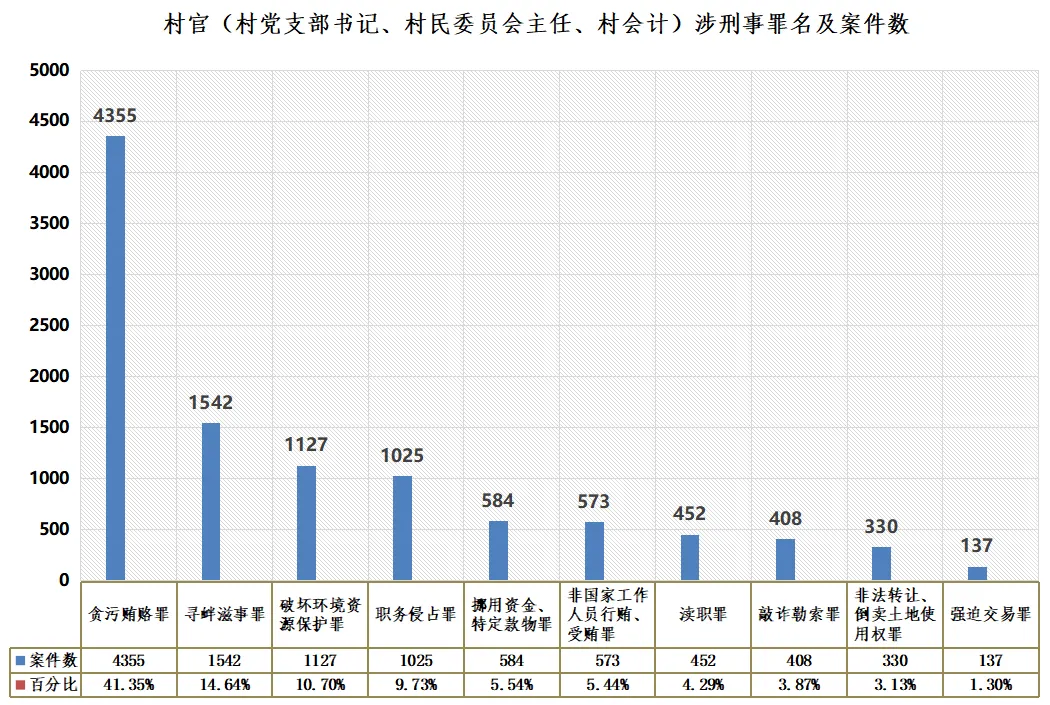
The chart shows the top ten criminal charges involving village officials (village Party branch secretaries, villagers’ committee directors, and village accountants) over the past five years, with data sourced from Alpha statistics. As can be seen from the chart, except for the crimes of picking quarrels and provoking trouble, extortion, and forced transactions, the other seven types of crimes are all related to the official positions of village officials, accounting for 78%. Among these, corruption and bribery crimes constitute the hardest-hit area, accounting for more than half of the duty-related crimes, with an involvement rate as high as 41%.
III. Analysis of the Phenomenon of Village Officials’ Crimes
(A) “Interweaving of Red and Black”
“Interweaving of red and black” manifests in two forms: one is “from red to black,” meaning a village official becomes the head of an organized crime syndicate; the other is “from black to red,” meaning the head of an organized crime syndicate is packaged as a village official. This distinction also has significant regional characteristics: economically developed urban-rural fringe areas, economically underdeveloped villages, and urban villages.
1. “A Business That Can’t Lose Money”
Being elected as a village official is seen as a business venture. This situation often occurs in economically developed urban-rural fringe areas, where village officials mostly undergo “from red to black.” Because these areas are the preferred sites for government development, there are often matters accompanied by government compensation, such as land expropriation, returning farmland to forest, demolition and renovation, etc. The economic interests involved are sufficient to make “perceptive” individuals covet the position of village official in that area. There are candidates who make early investments, using various benefits to win over government officials and villagers, just to obtain “expected returns” from government subsidies or villagers’ bribes after taking office. There are also villagers who have become wealthy through migrant work and wish to get a share of the pie or “return home in glory.” Since they lack deep-rooted connections in the village, they often collect information on various illegal and disciplinary issues of candidates and incumbent committee members and report them to government departments at all levels. Village officials in such areas are more often suspected of accepting bribes, embezzlement, abuse of power for personal gain, extortion, etc.
2. “The Mountains Are High and the Emperor Is Far Away”
This situation often occurs in economically underdeveloped villages, where some village officials undergo “from black to red.” According to case observations, in economically underdeveloped areas, village revenue often comes from “prostitution, gambling, and drugs,” such as operating brothels under the cover of the village, setting up gambling dens, or the entire village manufacturing gun parts or producing drugs.[2] Most of these acts require the control of the entire village by criminal forces; thus, it becomes logical for the heads of such forces to be packaged as village officials through power struggles. Village officials in these areas are more often suspected of picking quarrels and provoking trouble, personal injury, extortion, drug trafficking, running gambling dens, etc.
3. “This Road Was Opened by Me”
This situation often occurs in villages with monopoly over resources or industries, where village officials exhibit “interweaving of red and black.” Examples include the monopoly over the southern tea market, the monopoly of raw material supply for Shaxian snacks, the monopoly of sand mining rights, and deep control over non-agricultural collective land. Among these, there are cases where village officials, after taking office, took a wrong path in trying to enrich the village, and cases where heads of criminal forces, after being packaged as village officials, used their authority to monopolize resources and support the criminal forces. To monopolize resources, they organize villagers to clash with outsiders, threaten and intimidate to drive away external competitors, and forcefully seize property at low prices. Village officials in these areas are more often suspected of picking quarrels and provoking trouble, assembling crowds for brawls, forced transactions, illegal mining, illegal logging, etc.
Before the revision of the Organic Law of the Villagers’ Committees of the People’s Republic of China in 2018, villagers’ committees held elections every three years. With interests at stake, various forces—villagers living in the village, incumbent two-committee members seeking re-election, and local people who have worked outside—all participated in the fierce competition. In elections, there were letters of complaint sent to government departments at all levels; people delivering rice, oil, and money door-to-door and collecting ballots; hired thugs threatening the personal safety of candidates; rivals’ houses being painted with paint or set on fire; and people gathering large numbers of social members, dressing in mourning clothes at the election venue on voting day, and parking ambulances at the election site. Therefore, village officials’ crimes also have a periodic characteristic centered around elections.
(B) “More People Make Things Easier”
Village officials elected through elections necessarily have a certain mass base. Therefore, when a village official is involved in a crime, it inevitably “pulls up the radish and brings out the mud” — implicating others. The group nature of village officials’ crimes is mainly reflected in two aspects: the influence of clan forces and the construction of interest groups.
1. Influence of Clan Forces
In rural areas, clan thinking is still deeply entrenched. Some seek to “inherit” the position of village official by having incumbent two-committee members use their influence or authority to manipulate elections. Some villagers, after committing crimes, rely on the official powers of family members serving on the two committees to conceal and shield each other, creating obstacles for investigation and inspection. In some rural areas with simple folk customs, villagers have close relationships and are accustomed to uniting against outsiders. When a person of prestige, such as a village official or township head, calls on everyone “to show support” or “to defend the village’s interests,” it often results in a scene of “a signal arrow in the sky, thousands of horses and troops coming to meet.”
2. Constructing Interest Groups
Constructing interest groups and forming alliances to resist supervision is a distortion of the concepts of “the law cannot punish the majority” and “everyone who sees gets a share, sharing the same boat through storm and stress.” For example, some village officials with a low level of legal knowledge believe that as long as enough people commit a crime, it becomes a “get-out-of-jail-free card” and the law cannot hold individuals accountable. Additionally, some village officials use their official positions to co-opt other two-committee staff, distributing spoils fairly, so that everyone knows each other’s dirty secrets and forms an “interest alliance” to jointly resist inspections.
(C) “Pie in the Sky” Turning into “Trap”
For villages, government-initiated projects such as land expropriation and renovation, agricultural benefit and poverty alleviation projects, and production resource contracting projects are often accompanied by compensation for land acquisition and demolition, cultivated land occupation tax, compensation for returning farmland to forest, and agricultural benefit and poverty alleviation funds, which are like “a pie falling from the sky.” Faced with such “fat meat,” some village officials cannot resist temptation, turning the “pie” into a “trap” leading to imprisonment.
Regarding power: “Seeking rent” for power, actively contacting developers to invest in the village and demanding kickbacks[3]; those who do not pay kickbacks will inevitably face重重阻挠 from villagers.
Regarding money: Either instructing the village accountant to issue false invoices to balance the village accounts, defrauding demolition compensation and cultivated land occupation tax; or directly misappropriating public funds for personal use or investment; or setting up a “small treasury,” treating the public account as an ATM without keeping records.
Regarding matters: Either using the influence of the village official to gather villagers to set up roadblocks for external enterprises, destroying roads to prevent transportation vehicles from entering and exiting, forcing them to pay an “entry fee,” or forcing external enterprises to subcontract part of the project to local village enterprises; or accepting bribes to falsely report the subsidy area of the briber, or including the briber’s land in the scope of returning farmland to forest, helping the briber defraud state subsidies, etc.
IV. Analysis of the Causes of Village Officials’ Crimes
(A) Weak Legal Awareness
Village-level cadres receive relatively little anti-corruption education and legal education, resulting in weaker willpower to resist temptation or weaker ability to identify illegal activities. Examples include misappropriating funds for investment or temporary turnover, using public funds for dining, entertainment, and personal favors, organizing the masses to “advance and retreat together” for the village’s interests, using money to buy votes or forming cliques to intimidate for re-election, and using authority to extort or coerce submission. According to the “old-timers’” customs or the common views or practices of people around them, some behaviors of village officials are considered habitual and unremarkable, but they are precisely illegal and disciplinary violations. Weak legal awareness prevents some village officials from correctly understanding their own actions.
(B) Weak Awareness of Norms
Systems related to financial transparency and democratic financial management have not been fully implemented, existing only in name. There are also a small number of village officials who treat village finances with a “family finance” mentality, making decisions alone without democratic management or financial disclosure. Additionally, a few village cadres have unclear boundaries of responsibilities, often overstepping their authority, such as the village accountant managing both accounts and money, and village cadres approving and spending money. Some village officials, due to ignorance of legal systems and corresponding legal procedures, directly withhold village funds, mixing personal accounts with village accounts, causing financial chaos.
(C) The Lingering “Use Relationships” Mentality
When some villagers become village officials, they consider it a matter of social obligation to repay their family. Therefore, after taking office, they dilute their sense of public service, allowing family interests to blind them. They often act as family representatives, helping handle family affairs and striving to obtain benefits for the family. Additionally, influenced by the thinking of the older generation or former village officials, they believe that getting things done requires money and connections. This faith in money as a path to success reflects a lack of government credibility and the continued dominance of official-standard thinking.
(D) Lag in Rural Legal Construction
1. Absence of Legal Aid
Insufficient publicity results in low awareness of the legal aid system among rural groups. Most people believe that as long as they “follow the old rules” or do not break the law, the law has nothing to do with them. They rarely participate in or pay attention to relevant legal popularization lectures or “lawyer clinics in the countryside” consultation activities. Their own legal capabilities are insufficient, and external legal training has not improved. When encountering legal problems, they do not understand legal principles, forming a closed loop: when their legitimate rights and interests are violated or they are unsure whether their actions are legal, they either take illegal actions to protect their interests or continue such illegal behavior.
2. Lack of Government Support
Whether it is cultivating “legal aware” people in rural areas, inviting law firm lawyers to hold “clinics in the countryside,” conducting free and universal legal aid, or appropriately and specifically reducing excessive litigation costs for rural members, all require government provision of venues, policy guidance, financial subsidies, etc. Although this is also a livelihood project, the government mostly incurs pure expenditure on this item, making it difficult to form a healthy revenue return. This puts pressure on the already scarce local financial resources. Under the theme of prioritizing the economy and ensuring people’s livelihood, out of economic considerations, there is significant room for improvement in the government’s emphasis on rural legal issues.
3. Defects in Problem Resolution
Due to unfamiliarity with relevant legal procedures and habitual tendencies, some village officials adopt simplistic and crude methods of problem-solving. Their way of thinking about issues is often based on past practices or personal feelings, with insufficient knowledge reserves and rich experience to cite legal provisions and resolve disputes in a reasoned and evidence-based manner. Judging based on personal perception can easily lead to unfair and unequal decisions, easily infringing on villagers’ legitimate rights and interests, and may also lead village officials into danger due to improper operation.
(E) Substantive Supervision Becomes a Formality
Currently, the management of village cadres is roughly as follows: organizational departments manage Party building, civil affairs departments manage elections, township finance manages collective assets and off-office auditing, township governments provide work guidance, disciplinary inspection and supervision departments handle disciplinary and legal violations, and public security handles criminal cases[4]. The supervision duties that should be performed by disciplinary inspection and supervision are hampered by insufficient rural personnel and buck-passing among multiple departments, resulting in an attitude of “no action unless reported” towards village cadres’ disciplinary and legal violations. When villagers wish to exercise their supervisory rights, they are often ignored due to their low status, and the混乱 of village affairs accounts and meeting records prevents them from collecting sufficient evidence, leading to ineffective reports. Those who have the power to manage do not want to manage; those who want to manage do not have the ability to manage. Eventually, the village committee gradually becomes a “one-man show,” and supervision becomes a mere formality.
V. Countermeasures and Suggestions
(A) Enhance Legal Awareness
Strengthen ideological education and legal education for village cadres. By strengthening education on ideals, beliefs, Party discipline, and laws and regulations, enhance village cadres’ awareness of governing according to law and self-discipline integrity. Through case-based explanations of legal procedures and setting up negative examples, educate and admonish village cadres, making them accept the warning of “don’t reach out your hand.” Through government-organized targeted legal lectures, sending legal knowledge to the countryside, legal knowledge competitions, and other activities, let village cadres receive legal shaping to improve legal awareness.
(B) Strengthen Awareness of Norms
Strengthen and implement existing financial systems such as financial accounting, financial personnel arrangements, financial approval, and financial disclosure. For issues where village cadres are prone to mistakes and which are frequently reported by the masses, promptly formulate effective and targeted rules and regulations. In addition, through regular audits to check financial conditions and making village affairs and finances transparent and public, enhance village cadres’ normative thinking, acting according to authority, rules, and procedures.
(C) Eradicate the “Relationship” Mentality
Fully leverage the punitive and preventive roles of crime fighting. For verified disciplinary and legal violation cases involving village cadres, deal with them seriously, implementing the “three no’s” principle of case handling: no cover-up, no protection, no疏通. For other potential factors, through strong and consistent打击, create deterrence, making other village cadres lead by example and strictly self-discipline. Then, through case-based explanations, encourage the masses to report disciplinary and legal violation cases, subjecting village cadres to public supervision. In addition, expand the scope of legal aid, enabling everyone to have access to and understand the law, avoiding the old path of relying on relationships.
(D) Accelerate Legal Construction
Increase publicity efforts and innovate publicity methods. By collecting and analyzing the legal relationships in matters occurring in the village, villagers and village cadres can personally feel the importance of the law, and it can also address the legal pain points in the village, increasing attention, so that publicity and education are no longer treated as “something that doesn’t concern me.”
The government should establish legal aid associations. With a long-term perspective, on the one hand, invite lawyers from law firms to hold “clinics in the countryside” to answer legal questions for villagers; on the other hand, improve the talent security system, including引进 or inviting law school graduates to participate in legal aid work to accumulate practical experience, and cultivating local legal talent, selecting villagers who are enthusiastic about the law and village affairs, providing targeted subsidies for training in areas such as marriage law, labor law, and other village-related content, then incorporating them into local legal aid stations to help villagers solve some legal issues or邻里 disputes.
Guide compliant handling of matters. Reduce simplistic and crude governance, guide village cadres to actively learn legal knowledge and familiarize themselves with the compliance processes for handling affairs and governing, shape good governance concepts, and cultivate rational compliance dialectical thinking.
(E) Ensure Supervision Implementation
For Party members and cadres, Party organizations and disciplinary inspection departments should supervise, focusing on improving Party conduct and avoiding formalism. For non-Party cadres, implement the relevant provisions of the Supervision Law, establishing supervision commissions at the county level for supervision by the supervision commission. For township areas, supervision commissions at all levels can flexibly choose to dispatch or assign supervision agencies or supervisors to their administrative areas. To enable villagers to exercise their supervisory rights, establish “information sentinels” by introducing retired cadres, college-graduate village officials, and rural Party members who are disinterested third parties with high awareness, as grassroots “eyes,” ensuring that villagers have channels to communicate upward and are not left without recourse.
VI. Conclusion
Do not use power outside the rules; do not covet money beyond your sight; do not commit minor evils beyond the bottom line; do not cultivate hobbies harmful to health. In other words, controlling desires and controlling power is the absolute firewall that village officials set for themselves, and is the best magic weapon for self-preservation.
Village officials should conduct risk compliance as early as possible, promptly自我检查 whether their own actions are illegal or disciplinary, and remedy and resolve them in time. When personally involved in criminal offenses, they should also seek professional legal assistance as soon as possible, making full use of the maximum 37 days from the public security organ’s detention to the procuratorate’s approval of arrest, allowing lawyers to help safeguard their legitimate rights and interests.
[1] Cao Xiaoguang: “Activating the Peripheral Nerves of Grassroots Supervision,” China Discipline Inspection and Supervision News, November 24, 2022, Theoretical Weekly, 6th edition.
[2] Zhang Wei: “The ‘Red’ and ‘Black’ of Village Officials: The Truth Behind 146 Samples of Rural Criminal Forces,” Shenlan Finance Website, http://www.mycaijing.com.cn/news/2014/08/07/7562.html, August 7, 2014.
[3] Feng Shaolin: “Research on Economic Crimes of Village Cadres in the Process of Urban Village Reconstruction — Starting from a Case of Village Cadre Bribery Tried by Our Court,” Jinyuan District People’s Court, Taiyuan.
[4] Liu Aijun: “Analysis of the Characteristics, Causes, and Countermeasures of Current Disciplinary and Legal Violations by Village Cadres,” Xunyang Municipal People’s Government Website, March 16, 2015.
Contact Lawyer
Submit your contact details and consultation question. We will follow up ASAP.