
Technical Secrets vs. Patents: Which Path Should Corporate IP Protection Strategy Take?
Technical Secrets vs. Patents: Which Path Should Corporate IP Protection Strategy Take?
Attorney Guo Shuai systematically compares the similarities and differences between technical secrets and patents in intellectual property strategy. The article first defines the legal concepts and constitutive elements of trade secrets and technical secrets, and outlines the full lifecycle of patent application, grant, validation, and enforcement. On this basis, it conducts an in-depth analysis of the differences between the two from four stages: right formation, confirmation, exercise, and infringement defense. Patents exchange technical disclosure for a limited monopoly, emphasizing novelty, inventiveness, and practical applicability, with validation dominated by administrative authorities, and infringement determined by the all-elements rule. Technical secrets focus on confidentiality measures and continuous protection, with validation relying on judicial proceedings and a partial shift in the burden of proof, and infringement determined by the standard of substantive identity of technical solutions. The conclusion points out that although the protection period of technical secrets is indefinite, enterprises have stronger control and higher manageability; enterprises should flexibly formulate a combination or selection strategy of patents and technical secrets based on the characteristics of core technologies and market competition needs, so as to maximize the protection of innovation achievements.
Abstract:
With the rapid increase in patent applications, patents are no longer unfamiliar to enterprises. Companies have been able to timely transform research and development achievements into patent rights, and both macro policy levels and enterprises themselves advocate patent applications. Some enterprises, relying on their accumulated technical strength, have become “invisible champions” or even world leaders in certain niche industries. In addition, with the increasing number of cases involving technical secrets in recent years, where should enterprises’ intellectual property protection strategies head?
I. Concepts of Trade Secrets and Technical Secrets
Article 9, Paragraph 4 of the Anti-Unfair Competition Law (hereinafter referred to as the “Anti-Unfair Competition Law”) stipulates that trade secrets refer to technical information, business information, and other commercial information that is not known to the public, has commercial value, and for which the rights holder has taken appropriate confidentiality measures [1]. Trade secrets are characterized by secrecy, value, and confidentiality.
Article 3 of the Provisions of the Supreme People’s Court on Several Issues Concerning the Application of Law in the Trial of Civil Cases Involving Infringement of Trade Secrets (hereinafter referred to as the “Trade Secret Provisions”) stipulates:
Where the information for which the rights holder seeks protection is not generally known or readily accessible to relevant personnel in the field at the time of the alleged infringing act, the people’s court shall determine that it constitutes information not known to the public as referred to in Article 9, Paragraph 4 of the Anti-Unfair Competition Law [2].
For example, if the information is common knowledge or industry practice in the relevant field, or has been publicly disclosed through publications or other media, it lacks secrecy.
Article 7, Paragraph 1 of the Trade Secret Provisions stipulates:
Where the information for which the rights holder seeks protection has actual or potential commercial value because it is not known to the public, the people’s court may, upon review, determine that it has commercial value as referred to in Article 9, Paragraph 4 of the Anti-Unfair Competition Law [2].
This value may be actual or potential and can bring economic benefits or competitive advantages to the rights holder.
Article 5, Paragraph 1 of the Trade Secret Provisions stipulates:
Where the rights holder takes reasonable confidentiality measures before the alleged infringing act to prevent the disclosure of the trade secret, the people’s court shall determine that such measures constitute the corresponding confidentiality measures referred to in Article 9, Paragraph 4 of the Anti-Unfair Competition Law [2].
These measures include but are not limited to signing confidentiality agreements, imposing confidentiality requirements through internal regulations, managing confidential premises, and encrypting electronic devices. For example, where the rights holder takes reasonable confidentiality measures before the alleged infringing act to prevent the disclosure of the trade secret, the people’s court shall determine that such measures constitute corresponding confidentiality measures.
Technical secrets are an important type of trade secret, but they are not entirely identical concepts. Trade secrets have a broader scope, encompassing not only technical information but also business information and management information. For example, business information such as customers’ transaction habits, intentions, and content may also constitute trade secrets. Technical secrets focus specifically on the technical field, involving specific technical solutions and process flows.
Article 1, Paragraph 1 of the Trade Secret Provisions stipulates that information related to technology, such as structures, raw materials, components, formulas, materials, samples, styles, plant新品种 propagation materials, processes, methods or steps thereof, algorithms, data, computer programs, and related documents, may be determined by the people’s court to constitute technical information as referred to in Article 9, Paragraph 4 of the Anti-Unfair Competition Law [2].
The book Trade Secret Enforcement Guide: Dilemmas and Solutions defines technical secrets as:
“For successfully developed technical information, the technical ‘points of secret’ for which the rights holder seeks trade secret protection should constitute a complete technical solution” [4].
By defining technical secrets as a technical solution, this argument establishes a bridge between technical secrets and patents.
II. Content of Patent Application, Grant, Validation, and Enforcement
Patents are also a form of intellectual property. The full lifecycle of a patent includes four main stages: application, grant, validation, and enforcement. The following is a brief discussion of these four stages:
Patent Application: Enterprises continuously innovate in technology during research and development to gain a market advantage for their products and maximize commercial profits. To prevent competitors from copying and to enjoy a certain monopoly position, enterprises must transform their developed technologies into patent rights and seek legal protection. Enterprises invest continuously in research and development, encouraging R&D personnel to innovate constantly. In the course of innovation, technical solutions that solve technical problems are converted into patent application documents and submitted to the China National Intellectual Property Administration (CNIPA).
Patent Grant: The application documents submitted to the patent office are examined to confirm that the invention meets the conditions stipulated in the Patent Law, and a patent right is granted. Inventions particularly need to satisfy the three basic conditions of novelty, inventiveness, and practical applicability, as well as important provisions such as clarity, sufficient disclosure, and essential technical features. After examination, the patent office grants the patent right and issues a patent certificate.
Patent Validation: After a patent is granted, to ensure the stability of the patent right, any entity or individual that believes the grant does not comply with the relevant provisions of the Patent Law may request the Patent Reexamination and Invalidation Department to declare the patent right invalid. The validation procedure is a re-confirmation of the stability of the patent right and the scope of protection.
Patent Enforcement: To protect the legitimate rights and interests of the patentee and prevent others from using the patented technology without authorization, the patentee may take legal measures, such as civil litigation or administrative complaints, to stop the infringement.
The entire lifecycle of a patent is a complex process involving legal, technical, and economic factors. The patentee must take corresponding measures at each stage of application, grant, validation, and enforcement to ensure effective protection of their invention.
III. Comparative Analysis of Technical Secrets and Patents by Stages
Stage One: Formation of Rights
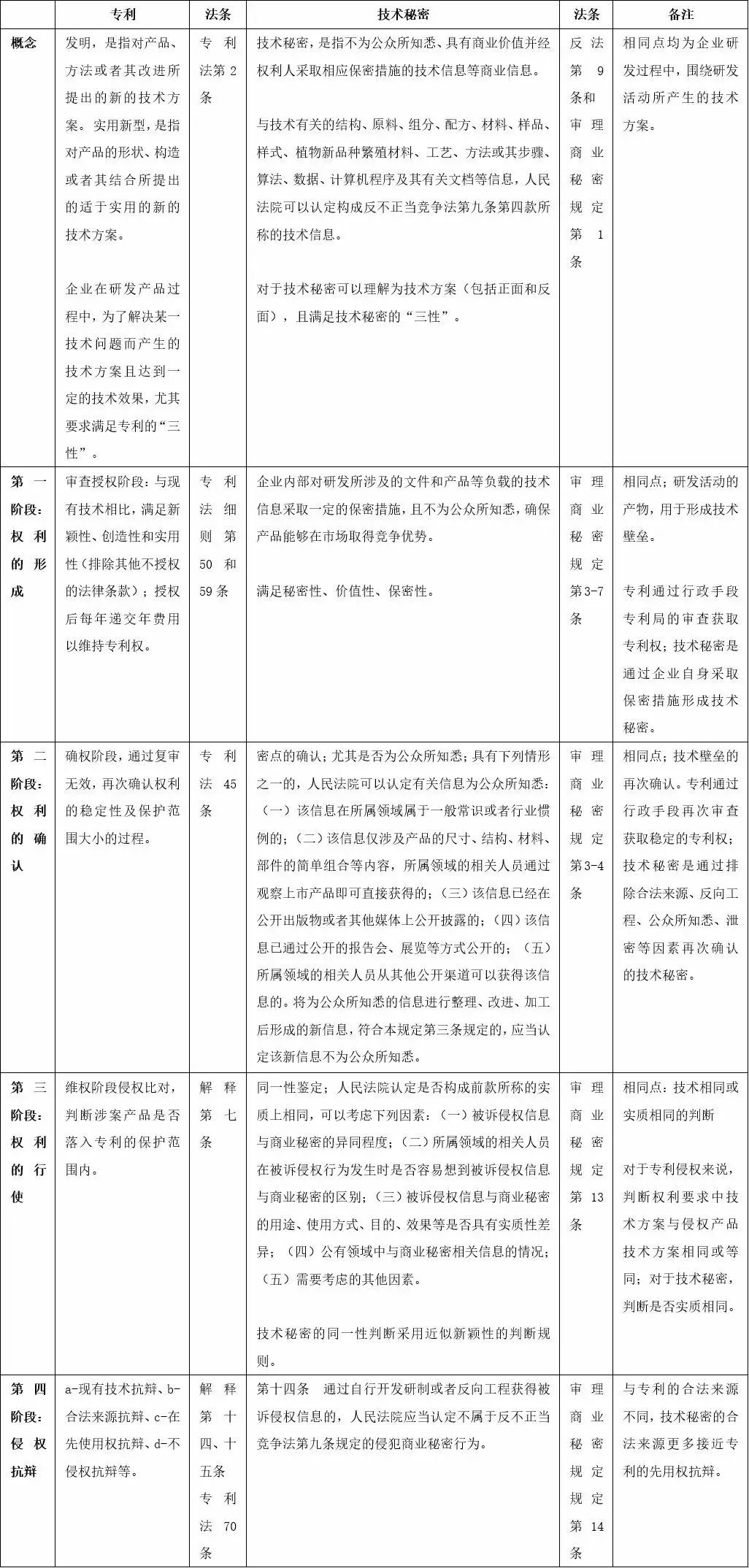
Based on a brief analysis of technical secrets and patents, it is evident that for enterprises, both belong to intellectual property, are inseparable from R&D activities, and can be understood as products of R&D. However, there are also differences between the two.
A patent is a successfully developed technical solution that meets certain conditions. It requires not only that the technical solution is clear and fully disclosed but also that it possesses the three patentability criteria (practical applicability, novelty, inventiveness). The patent applicant obtains the grant after applying to and being examined by the administrative authority, exchanging the disclosure of the technical solution for protection, and enjoying a monopoly for a limited period to compensate for prior R&D costs.
Technical secrets, on the other hand, include both successful and failed R&D solutions, and their scope is broader than that of patents. Although technical secrets also need to meet certain conditions, these conditions are entirely different from those for patents: technical secrets mainly need to satisfy the three characteristics (secrecy, value, confidentiality), with no requirement for the advancement of the technical solution. Technical secrets rely more on the enterprise’s own implementation of confidentiality measures to form an impenetrable protective wall. Their protection is indefinite, but over time and with technological development, once the technical threshold is surpassed and becomes publicly known, protection ends.
Therefore, the origin of patents and technical secrets is the same, but their technical paths are parallel—one is a visible line, the other an invisible line. For the enterprise, a choice of protection strategy must be made at the early stage of right generation.
Stage Two: Confirmation of Rights
Whether the formed rights can be used for enforcement requires further confirmation.
For patents, the confirmation of patent rights lies with the Patent Reexamination and Invalidation Department of the CNIPA. From the date of patent grant, any entity or individual that believes the grant does not comply with the relevant provisions of the Patent Law may request the patent administrative department of the State Council to declare the patent right invalid. The grounds for patent invalidation are mostly related to the three patentability criteria (practical applicability, novelty, inventiveness) and provisions such as lack of clarity, insufficient disclosure, and lack of essential features. The validation procedure further confirms whether the patent right is stable and the scope of protection.
For technical secrets, the confirmation of technical points of secret lies with the court. Through the tripartite process of prosecution, defense, and adjudication, the technical points of secret are further confirmed, mainly focusing on the three characteristics of technical secrets: secrecy, value, and confidentiality, especially secrecy and confidentiality. According to Article 32, Paragraph 1 of the newly amended Anti-Unfair Competition Law:
“In civil trial procedures for infringement of trade secrets, where the holder of the trade secret provides preliminary evidence proving that it has taken confidentiality measures for the claimed trade secret and reasonably indicates that the trade secret has been infringed, the alleged infringer shall prove that the trade secret claimed by the rights holder does not fall within the trade secrets defined by this Law.”
The burden of proof falls more on the defendant. Based on the defendant’s evidence, the court examines whether the technical points of secret are publicly known, further confirming whether the rights holder enjoys rights over the technical points of secret.
Stage Three: Exercise of Rights
After confirmation, the rights holder has the legal right to protect their interests when infringement occurs. For the patentee, to prove that the infringing product falls within the scope of protection of their patent, the all-elements rule is applied to determine whether the infringement is established. For technical secrets, the essence is to determine whether the technical solutions are substantially identical. The view in the aforementioned book is as follows:
“In the enforcement of technical secrets, the determination of ‘identity’ of a successfully developed technical solution should adopt the judgment method and standard for the same technical solution in the novelty determination of patent claims as provided in the Guidelines for Patent Examination.” [4]
According to the author’s understanding, the novelty standard is too strict, while the inventiveness standard is too lenient. The appropriate standard should fall between the two, including a subset with the novelty endpoint value. The mathematical expression is [novelty, inventiveness), and the inventiveness endpoint value is at most limited to a single X-type document. Based on this standard, it is determined whether the infringement is established.
Stage Four: Infringement Defenses
When facing infringement allegations, the defendant may use reasonable arguments and evidence to argue that their actions do not constitute infringement. Legal defenses are the process of opposing the rights holder’s claim for performance and explaining the reasons. In patent infringement litigation, defenses are set forth in the Interpretation of the Supreme People’s Court on Several Issues Concerning the Application of Law in the Trial of Patent Infringement Dispute Cases (hereinafter referred to as the “Interpretation”), which mainly include prior art or prior design defenses, lawful source defenses, prior use rights defenses, and non-infringement defenses [3]. In technical secret infringement litigation, defenses mainly include lawful source defenses and identity defenses regarding technical points of secret. Here, lawful source mainly refers to “obtaining the alleged infringing information through independent development or reverse engineering.” Unlike lawful source defenses in patents, lawful source defenses in technical secrets are closer to prior use rights defenses in patents, but they do not emphasize the time sequence as much; rather, they focus on the source of the technology itself. Non-infringement defenses are similar to identity defenses, following the same logic as in Stage Three.
IV. Conclusion
Technical secrets and patents share many similarities but also have numerous differences. This article summarizes the distinctions and connections between patents and technical secrets in terms of concepts and the three characteristics, as well as the differences and connections between prior art and public knowledge, the all-elements rule for patents and the identity of technical secrets, prior art defenses and reverse engineering, etc., further extending the logic of patents to technical secrets. Both technical secrets and patents are important components of enterprise competitiveness. In the current objective environment—such as the lack of litigation thinking among patent agents, the unequal adversarial status between agents and examiners, and inconsistent standards for patent examination quality—problems at any stage (the enterprise providing technology, the agent drafting patent applications, the examiner conducting examination, or the invalidation department confirming rights) may lead to the grant of “fake patents,” “paper tigers,” or “castrated patents” that cannot be enforced. Compared with patent protection, technical secrets place more initiative in the hands of the enterprise, offering greater controllability and operability. With the emergence of leaders in niche industries, technical secrets have become increasingly important. Analyzing and organizing the characteristics of patents and technical secrets can help enterprises choose between patents and technical secrets for their core technologies, thereby better protecting their innovation achievements.
References:
[1] Anti-Unfair Competition Law of the People’s Republic of China (2019 Amendment)
[2] Provisions of the Supreme People’s Court on Several Issues Concerning the Application of Law in the Trial of Civil Cases Involving Infringement of Trade Secrets (Fa Shi [2020] No. 7)
[3] Interpretation of the Supreme People’s Court on Several Issues Concerning the Application of Law in the Trial of Patent Infringement Dispute Cases (Fa Shi [2009] No. 21)
[4] Zhang Jianqin, Cong Fang. Trade Secret Enforcement Guide: Dilemmas and Solutions. [M] Law Press, 2024.
Contact Lawyer
Submit your contact details and consultation question. We will follow up ASAP.