
Interpretation and Analysis of the World Bank's New Business Environment Assessment Project: Secured Transactions Component
Interpretation and Analysis of the World Bank's New Business Environment Assessment Project: Secured Transactions Component
Attorney Li Dingbang focuses on the World Bank's new Business Ready (B-READY) assessment project released in 2023, with particular emphasis on its secured transactions module. The article points out that the new assessment project adheres to a functionalist legislative philosophy, with the core goal of facilitating access to credit and transaction efficiency. In contrast to the assessment criteria, China's Civil Code and its supporting judicial interpretations have made significant progress in establishing a unified security framework, expanding the scope of eligible collateral property, and permitting general descriptions. However, shortcomings remain in areas such as the systematic integration of atypical security interests, equal treatment of floating charge subjects, the absence of automatic extension rules for collateral proceeds, the impact of statutory priority rights on the ranking of mortgages, strict restrictions on forfeiture clauses, and the lack of data interoperability among decentralized registration systems. The author argues that China should base its approach on domestic legal practice and national conditions, draw rationally from international assessment experience, and steadily modernize its secured transactions legal system through legislative improvements, advancing information connectivity in registration systems, and optimizing the enforcement procedures for security rights. This should be done without blindly chasing scores, so as to genuinely improve the business environment.
In May 2023, the World Bank released its new Business Ready (B-READY) assessment project. As an internationally authoritative comprehensive evaluation mechanism, it covers market access, labor, businesses, financial transactions, trade, dispute resolution, and many other aspects. Against the backdrop of the Chinese government’s commitment to optimizing the business environment, it is timely to carefully analyze the assessment project. It deserves particular attention from both academia and practice, providing forward-looking perspectives and corresponding countermeasures for legislation, judicature, and administrative enforcement. Limited by the scope of research, knowledge, and experience, this article focuses on the interpretation and analysis of the secured transactions component within the new business environment assessment project. The author integrates practical cases, comparative law experience, and existing domestic theoretical research in an attempt to produce a report-style paper. By referencing the assessment factors in the project and comparing them with existing domestic practices, China should gradually modernize its secured transactions legal system while approaching the business environment assessment project and its scores in a scientific and rational manner.
Note: This article was written in mid-June 2023, and the collection of related materials and data is also limited to this period.
I. Background of the New Business Environment Assessment Project
(A) International Background
On September 16, 2022, the World Bank announced the discontinuation of the original “Doing Business” report and declared its intention to develop the Business Enabling Environment (BEE) project. In December 2022, the World Bank published the “Concept Note” for the BEE project. In May 2023, the World Bank released two important documents for the new business environment assessment project, the “Business Ready” (hereinafter “B-READY”) project: the “B-READY Methodology Handbook” and the “B-READY Manual and Guide.”
The new business environment indicator assessment project will be implemented starting from 2023, conducting pilots and research activities globally in three batches. According to the plan in the Concept Note, the Hong Kong Special Administrative Region of China is listed among the first batch of 60 economies to be assessed. Expert interviews and enterprise surveys for data collection are scheduled for November of this year, with the first B-READY assessment report expected to be released in the spring of 2024. Meanwhile, the mainland of China is listed among the second batch of 60 additional economies to be assessed, with data collection expected to be completed by October 2024, and the first B-READY assessment report under the new indicator system expected in the spring of 2025.
In recent years, affected by sudden public health events such as the COVID-19 pandemic, new international trade situations, the Russia-Ukraine war, and changes in the international political and economic landscape, human society is experiencing significant transformations. Virtual economy elements such as internet technology, the metaverse, and blockchain are developing rapidly. Green, low-carbon, and environmentally friendly development is also increasingly becoming one of the main themes of economic growth. In the face of ever-changing technology, the positioning and value orientation of human beings themselves are being questioned and undergoing profound changes, with topics such as gender equality and other humanistic concerns gradually permeating. Against this grand backdrop, the B-READY project has established three pillar indicators: regulatory framework, public services, and efficiency. The scoring method has also been updated to some extent, as have the methods for collecting research data. It has also prominently announced three guiding principles: digital technology application, environmental sustainability, and gender equality.
(B) Domestic Background
Facing profound changes in both domestic and international situations, General Secretary Xi Jinping emphasized: “We should streamline administration and delegate power, fully implement the negative list system for market access, and support enterprises in better participating in market cooperation and competition.” “Continue to create a market-oriented, law-based, and internationalized business environment, providing a fair and just market order for both Chinese and foreign enterprises.” This indicates that optimizing the business environment and studying the various measurement elements of the World Bank’s business environment assessment is a significant political task.
Indeed, since the 18th National Congress of the Communist Party of China, the Party Central Committee with Comrade Xi Jinping at its core has attached great importance to optimizing the business environment. Local governments and relevant departments have continuously advanced reforms to “streamline administration, delegate power, improve regulation, and upgrade services,” accelerating the transformation of government functions to support high-quality development. Various localities have continually deepened administrative streamlining, significantly reducing administrative approval items, vigorously cutting taxes and fees, implementing commercial system reforms, reforming and improving market supervision systems and mechanisms, and promoting the networking, standardization, and facilitation of government services. A series of reform measures have effectively stimulated the vitality of various market entities. The “Regulations on Optimizing the Business Environment,” which came into effect on January 1, 2020, further incorporated optimizing the business environment as one of the requirements for legal system construction into the assessment indicators of governments at all levels. It aims to regulate the boundaries of public power’s involvement in commercial activities and promote the unity of powers and responsibilities. This law is also a typical example of the rule-of-law transformation of policy objectives. Article 4 of the Regulations directly declares: “Optimizing the business environment shall adhere to the principles of market orientation, rule of law, and internationalization, be guided by the needs of market entities, focus on the profound transformation of government functions, innovate mechanisms and institutions, strengthen coordination and linkage, improve legal safeguards, benchmark against international advanced levels, and create a stable, fair, transparent, and predictable good environment for all types of market entities to invest and do business.”
II. Examination of New Key Points Related to Secured Transactions in the New Business Environment Assessment Project
(A) Macro Guidance
The content related to secured transactions in the new business environment assessment project is mainly reflected in the chapter on Financial Services. As stated in the Concept Note (BEE-Concept-Note), the core point of financial services is access to finance. The forms and content of secured transactions represent the most direct path to reflect access to finance. Secured transactions occupied an important position in the World Bank’s previous business environment scoring. The new assessment project adds some new consideration factors while maintaining the original basic framework, which must be noted. It is worth noting that before the release of this new business environment assessment project, significant changes had already occurred in China’s legislative philosophy and certain specific rules regarding security law.
Traditional views hold that the most typical form of secured transactions is security rights in rem. As an important category of statutory limited real rights in civil law, security rights in rem have been inseparable from commercial exchanges and economic and trade exchanges since their inception. Globalization has further deepened this close relationship. Theoretical researchers and practitioners should observe domestic and international development trends, channel the flexibility and adaptability of commercial activities onto a clear and rational track, shape a security system with social utility, and realize the function of property law. Market transactions differ from family life; to a large extent, they constitute a “market of strangers,” thus requiring credit guarantees. Credit guarantees are also an important factor in promoting smooth transactions, and the most prominent among credit guarantees is security rights in rem. Apart from using the concept of real rights to encompass some forms of secured transactions, the functionalist legislative philosophy prevalent in the Anglo-American security system has gradually played an important role in China’s security law legislative framework with the deepening of globalization. Specifically, the compilation of the Real Rights Book of China’s Civil Code drew on legislative documents from advanced developed countries, such as Article 9 of the United States Uniform Commercial Code (UCC), the UNCITRAL Model Law on Secured Transactions, and the Draft Common Frame of Reference (DCFR). Article 388 of the Civil Code stipulates, “Security contracts include mortgage contracts, pledge contracts, and other contracts with security functions.” Similarly, in specific systems such as financial leasing and retention of title, a “registration as a condition for opposability” rights model has emerged, indicating that the functionalist legislative philosophy of security law has gradually penetrated China’s legislative system. The modernization and transformation of the security system have been reflected to some extent in the Civil Code, but other civil and commercial law departments and other legal departments still need to fully reflect this (e.g., in the field of criminal law, see Li Dingbang, “On the Victim Subject and Conviction Amount of Theft of Secured Property in the Era of the Civil Code—Reflections from a Civil Law Scholar,” in Xiamen University Law Review, 2022 volume).
When academia and practice harbored considerable doubts and confusion about the functionalist legislative philosophy of security law, the World Bank’s new business environment assessment project consistently adheres to the functionalist model of security law. The World Bank’s B-READY Methodology Handbook states on page 313:
“Under this approach, all secured transactions, no matter how denominated, are classified as security rights and are subjected to an identical legal framework. Having an integrated and functional approach to secured transactions provides flexible contractual arrangements for security purposes that allows borrowers to use as much of their movable assets as collateral to get credit…”
That is, to promote the optimal use of assets, implement a unified security rights framework, and follow the functionalist approach, regardless of the specific transaction form or motivation. Thus, if we respect and accept the World Bank’s assessment project, both academia and practice should still strive to adhere to functionalism in the legislative and judicial application of security law. This can constitute a “pre-understanding” for legal interpretation and reasoning. For example, the construction of the right of repossession in retention of title should lean towards functionalization, rather than simply following the pre-Civil Code rights structure (for an opposing view, see He Xiaorong ed., Minutes of the Second Circuit Court of the Supreme People’s Court – Judges’ Meeting (Third Series), People’s Court Press, 2022, p. 279). Of course, relying on theoretical innovation and practical attempts to explore a Chinese-style functionalist security law legislation is the ultimate goal, but this is a long and arduous task.
(B) Micro Assessment
Specifically, in the chapter on Financial Services, the measurement and assessment of secured transactions are mainly reflected in “Good Regulatory Practices for Secured Transactions,” which primarily includes: Integrated Legal Framework for Secured Transactions; Types of Movable Assets, Debts, and Obligations that Can Be Secured; and Priority/Enforcement. These are analyzed one by one below:
1. Integrated Legal Framework:

In this part, regarding how to measure an integrated legal framework for secured transactions, the new B-READY project points out six factors: an integrated legal framework; assignment by way of security (guarantee assignment); financial leasing; factoring and substantive assignment of accounts receivable; retention of title sales; and debtors and creditors of both incorporated and unincorporated entities.
(1) Regarding the integrated legal framework: aside from Article 388 of the Civil Code, which unifies the concept of secured transactions, Article 414 of the Civil Code stipulates: “Where the same property is mortgaged to two or more creditors, the proceeds from the auction or sale of the mortgaged property shall be used for repayment in accordance with the following provisions: (1) Where the mortgage has been registered, the order of repayment shall be determined according to the time of registration; (2) A registered mortgage shall be satisfied before an unregistered mortgage; (3) Where mortgages are not registered, repayment shall be made in proportion to the claims. For other registrable security rights, the order of satisfaction shall apply mutatis mutandis by reference to the preceding paragraph. ” Especially the second paragraph of this article shows that the legislator has endeavored to unify the ranking of typical security rights and atypical security interests. Another example is Article 67 of the Judicial Interpretation of the Supreme People’s Court on the Application of the Civil Code’s Security System (hereinafter “Security Judicial Interpretation”), which stipulates that the rule of registration as a condition for opposability for chattel mortgages applies mutatis mutandis to retention of title sales, financial leasing contracts, etc., aiming to unify the effect and scope of opposability. Furthermore, Articles 64, 65, and 68 of the Security Judicial Interpretation stipulate that the realization of creditors’ rights in retention of title, financial leasing, and assignment by way of security may refer to the relevant provisions of the Civil Procedure Law on “proceedings for realizing security rights in rem” when auctioning or selling the subject matter. This seeks unification in the procedures for realizing security rights. Therefore, from the perspectives of creation, ranking, effect and scope of opposability, and realization of security rights, China’s score on this point should improve.
However, it cannot be ignored that how concepts and rights models such as retention of title and financial leasing can be smoothly integrated into the functionalist system remains a difficult and significant issue (for opposing views, see Ji Hailong, “The Construction of Security Rights in Retention of Title under the Civil Code,” in Legal Research, Issue 6, 2022; Zou Hailin, “On the Seller’s Right of Repossession in Bankruptcy Proceedings—Focusing on the Retention of Title System,” in Journal of Shanghai University of Political Science and Law (Rule of Law Forum), Issue 4, 2021). For example, although the rule of registration as a condition for opposability for chattel mortgages applies mutatis mutandis to retention of title sales and financial leasing contracts, provisions restricting the circulation of the collateral exist in retention of title and financial leasing (e.g., Article 642 of the Civil Code), which directly contradicts the spirit of free circulation of chattel collateral under Article 406 of the Civil Code. Different forms of secured transactions have barriers regarding the permission to circulate collateral, so the proposition of unity of security rights has not been fully completed. If this proposition cannot be completed, it will directly affect the World Bank’s assessment of whether China has implemented the functionalist legislative philosophy. This should be a cause for concern.
Among the elements specified in this indicator, the most important factor concerning retention of title and financial leasing is how to integrate them into the functionalist security system. Therefore, these two will not be separately discussed later.
(2) Regarding assignment by way of security (guarantee assignment), Articles 68 and 69 of the Security Judicial Interpretation have clarified this issue, to some extent “rescuing” this form of transaction.
Overall, in assignment by way of security, the current judiciary tends to construct it as a form of security right in rem, strictly distinguishing the effect in obligations from the effect in rem, and imposes a compulsory liquidation obligation on the creditor. Forfeiture-type liquidation is denied by the judiciary. Some scholars believe that assignment by way of security, stripped of forfeiture-type liquidation (or broadly termed attribution-type liquidation), can no longer maintain its original intent, and its reduction to a simple security right in rem distorts the true intent of the parties’ transaction and reduces transaction efficiency (Wang Haifeng, “The Numerus Clausus of Real Rights, Structural Construction, and Private Autonomy in the System of Assignment by Way of Security,” in Application of Law, Issue 10, 2021). This view is worthy of agreement. In the author’s opinion, assignment by way of security is closely linked to forfeiture clauses (the discussion on forfeiture clauses appears later). The forfeiture-type liquidation of assignment by way of security is a major point distinguishing it from other forms of security. If the legislative and judicial concept of strictly controlling forfeiture clauses continues to be upheld, the transaction efficiency of assignment by way of security cannot be fully realized. Simply referring the realization method of assignment by way of security to the typical realization method of security rights in rem would be akin to cutting one’s feet to fit one’s shoes (Li Dingbang, “On the Positioning and Future Choice of the Civil Code’s Forfeiture Norms,” in Chaoyang Law Review, 2022 volume).
Second, the applicable rules for assignment by way of security of immovable or movable property are not yet clear in China’s positive law. In judicial proceedings, only analogical application through legal methodology can be used to resolve this. However, since the World Bank examines the business environment by reading legal texts rather than judicial cases, this may be a disadvantage. When sending questionnaires to industry experts, experts may have different answers to this question. Finally, there is significant controversy over the application of rules for assignment by way of security concerning certain special collateral. For example, Article 69 of the Security Judicial Interpretation on equity assignment by way of security seems not to fully consider the special nature of equity and the unique structure of companies different from contracts, altogether excluding the company law obligations of the creditor-shareholder. Many unfair phenomena have occurred in practice, and academia has also reflected on this (Zhu Xiaohui, “An Empirical Study on Equity Changes in Equity Assignment by Way of Security,” in Western Law Review, Issue 4, 2022). Therefore, in the case of equity assignment by way of security, a more comprehensive decision must be made by combining the basic principles of company law (e.g., commercial appearance principle), paying attention to the precision of semantic subsumption.
(3) Regarding factoring and assignment of accounts receivable: China’s Civil Code dedicates Chapter 16 of the Contract Book to the rules on factoring contracts, sequentially stipulating the definition of factoring contracts (Articles 761, 762), the treatment of fictitious accounts receivable between the creditor and debtor (Article 763), the treatment of unauthorized changes to the underlying contract between the creditor and debtor (Article 765), recourse factoring and non-recourse factoring (Articles 766, 767), the priority of rights to the same accounts receivable (Article 768), and the residual application of general assignment of claims rules (Article 769). Significant progress has been made in institutional construction. Furthermore, Article 66(1) of the Security Judicial Interpretation further stipulates that where there are concurrent factoring, pledge of accounts receivable, and assignment of claims in respect of the same accounts receivable, the priority order shall be determined by reference to Article 768 of the Civil Code, further enhancing systemic consistency, which is commendable. However, several issues exist in this part:
First, Article 761 of the Civil Code affirms that future accounts receivable can serve as eligible subject matter for financing security. However, there is controversy over how to accurately define and describe future accounts receivable (the issue of “Description of the collateral” is detailed later). That is, how to coordinate this with Article 53 of the Security Judicial Interpretation, which requires reasonable identification for chattel and rights security clauses. The interpretation book edited by the Legislative Affairs Commission of the National People’s Congress believes that as long as a future account receivable without a current underlying relationship can be identified, when it arises, as having been encompassed by a previously concluded financing contract, the examination of its definiteness can be fulfilled (Huang Wei ed., Interpretation of the Civil Code of the People’s Republic of China (Volume II), Law Press, 2020, p. 1403). For example, in a Chinese case, the object of security financing was “all accounts receivable arising from sales to all downstream customers during the two-year operating period starting from December 26, 2017.” The court held that although the future accounts receivable in this case were only time-limited, this description sufficed for reasonable identification (Taizhou Intermediate People’s Court of Zhejiang Province, (2020) Zhe 10 Min Zhong No. 1065 Civil Judgment). In comparative law, German case law has held that an important reference for the specification of future claims is their limitation to a specific period (BGH, WM 1996, 13). Recent Japanese case law has also adopted similar views (Supreme Court, January 29, 1999, Minshu Vol. 53, No. 1, p. 151). Thus, it can be seen that there is still room for discretion regarding future accounts receivable, leading to uncertainty in individual case decisions.
Second, the relationship between factoring of accounts receivable and ordinary assignment of claims needs further clarification. Article 66 of the Security Judicial Interpretation provides: “Where there are concurrent factoring, pledge of accounts receivable, and assignment of claims in respect of the same accounts receivable, and a party requests that the priority order be determined by reference to Article 768 of the Civil Code, the People’s Court shall support it.” However, the rules on assignment of claims have already been stipulated in Article 546 of the Civil Code. Ordinary assignment of claims does not require registration to become effective. Furthermore, Article 34 of the “Measures for the Registration of Pledge of Accounts Receivable” limited the assignable accounts receivable for registration to those “for financing purposes.” Its revised “Uniform Registration Measures for Chattel and Rights Security” has an even narrower scope, limited to security-type assignments. This leads to the issue that the “assignment of claims” in Article 66(1) of the Security Judicial Interpretation faces the problem of “restrictive interpretation” in practice.
However, some researchers argue that the existing legislative practice of limiting the scope of registration for assignment of accounts receivable to “for financing purposes” is inappropriate. They advocate for the unification of the capacity for assignment registration, making ordinary assignment of claims and assignment for financing purposes subject to the same opposability requirements, directly modifying Article 546 of the Civil Code (Li Mingjie, “On the Priority of Competing Rights to Accounts Receivable—Centered on the Judicial Application of Article 66(1) of the Interpretation of Security System,” in Times Law, Issue 3, 2022).
Thus, while the legislator’s original intention of linking factoring and ordinary assignment of claims through the residual application of assignment rules (Article 769) is laudable, it is necessary to be constantly vigilant that there are clear differences between the two in terms of legislative philosophy, rule content, and systemic influence. The relevant rules on assignment of accounts receivable and ordinary assignment of claims need further improvement.
(4) Regarding equal treatment of enterprises and non-enterprise entities in secured financing, China should be aware of the possibility of losing points here.
First, from the framework of the Civil Code legislation and judicial interpretations, equal treatment of enterprise and non-enterprise financing needs has been relatively consistently implemented, with few differential provisions. However, Article 396 of the Civil Code on chattel floating charges may raise doubts. It stipulates that enterprises, individual industrial and commercial households, and agricultural production operators may mortgage their existing and future production equipment, raw materials, semi-finished products, and finished products to obtain financing. It does not explicitly mention natural persons or unincorporated organizations as eligible to use chattel floating charges, nor does it use general terms like “etc.” The legislator seems to deliberately distinguish different subjects when dealing with chattel floating charges, excluding some subjects. The legislator believes this is based on the special nature of the collateral in floating charges—most entities using chattel floating charges for financing are continuously operating commercial entities, and general civil subjects have weaker risk tolerance, so for reasons of legal policy, they should not be included (Huang Wei ed., Interpretation of the Civil Code of the People’s Republic of China (Volume II), Law Press, 2020, p. 1005).
The author believes that with today’s advanced network technology and unprecedented development of the virtual economy, the types and manifestations of property are increasingly diverse. The distinction between civil and commercial subjects cannot be strictly maintained either legally or policy-wise, and there is insufficient necessity. From the perspective of encouraging civil and commercial transactions and innovation, the applicable subjects of chattel floating charges should be left to the market to decide; the legislator should not directly exclude other subjects in terms of rule application. Moreover, this legislative model is rare in comparative law and is not conducive to forming consensus. Therefore, the exhaustive expression in this article is technically flawed. Future amendments should add words like “etc.” to become a “enumeration + catch-all” clause. In current judicial application, purposive expansion as a gap-filling method could be considered to expand the legal concept of “individual industrial and commercial households,” etc. In summary, this may become a major point of deduction.
Second, beyond the legislative level, China should also gradually implement the basic spirit of equal treatment in administrative documents and policy formulation. Article 3(4) of the “Measures for the Administration of Urban Real Estate Mortgage” stipulates: “The term ‘pre-sale commercial housing loan mortgage’ as used in these Measures refers to the behavior where the home buyer, after paying the initial stipulated portion of the housing price, has the lending bank pay the remaining purchase price on its behalf, and mortgages the purchased commercial housing to the lending bank as a guarantee for repayment of the loan.” Article 3(5) of the same Measures stipulates: “The term ‘project under construction mortgage’ as used in these Measures refers to the behavior where the mortgagor, in order to obtain a loan for the continued construction funds of the project under construction, mortgages the land use right acquired lawfully together with the invested assets in the project under construction to the lending bank in a non-possessory manner as a guarantee for repayment of the loan.” Some registration authorities and even courts have accordingly held that the mortgagee in pre-sale commercial housing loan mortgages and project under construction mortgages can only be a lending bank.
In response, the “Reply of the Supreme People’s Court on Whether the Provisions on Project Under Construction Mortgage in the ‘Measures for the Administration of Urban Real Estate Mortgage’ Conflict with the Higher-Level Law” (2012 Xing Ta Zi No. 8) clarified the rule: “The law does not impose restrictions on the scope of the mortgagee for a project under construction. The provisions on project under construction mortgage in Article 3(5) of the ‘Measures for the Administration of Urban Real Estate Mortgage’ are special provisions for when the lending bank is the mortgagee, but they do not restrict entities other than the lending bank from becoming the mortgagee of a project under construction.” On this issue, Article 13 of the “Guiding Opinions of the General Office of the State Council on Improving the Market for the Transfer, Lease, and Mortgage of Construction Land Use Rights” (Guo Ban Fa [2019] No. 34) stipulates: “Relax restrictions on mortgagees. Natural persons and enterprises can apply to handle relevant formalities for the mortgage of construction land use rights and the ownership of buildings and other attachments thereon as mortgagees. Inter-enterprise debt contracts must comply with relevant laws and regulations.” However, this rule has not yet been implemented nationwide. The expression “relax restrictions on mortgagees” also indirectly indicates that registration authorities previously had certain requirements regarding the identity or qualifications of mortgagees. Administrative authorities must strictly follow the corresponding guidance norms to reduce the possibility of losing points when responding to the business environment assessment. However, in judicial practice, although this can be flexibly resolved through the entrustment and holding arrangement for security rights in rem provided in Article 4 of the Security Judicial Interpretation, this can only be a temporary measure (Xiong Jing, “Interpretation of Entrustment and Holding of Security Rights in rem in Commercial Transactions—Centered on Article 4 of the Judicial Interpretation of the Civil Code’s Security System,” in Financial and Economic Law, Issue 2, 2023). Whether this will be recognized by the World Bank is undoubtedly questionable.
2. Types of Movable Assets, Debts, and Obligations that Can Be Secured:
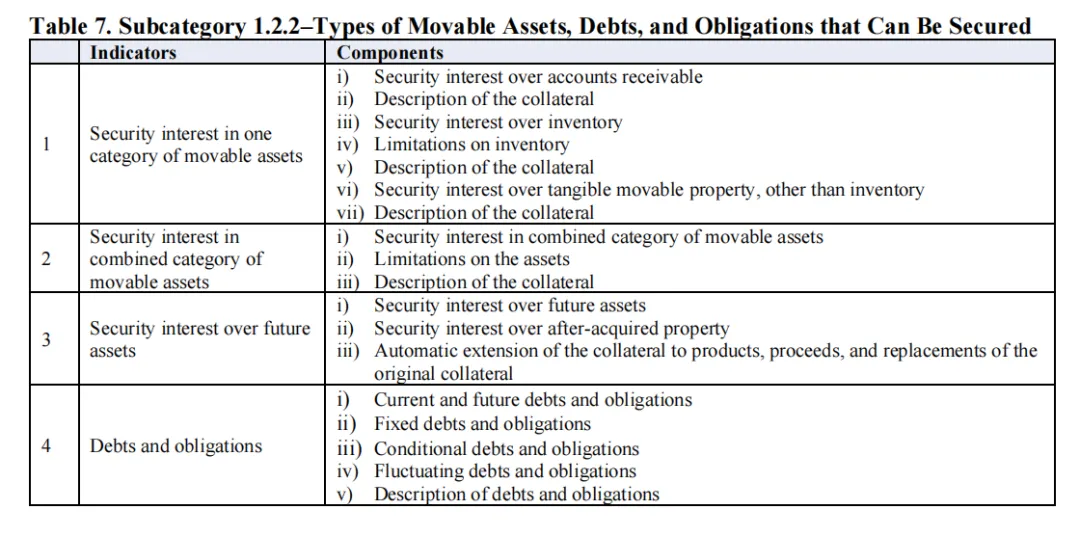
Since some of the factors considered in this assessment overlap, and some content is quite important, this article will combine the relevant parts for interpretation and analysis, rather than strictly following the order in the table. Readers should note this.
(1) Security interests in a single movable asset and a pool of movable assets:
Regarding accounts receivable, as mentioned above, Chinese law allows existing and future accounts receivable as secured financing assets. There should be no dispute on this point.
Regarding inventory, from Article 396 of the Civil Code (chattel floating charge clause), Article 404 (ordinary course buyer clause), and Article 56 of the Security Judicial Interpretation, Chinese law also allows inventory as secured financing assets. There should be no dispute on this point.
Regarding other tangible movable property and limitations: The Chinese legislator has not imposed restrictions on the types of inventory and pools of movable assets. Article 406 of the Civil Code, in contrast to the original Property Law’s spirit, allows free transfer of chattel collateral. Article 399 on property prohibited from mortgage includes item (6): “other property that laws and administrative regulations prohibit from being mortgaged” as an explicit limitation. Other content in Article 399 is clarified in Article 37 of the Security Judicial Interpretation, eliminating some misunderstandings. Legislation and judiciary tend to support the expansion of mortgageable property. As for pool mortgages (also called enterprise mortgages), due to their effect of aggregating property value, debtors can obtain stronger bargaining power, making them highly favored abroad. Article 395(2) of the Civil Code affirms pool mortgages, i.e., “the mortgagor may mortgage the properties listed in the preceding paragraph together.” However, since the Property Law era, the actual application effect has not been satisfactory because property types are complex and diverse, registration authorities differ, and high registration efficiency cannot be achieved. This has led to pool mortgages not being favored in practice, which should be noted.
Finally, Article 63 of the Security Judicial Interpretation further advances this. It stipulates: “Where a creditor and a guarantor enter into a security contract agreeing to create a security interest in a property right that is not yet provided by laws or administrative regulations as capable of being used as security, and a party claims that the contract is invalid, the People’s Court shall not support it. If the party does not register in accordance with the law with a statutory registration authority, and claims that the security interest has the effect in rem, the People’s Court shall not support it.” While adhering to the dichotomy of obligation and real rights, this affirms the legal effect of the relevant security contract. Moreover, if strictly adhering to the principle of numerus clausus of real rights may prove futile in the face of emerging property rights, considering expanding it through “customs” as a source of law in Article 10 of the Civil Code is also a path worth considering. In arbitration practice, there have been cases affirming that trade customs and industry customs can support the effect in rem. In short, if the principle of numerus clausus of real rights is to be upheld, the “law” here must be flexible and efficient; otherwise, numerus clausus may become a “fig leaf” for inertia.
Regarding the description of collateral: Article 16(3) of the “Operating Rules for the Unified Registration System for Chattel and Rights Financing of the Credit Reference Center of the People’s Bank of China,” revised in 2019, stipulates that as long as the collateral can be identified, either specific description or general description is permissible. Some courts have also adhered to this view (Chongqing Yubei District People’s Court (2015) Yu Bei Fa Min Chu Zi No. 11775 Civil Judgment). However, the World Bank’s “Doing Business 2020” report indicated that in Beijing and Shanghai, general description of collateral was not permitted when enterprises created non-possessory security interests in specific categories of movable assets (World Bank Group, Economy Profile of China: Doing Business 2020, pp. 55-58). In response, China’s Civil Code follows the global legal trend of allowing general descriptions of collateral in security contracts. Articles 400(3) and 427(3) on the content of collateral description only list “name” and “quantity,” with a catch-all “etc.” Furthermore, Article 53 of the Security Judicial Interpretation clearly interprets this change, providing that in contracts for security over chattels and rights, the collateral may be described generally. If such a description can reasonably identify the collateral, the security interest is established. This greatly enhances the practicability and acceptability of security over chattels and rights. Compared to the previous business environment score, China should achieve new progress here.
Research by scholars has found that the general description of collateral originates from the United States, with its justification lying in enhancing description accuracy, promoting efficiency in creating security, protecting the guarantor’s trade secrets, and curbing the guarantor’s fraud and other dishonest behavior (Xie Hongfei, “General Description of Collateral and Its Sufficiency,” in Law, Issue 11, 2021). Undeniably, the intent of allowing general description of collateral is appropriate. However, how to define the “reasonable identification” standard remains controversial in judicial practice, as there is no clear legal rule. For example, in a certain case (Huangshi Xisaishan District People’s Court of Hubei Province, (2021) E 0203 Min Chu No. 399 Civil Judgment), the parties agreed to “first use the fixed assets actually controlled by the debtor for repayment, and now take one CNC machine tool (worth approximately one hundred thousand yuan) as collateral.” However, the debtor failed to provide the invoice and pictures of the CNC machine tool as required by the contract.
The court held that “the described collateral ‘CNC machine tool’ should have a lawful and clear scope; because the debtor Wang Gaofeng did not submit the invoice and pictures of the CNC machine tool to the plaintiff as agreed in the mortgage agreement, the CNC machine tool was not clear and the collateral could not be reasonably identified. Therefore, the mortgage right regarding the CNC machine tool in the loan contract was not established.” This article believes that in this case, the parties had already agreed on the type (CNC machine tool) and quantity (one) of the collateral, specified the time (present) and approximate value. Based on these characteristics, the collateral could have been distinguished from the debtor’s general assets, and it should be considered that the collateral could be reasonably identified, thus the chattel mortgage right should have been established. In fact, this issue should be considered systematically. A security contract is still a bilateral legal act, so referring to the general formation requirements of contracts to determine whether the security contract is formed is appropriate. According to the former “Interpretation (I) of the Supreme People’s Court on Several Issues Concerning the Application of the Contract Law of the People’s Republic of China,” Article 1, all contracts must have at least the three basic elements: parties, subject matter, and quantity, to be formed. Therefore, the “reasonable identification” standard should also be built on this basis.
(2) Security interests in future assets:
Regarding security interests over future assets, China’s Civil Code and the Security Judicial Interpretation both adopt a relatively open attitude. Combined with Article 395(7) of the Civil Code, other property not prohibited by laws or administrative regulations can serve as mortgage property. According to Articles 425 (chattel pledge) and 440 (rights pledge) of the Civil Code, Chinese legislation imposes stricter requirements only on the elements of the pledge among traditional typical security rights in rem, although some views consider this restriction inappropriate (Shi Guanbin, “Legislative Commentary on the ‘Rights Pledge’ Chapter of the Civil Code (Draft) Property Book,” in Rule of Law Research, Issue 1, 2020). Combined with the legal phenomena mentioned above—functional inclusion of security contracts, general description of chattel and rights security, recognition of future accounts receivable, and that registration of new property rights only affects the effect in rem—we can conclude that China’s legal system adopts a positive attitude towards security rights in rem over future assets, especially in the area of chattel and rights security. This point is clearly aligned with international standards.
Regarding security interests over after-acquired property: China’s Civil Code explicitly accepts this in the chattel floating charge clause of Article 396. However, compared with Article 9 of the U.S. Uniform Commercial Code, there are still areas in Chinese legislation that need improvement: First, Article 396 stipulates that floating charge property includes raw materials, semi-finished products, finished products, and production equipment. Among these, raw materials, semi-finished products, and finished products originate from the full content of subparagraph (d) and part of subparagraph (b) of the definition of “inventory” in UCC 9-102(48). Generally, different types of enterprises have different inventories and different production equipment. Precise definitions of these concepts should be left to subordinate legislation. Second, the proceeds derived from raw materials, semi-finished products, finished products, and production equipment should be accurately positioned to ensure the dynamic protection of security rights. Since proceeds are diverse, the original security right needs to be updated and perfected based on the characteristics and types of proceeds. This is closely related to the “automatic extension of collateral proceeds” discussed below. However, some scholars suggest summarizing intangible asset types more broadly, referring to the classification approach for intangible assets in UCC Article 9: collectively calling intangible property used for investment “investment property,” classifying documents frequently used in commercial activities as “semi-intangible property,” and calling intangible property that cannot be included in the above types “other intangible property,” thereby improving alignment with commercial practice (Li Li, “On the System for Determining Floating Charge Property,” in Global Law Review, Issue 2, 2021).
Regarding the automatic extension of the collateral to products, proceeds, and replacements of the original collateral: This is one of the most criticized major defects in China’s current security system and requires special attention. In comparative law, to protect the secured creditor from the depletion of the collateral’s productive capacity, the extension of a security right in movables to identifiable proceeds of the original collateral, and proceeds of proceeds, is a common legislative practice internationally. This is reflected in UCC 9-315, DCFR 9-2:306, and UNCITRAL Model Law on Secured Transactions Article 10. Article 390 of the Civil Code continues the approach of the original Property Law: “During the security period, if the secured property is destroyed, lost, or expropriated, the secured creditor may be satisfied out of the insurance compensation, damages, or expropriation compensation obtained, with priority. If the performance period of the secured claim has not yet expired, the insurance compensation, damages, or expropriation compensation may also be deposited.” However, it is clear that the scope of this provision is narrower than international legislation, as its prerequisite is the complete physical disappearance of the collateral due to destruction, loss, expropriation, etc.
Regarding how to achieve the extension of collateral proceeds, academia currently has roughly two main approaches: The first view holds that China should adopt the “automatic extension, exception by agreement” model of UCC 9-315. This model posits that the automatic extension of a chattel security right to proceeds is based on the parties’ inferable intent (implied agreement), assuming that the parties would have intended to create a security interest in the substitutes for the original collateral, unless the parties clearly express an intention to exclude this inferable intent. The purpose is to promote security efficiency and reduce unnecessary transaction costs (Zhuang Jiayuan, “Implied Extension of Chattel Security Rights,” in Legal Research, Issue 2, 2021). The UNCITRAL Model Law on Secured Transactions (Article 10) and the Louisiana Civil Code (Book X, Article 9-306) also adopt this model. The second view holds that China should adopt the “no extension, extension by agreement” model stipulated in DCFR 9-2:306(3). Under this model, the security right only extends to proceeds from the original collateral if the parties expressly agree. The parties must indicate in the security agreement that the security right extends to proceeds, and must describe “proceeds” in the registration system. Only then does the security right extend to proceeds. If, after the proceeds arise, they are registered or possessed/controlled by the secured creditor, the security right in the proceeds can retain the priority of the original security right (Ji Hailong, “The Consensual Path for Extending Chattel Security Interests,” in Modern Law Science, Issue 3, 2022).
From the implementation path perspective, the first view suggests expanding the interpretation of the word “etc.” in Article 390 of the Civil Code to conform to the assumed intent of the parties’ security agreement. The second view suggests that without changing the semantic scope of the Civil Code, only the registration system and procedures need reform. In particular, researchers supporting the second view have provided strong arguments from aspects such as legislative paradigm, commercial practice, hidden security, transaction costs, and reform costs, which are noteworthy (Liu Ping, “Systematic Expansion of the Rules for Preservation of Transferred Chattel Mortgages in China,” in Comparative Law Research, Issue 2, 2023).
This article holds that the second view should be adopted: First, China’s existing civil legislation still adheres to the traditional civil law models of “numerus clausus of real rights” and “dichotomy of obligation and real rights.” The issue of proceeds extension mostly arises in the field of chattel and rights security. However, unlike the relatively “flexible” rights discourse system in common law countries, blindly introducing the rule of automatic extension of proceeds into China’s legislation would have too great an impact on the legal system. We should not implement common law rules wholesale for the sake of business environment assessment, avoiding the mistake of focusing on the means while neglecting the end. Second, the proceeds extension rule mainly serves to balance interests in commercial transactions. The legislative impulse of legal paternalism should be restrained. Civil legislation should not establish a “default” rule for this, but instead leave it to the autonomy of merchants. Finally, in terms of the resolution path, China should promptly issue detailed rules for unified registration of chattels and rights. When parties register chattel and rights security, authorities should specifically remind them and ask whether they intend to extend the security right to proceeds. If so, a specific registration field should be established for the parties to describe the characteristics of the relevant proceeds. This would be essentially similar to automatic extension, yet better highlight the legislator’s respect for party autonomy.
In fact, the proceeds extension rule is closely related to the general reasonable description rule for collateral. Since the description of collateral must reasonably identify the specific collateral, based on the legal principle of “similar matters, similar treatment” applied mutatis mutandis, the description of proceeds generated from the collateral should also be reasonably identifiable to specific proceeds. As for other issues, they have already been explained above in the section on the general reasonable description rule for collateral and will not be repeated here.
(3) Debts and obligations:
Regarding current and future debts and obligations: Chinese legislation does not prohibit the creation of security for future debts.
Regarding fixed debts and obligations: Chinese legislation does not prohibit the creation of security for fixed debts.
Regarding conditional debts and obligations: Chinese legislation does not prohibit the creation of security for conditional debts.
Regarding fluctuating debts and obligations: Articles 420 to 424 of the Civil Code provide for maximum amount mortgages, along with corresponding mutatis mutandis application provisions (Article 690). The overall conclusion is that China’s security system recognizes the possibility of securing fluctuating debts.
Regarding the description of debts and obligations: Chinese legislation has no explicit provision. However, based on the general principles of the law of obligations, the underlying debt that can be secured should also satisfy the general elements for the formation of obligations. That is, referring to the general formation requirements of contracts, all contracts must have at least the three basic elements: parties, subject matter, and quantity, to be formed, as per the former “Interpretation (I) of the Supreme People’s Court on Several Issues Concerning the Application of the Contract Law of the People’s Republic of China,” Article 1. From a comparative law perspective, this provision leans towards commercial contracts, emphasizing the encouragement of transaction efficiency, and should be upheld and implemented.
3. Priority/Enforcement:
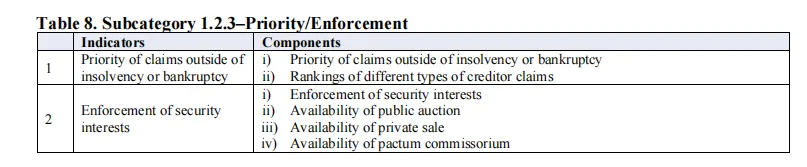
(1) Priority of claims outside of insolvency or bankruptcy
In general circumstances, regarding the priority of claims over collateral, China’s Civil Code and its Security Judicial Interpretation have made significant breakthroughs. A preliminary summary is as follows: Priority among mortgages—Article 414 of the Civil Code; Priority between chattel mortgages and pledges—Article 415; Priority of purchase money security interests—Article 416 and Article 57 of the Security Judicial Interpretation; Priority of possessory liens—Article 456; Priority between chattel mortgages and other right holders—Article 403 and Articles 54, 67 of the Security Judicial Interpretation. From the existing provisions, the issue of priority over collateral still requires more specific rules to be clarified. Chinese legislation should continue to absorb and learn from certain advanced rules and concepts of comparative law while based on domestic practice.
It is generally believed that the ranking of civil and commercial rights involves the policy orientation of a country or region. Therefore, special caution is needed regarding certain priority rights arising from China’s unique national conditions. If not systematically sorted out and discussed, they may become adverse factors in the business environment assessment. The ranking “Consumer home buyer’s priority right > Priority right for construction project price > Mortgage right” is a very typical example.
The “Reply of the Supreme People’s Court on Issues Concerning the Protection of the Rights of Consumers Who Purchase Commercial Housing” (hereinafter “Reply on Protection of Consumer Home Buyer Rights”), effective from April 20, 2023, timely resolved the significant issue in judicial practice regarding whether the relevant provisions of the “Reply on Issues Concerning Priority Right to Compensation for Construction Project Price” (now invalid) could continue to be applied by reference. It stipulates:
First, the priority relationship among the priority right to compensation for construction project price, mortgage right, and other claims shall be handled in accordance with Article 36 of the “Interpretation (I) of the Supreme People’s Court on Several Issues Concerning the Application of Law in the Trial of Disputes over Construction Project Construction Contracts.”
Second, if a consumer who purchases commercial housing for residential purposes has paid the full price and claims that his right to delivery of the house has priority over the priority right to compensation for construction project price, mortgage right, and other claims, the People’s Court shall support it. For a consumer who has only paid part of the price, if the remaining price is actually paid before the conclusion of the oral argument at the first instance, the preceding paragraph may apply.
Third, if the house cannot be delivered and there is no possibility of actual delivery, and the consumer claims that the right to claim return of the price has priority over the priority right to compensation for construction project price, mortgage right, and other claims, the People’s Court shall support it.
Digging deeper, the legal concept of the so-called “consumer home buyer’s priority right” is not clear, leaving significant room for judicial discretion and low certainty. The legal basis for determining that a statutory right (mortgage right is a statutory right) is subordinate to a special right through the form of a Supreme People’s Court Reply or directly through a judicial interpretation is easily subject to criticism. If real rights require numerus clausus, why should a right more powerful than a real right not be determined by laws or administrative regulations?
Article 42 of the “Interpretation (I) of the Supreme People’s Court on Several Issues Concerning the Application of Law in the Trial of Disputes over Construction Project Construction Contracts” provides for situations where the contractor waives or limits its corresponding priority right to compensation for construction project price. Through research, the author found that contractors mostly do this by issuing a written waiver letter to bank creditors to enable the employer to obtain further financing, thus ensuring the smooth payment of progress payments and other funds. However, in judicial practice, Article 42 of this Interpretation often becomes a tool for contractors to speculate, leading to many social problems. Therefore, the priority relationship between the priority right for construction project price and mortgage rights should be reconsidered.
It should also be noted that in addition to the priority right of consumer home buyers, recent authoritative case law has also clarified that “non-consumer home buyers” enjoy a certain degree of priority in individual cases. The Supreme People’s Court Bulletin, Issue 6, 2023, includes the Supreme People’s Court Civil Judgment (2022) Zui Gao Fa Min Zhong No. 34, concerning the case of the Huaihua Branch of China Construction Bank Co., Ltd. v. Hunan Branch of China Huarong Asset Management Co., Ltd., et al. (objection to enforcement by an outsider). It established the adjudication rule: “Whether a non-consumer home buyer can exclude the mortgagee’s application for enforcement may be determined based on factors such as the nature of the rights of both parties, the time sequence of acquiring the rights, whether there was fault in acquiring the rights, and how to reduce or prevent the recurrence of risks, combined with the specific facts of the case, and after a substantive examination of the rights enjoyed by both parties.” On one hand, this helps clarify the priority ranking and enhances the predictability of judgments. On the other hand, this judgment elevates non-consumer home buyers who meet conditions such as possession to the status of holders of an expectancy right in the ownership of the house, potentially further weakening the priority of mortgage rights. Moreover, granting the judge the authority to make such ranking determinations on a case-by-case basis, while balancing actual interests to a considerable extent, raises major doubts both legally and in terms of social effect. Establishing rules involving the ranking of mortgage rights through typical case law must necessarily be accompanied by principles and procedures such as stare decisis in the common law system; otherwise, it is difficult to achieve the goal of unified ranking of security rights. Considering the progress in building a unified adjudication system in China, this article believes there is a possibility of losing points here.
Thus, the operation of mortgage rights in China is still constrained by policy environment, social interactions, and other institutional mechanisms. The ranking system for security rights still requires continuous research and practice.
(2) Enforcement of security interests
Regarding the availability of public auction: Article 410 of the Civil Code and related provisions regulate this. Chinese legislation has explicitly accepted public auction as a means of realizing security rights in rem for many years. The biggest current issue is how to improve the special procedure for realizing security rights in rem to enhance transaction efficiency, which depends on improvements in procedural law.
Regarding the availability of private sale (or sale by agreement): Article 410 of the Civil Code and related provisions allow the parties to reach an agreement on sale by agreement after the debt performance period has expired, provided that the lawful interests of other creditors are not harmed. Article 45 of the Security Judicial Interpretation further stipulates: “If the parties agree that when the debtor fails to perform the matured debt or upon the occurrence of the circumstances agreed by the parties for realizing the security right, the secured creditor has the right to auction or sell the secured property privately and obtain priority in satisfaction from the proceeds, such an agreement is valid. If the secured creditor cannot auction or sell the secured property privately due to the guarantor’s reasons, and the secured creditor requests the guarantor to bear the increased costs, the People’s Court shall support it.” This is academically referred to as a “special agreement for private sale.” Although there are divergent judgments in practice regarding its validity (e.g., Guangzhou Intermediate People’s Court of Guangdong Province (2021) Yue 01 Min Zhong No. 11805; Shenyang Tiexi District People’s Court of Liaoning Province (2021) Liao 0106 Min Chu No. 981), this to some extent recognizes the legality of private enforcement of security rights in rem, reflects a certain judicial tendency, saves valuable judicial resources in a socially effective sense, and reasonably punishes dishonest guarantors.
Regarding the availability of pactum commissorium (forfeiture clause): The author has conducted in-depth research on this issue and has written and published multiple series of research papers. These series of papers start from the economic motivation, historical origin, comparative law reference, China’s judicial and transactional status, and systemic connections of forfeiture clauses, clarifying the judicial application of China’s forfeiture clauses from both legislative and interpretive perspectives. In particular, they deeply compare the legislation and judicial practice on forfeiture transactions in Anglo-American legal systems, filling a research gap in academia to a certain extent. For specific content, please refer to the author’s published papers; repetitive content will not be described here (Li Dingbang, “On the Contradictory Nature of the Forfeiture Norms in the Civil Code under the Modernization of the Security System,” in Tsinghua Law Review, Vol. 11; “On the Optimization of China’s Forfeiture Norms—Lessons from American Law Setting Aside the Validity Dispute,” in Beihang Law Review, Vol. 12; “Commentary on the Civil Code’s Prohibition on Forfeiture Mortgages,” in Jinling Law Review, 2022 volume; “A New Interpretation of the Civil Code’s Forfeiture Norms,” in CUPL Graduate Journal, 2022, Issue 1).
In summary, regarding the forfeiture norms of the Civil Code (Articles 401 and 428), they stipulate: “If the mortgagee/pledgee, before the expiration of the debt performance period, agrees with the mortgagor/pledgor that the mortgaged/pledged property shall belong to the creditor if the debtor fails to perform the matured debt, the creditor can only obtain priority satisfaction from the mortgaged/pledged property in accordance with the law.” Academic views on their validity nature roughly fall into three categories: invalidity, validity, and compromise. However, there is still intense controversy over whether China’s current legislation accepts or can accommodate the forfeiture transaction model. Based on judicial cases, most views still do not accept forfeiture clauses as a method of realizing security interests. In security law theory, regarding the satisfaction of secured claims and the realization of collateral, there are mainly two liquidation models: disposal-type and attribution-type. Depending on the specific method of realization, these can be further divided into liquidation-type, forfeiture-type, claim for disposal, and claim for attribution—four typical ways of realizing claims. (See Wang Chuang, A Study on the Legal System of Assignment by Way of Security, Law Press, 2000, pp. 355-357.) Strictly interpreting the wording of the forfeiture norms, it can be found that the Civil Code actually does not positively affirm the forfeiture-type or claim-for-attribution type. In practice, the claim-for-disposal type satisfaction method is highly controversial, with divergent views across different judgments. Therefore, at the normative level, China’s legal order only explicitly recognizes the liquidation-type debt satisfaction method. This point is strictly followed in Article 68 of the Security Judicial Interpretation on assignment by way of security, although it “goes further” compared to the Civil Code’s forfeiture norms. Although some interpretive techniques within legal dogmatics might be attempted, based on China’s existing positive law system, China has not recognized the legal status of forfeiture clauses. From the perspective of China’s social security and policies to curb financial speculation risks, failing to positively affirm forfeiture transactions has some rationality. However, if the current rules are maintained, China will inevitably lose points on this assessment factor. Countermeasures that can be flexibly adopted still require in-depth discussion.
In summary, the methods and paths for realizing security rights in rem determine to a considerable extent the essence of security rights in rem and the transaction efficiency and innovation vitality they bring (Li Linqi, A Study on Non-Contentious Procedures for Realizing Security Rights in Rem, Law Press, 2021, p. 2 et seq.). China’s legislation and judiciary should continue to reform and improve in this regard, gradually making the declaration that “security is the lubricant for economic development” come true in its ultimate utility.
4. Features of Collateral Registries:
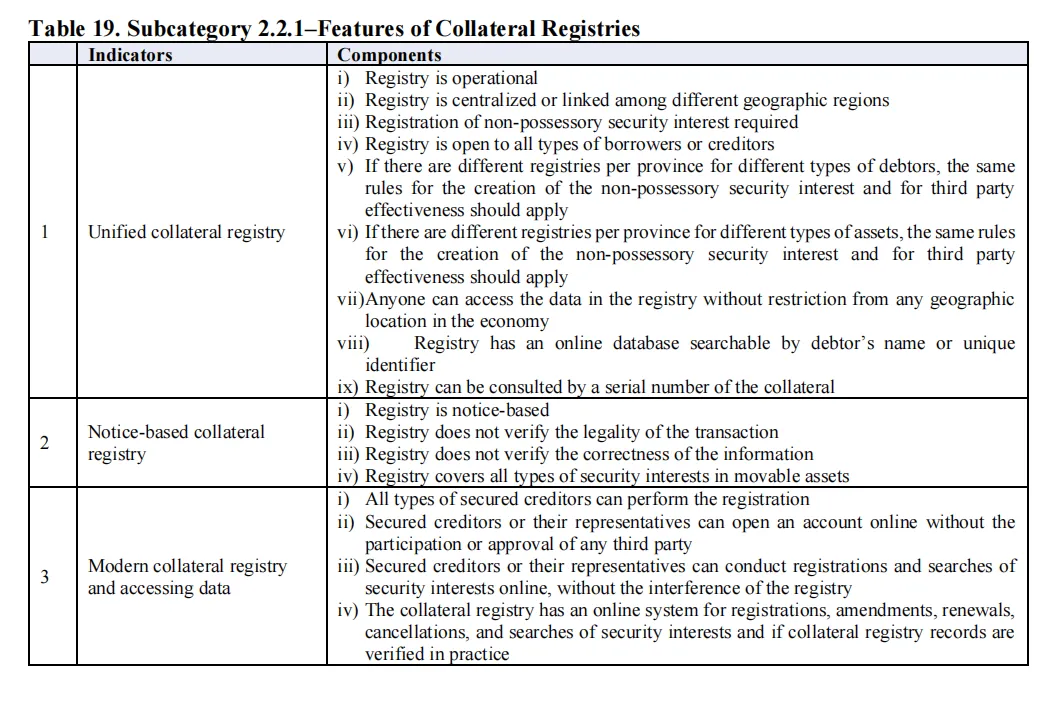
In addition to the regulatory framework pillar, the World Bank’s Methodology Handbook, in its Chapter 6 on Financial Services, has another supporting pillar: Public Services. This focuses on whether administrative authorities provide complete service facilities, information transmission methods, infrastructure, etc., to facilitate financial transactions. In Section 2 of the Public Services part, i.e., Operation of Collateral Registries, the features of a modern collateral registry are proposed.
The “Decision of the State Council on Implementing Unified Registration of Chattel and Rights Security” (Guo Fa [2020] No. 18) implements the security legislative philosophy of the Civil Code, deciding to carry out unified registration of chattel and rights security nationwide. Subsequently, the People’s Bank of China promulgated the “Unified Registration Measures for Chattel and Rights Security,” which came into effect on February 1, 2022. This regulation basically draws on the relatively advanced legislative concepts and rules of Anglo-American countries. Most of its content meets the features required by the World Bank for a collateral registry, such as online application and acceptance, notice filing, etc. The differences between the two are now discussed:
Through comparison, the author finds that China may lose points on the scope of collateral registration (Registry covers all types of security interests in movable assets), i.e., the degree of “unification” of the chattel and rights security registration system still needs further improvement. Mortgages of motor vehicles, ships, and aircraft, pledges of bonds, fund shares, equity, and property rights in intellectual property are still registered in their respective decentralized systems, with different requirements and different competent government agencies. However, considering the public interest attributes or significant value of these properties, fully integrating them into a single registry is neither highly reasonable nor necessary. Nevertheless, a coordinated, comprehensive, and accurate network system should be established among the respective registration systems and authorities, gradually achieving the function of simultaneous information entry to minimize transaction costs and promote transaction efficiency (Gao Shengping, “Construction of a Unified Publicity System for Chattel Financing Registration,” in Global Law Review, Issue 6, 2017). In practice, some cities and regions have already explored in this direction. To implement the “Opinions of the State Council on Carrying out Pilot Work on Business Environment Innovation” (Guo Fa [2021] No. 24) regarding promoting the sharing and interconnection of guarantee information for motor vehicles, ships, intellectual property, etc., with the Credit Reference Center of the People’s Bank of China (hereinafter “Credit Reference Center”) Unified Registration System for Chattel and Rights Financing (hereinafter “Unified Registration System”), and achieving unified query of various registration information, starting from May 30, 2022, the Unified Registration System provides query services for registration information of motor vehicle mortgages, ship mortgages, and intellectual property (including exclusive rights to registered trademarks, patent rights, and copyrights) pledges in Beijing. Starting from 8:00 a.m. on December 7, 2022, the Unified Registration System of the Credit Reference Center also officially provides unified query services for guarantee registration information of motor vehicles, ships, and intellectual property in Guangzhou.
III. Conclusion
The new Business Ready assessment project released by the World Bank this time deserves careful analysis and comparison by Chinese government agencies, relevant enterprises, legal professionals, and other groups. As optimizing the business environment becomes one of the main tasks of economic and social development, the new assessment project also provides a good sample for us to glimpse the mainstream trends in international business environment construction. Undeniably, before the release of this assessment project, China was at the forefront of the world in information technology and network construction, which has already provided a good communication and exchange foundation for business environment construction. “Green finance” has also long been one of the main themes of China’s financial development. Therefore, China has achieved considerable and eye-catching results in business environment construction.
While the achievements are gratifying, when dealing with the new assessment project and its corresponding evaluation results, we need to more scientifically and rationally handle the mutual relationship between grounding in China’s domestic practice and drawing on the beneficial experiences of international business environment construction. China has unique national conditions and a legal system. The construction of the business environment must still respect local history and actual circumstances. Blindly chasing the scores of the business environment assessment and blindly tailoring Chinese law to foreign legal rules or systems to cater to the assessment would be like drinking poison to quench thirst. The World Bank’s new business environment assessment project is only one way to measure China’s business environment, not the only way. We need to gradually improve the consistency of the legal system and the perfection of legal rules through learning. Moreover, the measurement factors set in the new assessment project are not necessarily scientific or comprehensive. The assessment method of the business environment is only to send questionnaires to industry experts, ask business people, and read legal texts. The limitations of the method likely mean that the relevant survey results may be one-sided and limited.
In summary, the new B-READY assessment project is only one test in the assessment of China’s business environment optimization. We must recognize the gaps in the legal system with advanced developed countries, but more importantly, we must base ourselves on China’s domestic legal practice and social transformation. After all, exchange and mutual learning, openness and win-win, and efficiency and order remain the ultimate requirements for any optimization of the business environment.
Contact Lawyer
Submit your contact details and consultation question. We will follow up ASAP.