
Guide to "Avoiding Landmines" in Offshore Trusts — And an Equity Law Interpretation of the Judgment "Piercing" Ms. Z's Overseas Family Trust
Guide to "Avoiding Landmines" in Offshore Trusts — And an Equity Law Interpretation of the Judgment "Piercing" Ms. Z's Overseas Family Trust
Attorneys SONG Jie and LI Xinghua use the Singapore High Court case of the 'Piercing of Ms. Z's Family Trust' to point out that the industry's widespread attribution of the judgment to 'excessive control by the settlor' is actually a misunderstanding. Through an in-depth analysis of the judgment, the article indicates that the true jurisprudential basis of the case is the 'resulting trust' in equity law. The court did not examine the power reservation clauses in the trust document, but rather focused on whether the equitable ownership of the trust property (bank account funds) was substantively transferred. The fact that Ms. Z continued to freely dispose of, transfer, and act as the owner of the funds after they were transferred into the trust showed that she never relinquished her beneficial interest. Consequently, the funds legally constituted an automatic resulting trust and remained her personal property. This case marks a new direction in risk warnings for offshore trusts: the realization of the asset isolation function of a trust depends not only on the surrender of control but, more crucially, on the thorough transfer of both common law and equitable ownership. Otherwise, the trust property may still be pursued by creditors.
Recently, the case where an overseas family trust established by Ms. Z was “pierced” by a judgment of the Singapore High Court (referred to as the “Z Case”) has aroused widespread attention and heated discussion in the fields of wealth management and trust legal practice. Currently, many teams engaged in trust legal practice have used this hot topic to further promote legal risk warnings that have become common knowledge in the offshore trust sector, such as avoiding sham trusts, avoiding excessive control, and strictly adhering to the boundaries of the settlor’s powers.
However, upon careful study of the Singapore High Court judgment [2022] SGHC 278, the author found that the adjudicative basis and jurisprudential foundation of this case are vastly different from previous cases. The reasoning behind the “piercing” of Ms. Z’s family trust cannot be explained by “excessive control by the settlor” or “boundaries of the settlor’s powers” as claimed by current trending articles. It can be said that this case is not merely a hot topic, but a groundbreaking and landmark classic case regarding new types of risk warnings and court adjudication rules for offshore trusts.
In this article, based on years of studying Anglo-American trust law, the author interprets the judgment of the Z Case from the perspective of equity law. Through this “empathetic” interpretation, the author hopes to help readers accurately understand the extraterritorial adjudication rules of the Z Case and its warning significance for new types of legal risks in offshore trust practice.
I. Background of the Dispute, Basic Facts, and Judgment of the Z Case
(I) Background of the Dispute
Ms. Z had a dispute over an equity acquisition transaction with a private equity fund, LDV Company, which applied for arbitration to the China International Economic and Trade Arbitration Commission (CIETAC). On April 28, 2019, CIETAC ruled that Ms. Z and her affiliated enterprises, as debtors, must pay US$142 million in compensation to the private equity fund. Subsequently, LDV began seeking to enforce the CIETAC award against the assets of the family trust established by Ms. Z in courts across multiple asset locations. First, it applied to the Hong Kong courts for recognition and enforcement of the CIETAC award, which was supported by the Hong Kong courts. Later, LDV was granted permission to register the Hong Kong judgment in Singapore, obtaining a registration order on November 11, 2020, which allowed it to enforce the foreign court judgment in Singapore. To further execute the Singapore registration order, LDV filed a lawsuit in the Singapore High Court targeting two bank accounts under the name of SETL Company within the SE Trust, requesting the court to appoint receivers to take over the funds and securities in these accounts. Ultimately, the Singapore High Court issued a judgment on November 2, 2022, which is the judgment [2022] SGHC 278 referred to in this article.
(II) Basic Facts of the Case
Between December 16, 2013, and June 13, 2014, due to the acquisition of Ms. Z’s equity in a catering company by the private equity fund LDV, LDV paid a total of US$250 million in equity transfer funds in installments to Ms. Z’s personal account opened at Bank J. Safra Sarasin in Hong Kong.
On January 2, 2014, Ms. Z established SETL Company in the BVI, with Ms. Z as the sole shareholder and sole director. SETL Company opened bank accounts with Credit Suisse and Deutsche Bank in Singapore on February 11, 2014, and March 7, 2014, respectively, referred to as the CS account and the DB account.
Between March 10, 2014, and July 21, 2014, Ms. Z transferred US$140 million from her personal account to the CS account in installments. Between March 27, 2014, and November 27, 2014, Ms. Z transferred US$85 million from the CS account to the DB account in installments.
On June 3, 2014, Ms. Z established the SE Family Trust, with the beneficiaries being Ms. Z’s son, Mr. W, and his descendants, and the trustee being Asia Trust Limited.
On June 4, 2014, Ms. Z transferred her roughly 100% equity in SETL Company to the trustee of the SE Family Trust, Asia Trust. The sole director of SETL was changed from Ms. Z to ATP Directors Limited, an affiliate of the trustee Asia Trust, on March 3, 2015. After June 4, 2014, the overall structure of the SE Family Trust was as shown in the following diagram:
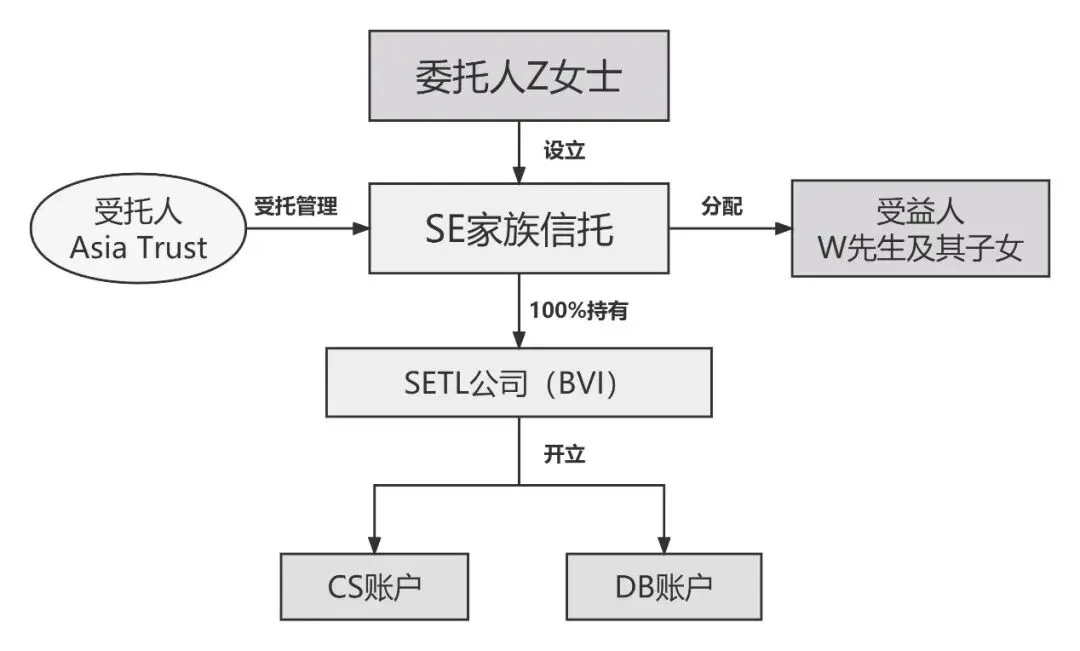
Between September 2014 and February 2015, i.e., after the establishment of the SE Family Trust, Ms. Z, acting as the sole authorized signatory of the CS and DB bank accounts, transferred funds out of the two bank accounts multiple times. The specific circumstances are as follows:
(1) On September 22, 2014, and February 10, 2015, US$3 million was transferred out of the CS account each time. Regarding these two transfers, Ms. Z stated that she “could not locate the relevant documents and materials”;
(2) On November 26, 2014, Ms. Z directed a transfer from the DB account to Company M. This fund was traced to the purchase of an apartment in New York, which the U.S. District Court for the Southern District of New York ruled belonged to Ms. Z.
In March 2015, within two days of receiving a freezing order from the Hong Kong court, Ms. Z ordered the transfer of US$36 million out of the DB account. Subsequently, the Singapore High Court issued a freezing order, freezing both the CS and DB accounts.
(III) Court Judgment and Rationale
On November 2, 2022, the Singapore High Court ruled that although Ms. Z directed and facilitated the establishment of the SE Family Trust and transferred the ownership of SETL Company to the SE Family Trust, she did not intend to relinquish, but rather retained, her beneficial interest in the funds held in the CS and DB bank accounts under SETL Company’s name. She was the beneficial owner (i.e., equitable owner) of the funds in these two bank accounts, thereby ruling in favor of the plaintiff LDV’s application to have the court appoint receivers for the bank accounts.
This judgment by the Singapore High Court means that the risk isolation function anticipated by Ms. Z when setting up the family trust failed to materialize, a scenario currently commonly known as the “piercing of a trust.” The specific facts and reasons for the court’s judgment are as follows:
(1) Ms. Z transferred funds from SETL Company’s accounts multiple times for her own purposes, and SETL Company never raised any objections for years after its board of directors was controlled by the trustee Asia Trust. This demonstrates that Ms. Z never intended to hand the funds over to SETL Company, but still wished to retain beneficial ownership of these funds;
(2) After receiving the Hong Kong court’s freezing order and before the Singapore court’s freezing order was issued, Ms. Z hurriedly transferred US$36 million out of the DB account. This indicates that Ms. Z believed the funds in the DB account were her own and feared that if they were not transferred out in time, they would likely be pursued by the plaintiff;
(3) Even after Ms. Z had transferred the ownership of SETL Company to the trustee of the SE Family Trust, Asia Trust, when she received the Singapore court’s freezing order, her instructed law firm sent a confirmation letter to Deutsche Bank’s lawyers stating that Ms. Z “maintained” the DB account at that time and was taking legal steps to discharge the freezing injunction. The judge pointed out that “maintain” indicated the account was owned by Ms. Z. If Ms. Z were merely the authorized signatory of the account, the lawyer would not have used the expression “maintain” the account. Moreover, Ms. Z’s lawyer confirmed that Deutsche Bank owed a duty of confidentiality to Ms. Z, which could only mean that for the DB account, Ms. Z was the direct client of Deutsche Bank.
Additionally, regarding some bank forms that were favorable to Ms. Z, the court, after comprehensively comparing the evidence from both sides, did not accept their probative value, and further elaborated on its rationale: Ms. Z’s subjective intention when transferring the funds into the two bank accounts in question was not to gift the funds, but to retain the beneficial interest in them. Ms. Z intended to sign whatever documents she was told to sign to prevent the plaintiff from pursuing her assets, while still retaining full control over those assets so she could freely dispose of them for her own benefit. In the wording used in the correspondence between Ms. Z’s law firm and Deutsche Bank, this indeed meant that even though the bank accounts were opened in SETL Company’s name, Ms. Z retained those accounts.
II. Analysis of the Z Case Judgment from the Perspective of Equity Law
(I) “Resulting Trusts” is the Main Jurisprudential Basis of the Z Case Judgment
Looking through the judicial precedent traditions of common law jurisdictions, before the Z case judgment, invalidating a trust or “piercing” a trust’s asset isolation function was mainly done through three avenues: “sham trusts,” “passive trusts where the trustee is merely a ‘conduit’,” and “revocable trusts that defraud creditors.” The jurisprudential basis of these three avenues is actually interconnected, namely, examining the validity of the trust from the perspective of the “three certainties” required to establish a trust (i.e., certainty of intention, certainty of subject matter, and certainty of objects). In offshore trusts, settlors often retain excessive powers or exhibit excessive control. Courts are highly likely to find an absence of intention to create a trust due to “excessive control,” thereby failing the “certainty of intention” requirement and invalidating the trust, or judging it to be a “sham trust.”
However, in the Z case, the main theoretical basis in trust law relied upon for the analysis and reasoning throughout the judgment was “Resulting trusts,” not “sham trusts” or “excessive control by the settlor,” nor was it related to the retention of the settlor’s powers or the boundaries of those powers.
1. “Resulting Trusts” and Their Categories
When a settlor transfers property, conveying the legal (common law) ownership of the property to a trustee, but for some reason does not completely relinquish the equitable ownership of the property, a resulting trust arises with the settlor as the beneficiary.
In the academic circles and judicial practice of common law jurisdictions, the two-category division of resulting trusts made by Megarry J in the Re Vandervell’s Trusts judgment is currently widely adopted: Presumed resulting trusts and Automatic resulting trusts.
A presumed resulting trust means that if there is a lack of evidence showing what the parties’ intentions actually were, then under certain circumstances, if A gratuitously transfers property to B, or A purchases property in B’s name, a presumed resulting trust arises, and B is deemed to hold the property for A’s benefit.
An automatic resulting trust stems from the application of the equity maxim “Equity abhors a beneficial vacuum.” A transfers property to B and settles it into a trust, but leaves part or all of the beneficial interest undisposed of. For the undisposed beneficial interest, B automatically holds it on a resulting trust for A. This resulting trust does not depend on any intention or presumption, but is the automatic result of A’s failure to dispose of the entire beneficial interest. This type of trust is called an automatic resulting trust.
In fact, as early as the beginning of the 20th century, the most famous British legal historian Maitland accurately defined this type of trust using the concept of dual ownership in equity: “the settlor transfers or bequeaths to the transferee property in which he has both legal and equitable ownership, but the existing facts are insufficient to show that the settlor has also disposed of the equitable ownership.”
In the common law system, ownership includes legal ownership (common law ownership) and equitable or beneficial ownership. Maitland’s definition of an (automatic) resulting trust using the concept of dual ownership in equity is extremely helpful for us to understand the adjudicative logic of the Z case judgment.
2. The Visible “Resulting Trust” in the Text of the Z Case Judgment
In the Z case judgment, the English phrase “Resulting trust” appears a total of six times.
First, in the most prominent section of the judgment’s keywords, “Resulting trust” appears as one of the four sets of keywords.
Second, in paragraph 19 of the judgment, it appears in the first sentence of the reasons for the plaintiff LDV Company’s claim: “First, on the basis of a resulting trust, Ms. Z is the beneficial owner of the assets in the Bank Accounts. She is identified in the banking documents as the beneficial owner of the Bank Accounts, in which…”
Third, it appears in paragraph 31: “In response to the plaintiffs relying on certain documents or evidence to prove that Ms. Z was the beneficial owner of the Bank Accounts under a resulting trust, SETL raised the following objections…”
Fourth, it appears twice in the judge’s reasoning section in paragraph 45: “As I noted at [19] above, the plaintiffs ground their case on a resulting trust. They and the defendants recognise that a resulting trust arises where a person transfers property to another without the intention to benefit the other.”
Finally, in paragraph 46, the judge deliberately emphasizes: “In this case, the plaintiffs do not rely on any presumption of a resulting trust, and I agree that resorting to a presumption of a resulting trust is neither necessary nor useful in a case like this, where there is direct and circumstantial evidence of the transferor’s intention.”
These six visible appearances of “resulting trust” strongly explain to the reader of the judgment: The plaintiff in this case based the jurisprudential foundation of its claim on a “resulting trust”—the plaintiff argued that due to a “resulting trust,” Ms. Z was the beneficial owner of the assets in the two bank accounts, and therefore requested the court to appoint receivers for the two bank accounts; the judge hearing the case similarly based the rationale for the judgment on the jurisprudential foundation of a “resulting trust.” Moreover, the judge further emphasized that because there was direct and indirect evidence in this case proving the transferor Ms. Z’s intention, there was no need to resort to a “presumption of a resulting trust.” The implication is that an “automatic resulting trust” applied in this case.
However, the author has searched and read more than twenty articles interpreting the Z case judgment and advising on preventing relevant legal risks. Even among public accounts specifically researching and writing about offshore trust legal affairs, very few articles mention this most important keyword—resulting trust—which serves as the legal basis for the judgment.
This judgment used the professional trust law term “Resulting trusts” six times in the keywords and content sections. If researchers could carefully read the original English judgment of the Z case instead of relying on translation software, then researchers with a basic knowledge of Anglo-American trust law would be able to capture this key information. This would help them accurately understand the internal jurisprudential logic of this classic judgment and its landmark significance for the offshore trust legal service industry.
3. The Focus of the Z Case is Not “Actual Control”, but Equitable Ownership under a “Resulting Trust”
In the Z case judgment, “resulting trust” not only appears in the text but serves as the jurisprudential basis for the judge’s analysis and reasoning throughout the entire document. Therefore, the core factual issue the judge focused on was not “excessive control” or “actual control,” but whether Ms. Z enjoyed the beneficial interest, i.e., equitable ownership, in the funds in the bank accounts in question.
The judge’s thinking in this case is first reflected in the two focal points of dispute summarized by the judge in paragraph 33 of the judgment:
(a) Whether, as a matter of law, a receiver can be appointed over property in which a debtor has no equitable interest but does exercise effective control.
(b) Whether Ms. Z has a beneficial interest in the funds in the bank accounts.
The reason for the first focal point is that the plaintiff proposed, “If the court does not find that Ms. Z is the beneficial owner of the assets in the bank accounts, then because she exercised control equivalent to ownership over these assets, Ms. Z could transfer the money in the bank accounts to any party she wishes, and this level of control is also sufficient to warrant appointing a receiver by way of equitable execution over the bank accounts.” The plaintiff also cited the precedent of “Skurikhin No.1” to support its claim (see paragraph 23 of the judgment).
Regarding the “Skurikhin No.1” precedent, the judge in this case responded by citing the view of a judge from the UK High Court, stating that “evidence of actual control may justify an inference that the person exercising actual control is the ultimate beneficial owner of the assets, but actual control itself does not warrant treating a third party’s assets as assets belonging to the judgment debtor available for execution in equity.”
From the plaintiff’s claims and the judge’s response above, it can be seen that in the Z case, the plaintiff’s claim regarding Ms. Z’s “actual control” over the bank accounts was merely used to support its request for the court to appoint a receiver. The judge merely treated “actual control” as one piece of evidence to prove that Ms. Z held equitable ownership of the bank accounts. This is fundamentally different in jurisprudential logic from traditional Anglo-American offshore trust precedents, which directly invalidate trusts through “excessive control by the settlor.”
In traditional precedents, “excessive control” or “the settlor retaining too much power” is assessed after the trust has been established and the ownership transfer procedures of the trust property have been completed according to the trust establishment documents. The court comprehensively evaluates factors such as the clauses and wording of the trust document itself, the settlor’s letter of wishes, the nature of the trust property, and past distributions made by the trustee, to judge whether it can be proven that the settlor had a genuine intention to create a trust. Ultimately, the discussion remains on whether the certainty of intention is satisfied.
However, in the Z case, the judge did not analyze and reason based on the trust’s establishment documents, nor did the judge address the powers reserved for Ms. Z in the trust document. Instead, the focus was on whether Ms. Z had truly transferred the equitable ownership of the bank account funds to the trustee, thereby determining whether the trust property had completed the transfer of ownership (including legal ownership and equitable ownership) in accordance with legal procedures.
(II) Whether the Equitable Ownership of the Bank Accounts in Question Had Been Transferred Was the Main Point of Contention in the Z Case Judgment
In the Z case, according to the structure of the SE Trust established by Ms. Z for the benefit of her son Mr. W and his children, the CS and DB bank accounts in question were opened in the name of SETL Company. When the shares of SETL Company were transferred to the trustee of the SE Family Trust, Asia Trust, the legal ownership (common law ownership) of the CS and DB bank accounts was also transferred to the trustee. However, was the equitable ownership of the two bank accounts also transferred? Where were the procedures or evidence for the transfer? This was the key point of dispute in the Z case, and also the focus of the offensive and defensive strategies of both the plaintiff and the defendant.
1. The Plaintiff Used Bank Documents and Other Evidence to Prove that Equitable Ownership of the Bank Accounts Remained with Ms. Z
Paragraphs 50 and 51 of the Z case judgment list the main evidence relied upon by the plaintiff:
(1) Internal emails from Bank J. Safra Sarasin in Hong Kong, to prove that Ms. Z’s motivation for transferring funds to the accounts opened in the name of SETL Company was to protect herself from claims that the plaintiff might bring.
(2) Bank forms constituting Ms. Z’s confirmations regarding beneficial ownership: In the CS bank account opening form, Ms. Z declared and confirmed that she was “the beneficial owner of the assets in the account” and promised to “immediately notify CS of any changes regarding the beneficial ownership of the assets in the CS account”; in the DB bank personal profile form, Ms. Z identified her role in the corporate account in three different ways, namely, authorized signatory, shareholder, and “beneficial owner.” She confirmed the accuracy of this information and promised to immediately notify DB of any changes.
(3) After June 4, 2014 (i.e., after the SETL shares were transferred to the trustee of the family trust) and before the court’s freezing order, the clear, unrestricted operation records of the two bank accounts by Ms. Z as the sole signatory, including two transfer records whose reasons were never explained and one transfer record used by Ms. Z to purchase an apartment in New York, USA.
(4) Payment instructions, marked “most urgent” by hand, given by Ms. Z notifying DB bank to make a transfer after learning of the freezing orders in Hong Kong and Singapore.
(5) Correspondence exchanged between Ms. Z’s instructed lawyers and DB bank’s lawyers, showing that both parties viewed Ms. Z as the beneficial owner of the DB account.
British jurists highly proficient in trust law have repeatedly emphasized that “the comparative unforeseeability and vulnerability of equitable property ownership compared with common law ownership suggest that dealings with trust property must be highly transparent” (Wilson, 2015, p. 97). Therefore, experienced lawyers have a very profound understanding and a strong sense of application regarding the rule that “the transfer of equitable interests must be manifested in writing.” In the litigation of the Z case, the plaintiff’s attorneys clearly understood this well and fully utilized this rule to prove their viewpoint, specifically reflected in paragraphs 21 and 49 of the judgment.
In paragraph 21 of the judgment, the plaintiff submitted that “when the consulting company retained by Ms. Z provided legal advice, it informed CS in October 2014 that Ms. Z had transferred the sole share in SETL to Asia Trust, but made no mention that Ms. Z had also transferred the beneficial ownership of the assets in the CS account to SETL.”
In paragraph 49 of the judgment, the plaintiff proposed that “although as of June 4, 2014, Ms. Z transferred her sole share in SETL to the SE Trust, the money in the bank accounts was not, and has never been, beneficially owned by SETL. On its face, the Deed of Addition transferring trust assets was limited to her share in SETL. Since she retained the beneficial interest in the funds in the bank accounts, the Deed of Addition made no mention of it, nor was there an intention to transfer it to the SE Trust.”
From these two paragraphs, it is evident that the plaintiff’s lawyers seized every opportunity to explain to the court: there was no documentary evidence to prove that the equitable ownership of the bank accounts in question was transferred to the trust company alongside the common law ownership; at the critical time and occasion when it should have been transferred together, the equitable ownership was not transferred.
2. The Defendant Adjusted Its Defense Strategy During Litigation, Using Externalized Transfer Actions to Prove the Equitable Ownership of the Bank Accounts Had Been Transferred
The defendant’s lawyers submitted bank documents favorable to their side to the court as evidence, mainly two forms submitted by SETL Company to CS bank when opening the account. By comparing these with Ms. Z’s personal account opening information at CS bank, they intended to prove that SETL was the beneficial owner of the proceeds in the CS account. Additionally, they mounted a defensive argument from the following two aspects:
On the one hand, they strongly argued that the equitable ownership of the two bank accounts was transferred to the trustee of the family trust along with the shares of SETL Company. They provided the following view from other precedents to support their claim: “when a person provides funds to a company wholly owned by him so that the company can purchase property, his intention is highly likely to let the company first hold both the legal and beneficial ownership of the money, and then own the property purchased with the money” (see paragraph 52 of the judgment). This was clearly a reluctant move by the defendant’s lawyers given the severe lack of documentary evidence capable of proving that the equitable ownership of the bank accounts had been transferred.
On the other hand, the defendant’s lawyers seemed to have realized during their defense that in the process of establishing the trust in question, the steps and documentary proof for transferring the equitable ownership of the bank account assets according to the trust’s intention were missing. Therefore, they immediately adjusted their defense reasoning and claims from “share transfer means automatic account transfer” to “the equitable interest in the funds in the two bank accounts was transferred to the beneficiary Mr. W the moment the funds were transferred out of Ms. Z’s personal Sarasin bank account” (see paragraph 24 of the judgment). In doing so, they grounded the property ownership transfer procedures required for establishing the SE Family Trust on the single externally visible transfer action of Ms. Z transferring funds from her personal account to the CS account.
3. The Judge Identified Ms. Z’s Lawyer’s Letter as the Primary Evidence Confirming the Equitable Ownership of the Bank Accounts was Retained by Ms. Z
As mentioned earlier, the judge summarized the two focal points of dispute in this case, one of which was “whether Ms. Z has a beneficial interest in the funds in the bank accounts.” This was exactly the core issue disputed by all parties regarding the facts of the Z case, and this focal point permeates the entire judgment. After comprehensively analyzing the evidence and defense claims of both the plaintiff and the defendant, the judge relied primarily on the highly unambiguous wording used in the correspondence between Ms. Z’s lawyer and DB bank—“maintain” the bank account—and the letter’s explicit confirmation that Ms. Z was the person to whom DB owed a duty of confidentiality. Ultimately, the judge concluded that the equitable ownership of the funds in the two bank accounts in question belonged to Ms. Z, supported the plaintiff’s claim, and ruled to appoint a receiver for the bank accounts.
Following the above analysis, let us look back at the definition of an (automatic) resulting trust by the famous British legal historian Maitland quoted earlier: “the settlor transfers or bequeaths to the transferee property in which he has both legal and equitable ownership, but the existing facts are insufficient to show that the settlor has also disposed of the equitable ownership.” Maitland’s definition of a resulting trust from over 100 years ago matches the circumstances of the Z case over 100 years later so perfectly that one cannot help but marvel. At the same time, it makes one sigh that if the keyword of the judgment, “resulting trust,” is missed, it is impossible to accurately understand the jurisprudential logic of the Z case judgment, let alone grasp its true essence.
III. How to “Avoid Landmines” When Establishing and Operating Offshore Trusts Based on the Z Case
(I) Ensure the Legitimacy of Establishing an Offshore Family Trust Regarding Timing, Purpose, and Power Settings
The legitimate purpose of establishing an offshore family trust is a crucial prerequisite for its legal validity. From the perspective of protecting family assets, it is recommended that settlors plan family trust arrangements as early as possible while their financial status is sound. If a family trust is established after potential litigation or bankruptcy risks already exist, it is hard to avoid the suspicion of using the trust to evade creditor pursuit. In such a scenario, if a creditor successfully proves that the purpose of the trust is to evade existing or potentially known debts, the court will set aside the family trust or deem it invalid, thereby causing the trust to lose its function of passing down family wealth and isolating assets.
Additionally, “excessive control by the settlor” or “the settlor retaining too much power” has been a primary characteristic of offshore trusts in recent years. To cater to the wealth control demands of high-net-worth individuals, more and more offshore jurisdictions legally permit the establishment of reserved power trusts. The settlor can stipulate the retention of certain powers in the trust instrument, but the retained powers cannot cross certain boundaries. This is because, in judicial practice, excessive retention of powers by the settlor is highly likely to be pierced by courts, which may determine a subjective lack of intention to create a trust, thereby deeming it an invalid sham trust.
In short, the extent of a settlor’s control over trust property is inversely proportional to the risk isolation effect of the trust property, and a proper balance between the two must be struck.
(II) Extra Attention Must Be Paid to Asset Delivery Procedures for Compound Asset Trusts in Common Law Jurisdictions
The greatest revelation and warning the Z case judgment offers to the offshore family trust industry is that offshore family trusts must strictly guard against the legal risk of missing procedures for the transfer of compound asset ownership.
Based on the jurisprudence of the historical evolution of trusts, Anglo-American jurists argue that the essence of a trust lies in the fragmentation of property rights; that is, the rights over trust property are divided into two: legal ownership belongs to the trustee, and equitable ownership belongs to the beneficiary. Both the trustee and the beneficiary enjoy ownership of the trust property. Under this dual ownership system in extraterritorial jurisdictions, the procedural requirements for transferring property ownership differ significantly from domestic laws. For instance, Section 53 of the UK Law of Property Act 1925 requires that dispositions of all equitable interests must be manifested in a valid written form. British jurist Sarah Wilson asserts that dispositions of equitable interests, or dispositions of existing trusts, must be in writing and signed by the person making the disposition or their lawfully authorized agent (Wilson, 2015, p. 105).
“Equitable rights in property are much less clear-cut than common law rights, and so these are much more vulnerable to destruction, and thus requiring the movement of beneficial interests between different legal actors to be recorded in writing is something which is helpful in establishing where these actually arise, and who in fact holds them.” (Wilson, 2015, p. 106).
In the Z case, the trust company and intermediaries serving as the trustee of her family trust were neither comprehensive nor professional regarding the legal procedures for validly establishing a compound asset trust involving cross-border equity and bank assets. They failed to realize that the requirements for transferring the equitable ownership of trust property under a compound asset trust are higher than those for a single-asset trust holding only equity or only bank funds. Instead, relying solely on domestic legal thinking and cognition, they mistakenly believed that “completing the share transfer means the ownership of the accounts under the company’s name is automatically transferred.” This cognitive misalignment caused by jurisdictional differences was the main obstacle leading to the failure to transfer the equitable ownership of the bank accounts promptly, legally, and effectively in the Z case.
This reminds domestic high-net-worth individuals that when establishing offshore trusts in extraterritorial jurisdictions, they must examine the transaction arrangements of the trust documents from the perspective of dual ownership. They should not only pay attention to the legal procedures at the time of the trust’s establishment but also give extra attention to the legal procedures upon the actual delivery of each asset that has become trust property, ensuring that the transfer of ownership of the trust property is completed promptly, legally, and effectively.
(III) The Management and Distribution of Trust Property Should be Handled by the Trustee According to the Trust Document to Ensure the Independence of Trust Assets
The establishment of a trust relationship does not mean the complete independence of the trust property. Even for a trust established in accordance with formal legal requirements, if the relevant trust property is not completely independent of the settlor, there is still a risk of the trust being “pierced.” In extraterritorial jurisprudence, courts will examine whether trust assets are independent from multiple dimensions, such as whether the settlor has the right to revoke the trust, whether the trustee has the right to independently review and dispose of trust assets, whether the trust assets and relevant rights are actually controlled or dominated by the settlor, and whether the settlor abuses the powers they have retained, etc.
Therefore, in the actual operation of a trust, the settlor should not ignore the stipulations of the trust document and arbitrarily strip the trustee of their independent will regarding the management of trust property, thereby rendering the trustee a mere figurehead. Settlors must be fully aware that a trust can only truly perform its risk isolation function when it satisfies the core requirement of trust property independence.
(IV) Strictly Prohibit Distributions of Trust Property to Persons Other Than Trust Beneficiaries
Taking the Z case as an example again, the beneficiaries of the family trust established by Ms. Z were her son Mr. W and his children; Ms. Z was not a beneficiary of the family trust. However, after Ms. Z transferred 100% of the shares of SETL Company to the family trust’s trustee Asia Trust, she still authorized the transfer of funds out of the CS and DB accounts under SETL Company’s name multiple times, and one sum was used to pay for Ms. Z’s personal purchase of real estate in New York, USA. The court used the actual usage of the account funds as one of the grounds to determine that Ms. Z remained the equitable owner of the CS and DB accounts under SETL Company’s name, and did not rule that the funds in the CS and DB accounts under SETL Company’s name were assets of her family trust.
(V) Select Truly Professional and Responsible Intermediaries, Especially Professionals Who Prioritize the Settlor’s Interests and are Familiar with Anglo-American Trust Law
In Ms. Z’s family trust case, whether it was the inappropriate wording “maintain” in the letter sent to DB bank by the law firm she retained, or the failure of her consulting company to promptly update the information in the bank documents, it showed that the staff of these two institutions lacked a basic awareness of legal risks regarding the validity of offshore trusts, and even more lacked professional cognition and awareness of the procedures for transferring the equitable ownership of trust property under a compound asset trust. This led to Ms. Z’s family trust being “pierced” by the court’s judgment.
This also reminds existing and potential settlors of offshore family trusts that, whether selecting overseas lawyers or domestic lawyers, they must choose professionals who are truly familiar with Anglo-American trust law rules and highly proficient in offshore trust business.
Conclusion
The judgment in the Z case highlights the legal risks that flaws in trust property ownership transfer procedures can bring from the perspective of “resulting trusts.” This is a classic, groundbreaking, and landmark case in terms of both new types of risk warnings for offshore trusts and court adjudication rules. The original English judgment of this case is well worth careful study and research by teams engaged in offshore trust practice. If one fails to untangle the jurisprudential logic of the Z case judgment, remains stuck in the entrenched notions of sham trusts or excessive control, and stubbornly insists on explaining the Z case through “excessive control,” they will miss the true revelation and warning significance this classic judgment leaves for the offshore family trust industry, and will be unable to summarize the new risk “landmines” and the correct preventive measures.
It is hoped that the risk warnings and extraterritorial court adjudication rules extracted from the Z case judgment in this article will enable offshore trust practitioners and existing and potential trust settlors to have a more comprehensive understanding of the legal risks of offshore trusts and to take prompt and effective preventive measures, thereby truly achieving the purposes of asset isolation and wealth inheritance.
References:
-
He Baoyu: Principles and Cases of Trust Law, China Legal Publishing House, 2013 Edition.
-
Gao Lingyun: Misunderstood Trusts: An Original Theory of Trust Law, Fudan University Press, 2010 Edition.
-
Zhou Xiaoming: The Trust System: Jurisprudence and Practice, China Legal Publishing House, 2012 Edition.
-
[UK] F.W. Maitland: Equity, also the Forms of Action at Common Law, translated by Wu Zhicheng, Law Press China, 2022 Edition.
-
[UK] Classic of History and Paradigm of Modernity: Translation and Compilation of British Trust Statutes, translated by Ge Weijun et al., Law Press China, 2017 Edition.
-
Gary Watt, Trusts and Equity, 5th Edition, Oxford University Press, 2012.
-
Philip H. Pettit, Equity and the Law of Trusts, 12th Edition, Oxford University Press, 2012.
-
Sarah Wilson, Todd and Wilson’s Textbook on Trusts and Equity, 12th Edition, Oxford University Press, 2015.
Contact Lawyer
Submit your contact details and consultation question. We will follow up ASAP.