
BIS Entity List Update: Over Half of Newly Added Entities Are Chinese Entities
BIS Entity List Update: Over Half of Newly Added Entities Are Chinese Entities
Attorneys Ou Yingshi and Pan Yetong opine that the U.S. Department of Commerce's Bureau of Industry and Security (BIS) issued a final rule effective September 12, 2025, adding 32 entities (over half of which are entities from Mainland China and their overseas branches) to the Entity List. The newly added entities were determined to threaten U.S. national security and foreign policy interests primarily due to their involvement in military applications, advanced semiconductors and computing, quantum technology, biotechnology research, and the illegal transshipment of items to sanctioned countries such as Russia and Iran. After being added to the list, the relevant enterprises must apply for licenses for exports of items subject to the Export Administration Regulations (EAR), and face a "presumption of denial" or "case-by-case review"; some entities are subject to additional Footnote 3/4 restrictions, extending the scope of controls to foreign-produced items incorporating U.S. technology. This update precisely targets key areas such as semiconductors, biotechnology, aerospace remote sensing, and industrial software, and strengthens efforts to combat circumvention through third-country transshipment. In the short term, it will cause supply chain disruptions for the affected entities and force technological self-reliance and substitution; in the long term, it will raise global compliance costs. Future U.S. technology controls on China are expected to become more precise, and emerging technology fields are likely to become key targets.
The U.S. Department of Commerce’s Bureau of Industry and Security (BIS) recently issued a final rule, Addition of Entities and Revision of Entries on the Entity List[1], which became effective on September 12, 2025. This final rule adds 32 entities from multiple countries and regions to the Entity List, with over half being Chinese entities. The addition is primarily based on BIS’s determination that these entities have been involved, or pose a risk of being involved, in activities contrary to U.S. national security or foreign policy interests.
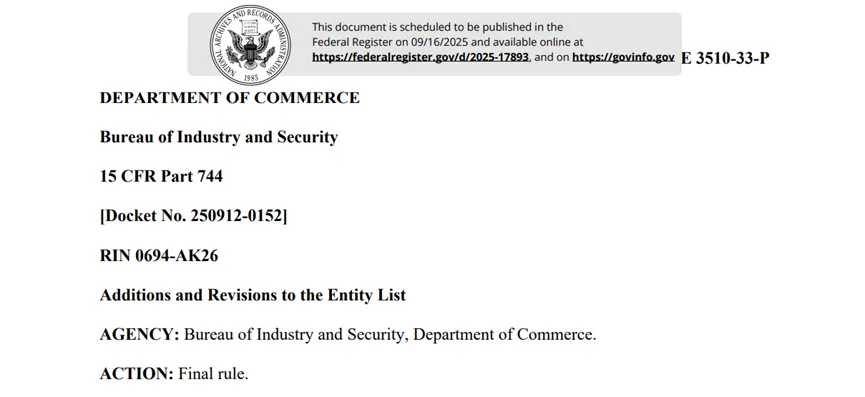 (Source: U.S. Federal Register website)
Once placed on the Entity List, these entities face strict export control restrictions. Specifically, any export, reexport, or in-country transfer of all items subject to the Export Administration Regulations (EAR) to these entities requires a license from BIS. BIS will apply a policy of “Presumption of Denial” or “Case-by-Case Review” for license applications related to these entities, making it extremely difficult to obtain a license.
I. Main Contents of the Final Rule
This final rule makes three major revisions to the Entity List:
-
Adds 32 entities to the Entity List, determining that these entities are involved, or pose a risk of being involved, in activities contrary to U.S. national security or foreign policy interests. Over half of these are Chinese entities or their overseas branches.
-
Updates information for one existing entity on the Entity List by removing two addresses for Russia’s Intertech Rus LLC.
-
Corrects spelling errors in 27 existing entries on the Entity List, involving entities from Belarus (3), China (11), Iran (1), Pakistan (1), Russia (9), and Turkey (2).
II. List of Newly Added Entities and Reasons for Addition (by Destination)
1. China (23 entities):
The 23 newly added entities and the main reasons for their inclusion are as follows:
(1) National Time Service Center, Chinese Academy of Sciences: Added for acquiring and attempting to acquire U.S.-origin items to support China’s military and defense-related space activities and China’s quantum technology capabilities. Given the military applications of quantum technology, these activities have serious implications for U.S. national security.
(2) Beijing Fudan Microelectronics Technology Co., Ltd.; Shanghai Fudan Microelectronics Co., Ltd.; Shenzhen Fudan Microelectronics Co., Ltd.; Shanghai Fukong Hualong Microsystem Technology Co., Ltd.; Shanghai Fuwei Xunjie Digital Technology Co., Ltd.; Shanghai Hualing Integrated Circuit Technology Co., Ltd.; and Shanghai Fudan Microelectronics (Hong Kong) Co., Ltd.: These entities have acquired and attempted to acquire U.S.-origin items to support China’s military modernization, participate in China’s advanced computing and integrated circuit manufacturing and distribution industries, and directly supply China’s military, government, and security apparatus. Among them, Shanghai Fudan Microelectronics and Shanghai Hualing, due to their involvement in the production of high-performance computing (HPC) chips, including AI and other dual-use applications, and because the former has provided technology to Russian military end users, have been marked with Footnote 4[2], extending the scope of controls to relevant foreign-produced items incorporating U.S. technology.
(3) Huake Logistics (Hong Kong) Co., Ltd.; Huake Supply Chain (Hong Kong) Co., Ltd.; Shenzhen Xinlikang Supply Chain Management Co., Ltd.: These entities have been involved in transferring dual-use items to sanctioned entities, including the Iranian military.
(4) Aerospace Information Research Institute, Chinese Academy of Sciences: This entity has connections with companies supporting China’s high-altitude balloon program.
(5) JMC Semiconductor Technology (Wuxi) Co., Ltd.; Jicun Semiconductor Technology (Shanghai) Co., Ltd.: These entities have procured U.S.-origin semiconductor manufacturing equipment for parties on the Entity List without BIS authorization.
(6) Beijing Tianyi Huiyuan Biotechnology Co., Ltd.; Beijing Qingke Biotechnology Co., Ltd.; Sangon Biotech (Shanghai) Co., Ltd.: There is an unacceptable risk that these entities use or transfer U.S.-origin items to the People’s Liberation Army Academy of Military Medical Sciences (AMMS).
(7) Shanghai Suochen Information Technology Co., Ltd.; Hong Kong Suochen Information Technology Co., Ltd.: These entities develop computer-aided engineering software for key customers in China’s military-industrial complex, including customers on the BIS list.
(8) Changsha Nanfei Microelectronics Co., Ltd.; Changzhou Nanfei Microelectronics Co., Ltd.; Chengdu Nanfei Microelectronics Co., Ltd.; Shenzhen Nanfei Microelectronics Co., Ltd.: These entities pose a risk of export control evasion and transfer of items to listed entities.
2. Singapore (1 entity):
Shanghai Fudan Microelectronics (Hong Kong) Co., Ltd. (Singapore Branch): Reason for inclusion same as Shanghai Fudan Microelectronics (Hong Kong) Co., Ltd.
3. Taiwan Region (1 entity):
Shanghai Fudan Microelectronics (Hong Kong) Co., Ltd. (Taiwan Representative Office): Reason for inclusion same as Shanghai Fudan Microelectronics (Hong Kong) Co., Ltd.
4. India (1 entity):
AR Sales Pvt Ltd: Without authorization, has transferred or attempted to transfer U.S.-origin items to Russia, and has engaged in delaying, evasive, or misleading conduct during end-use checks (EUCs).
5. Turkey (3 entities):
Atempo Proje Taahhüt Ses ve Görüntü Sistemleri Anonim Şirketi İstanbul Şubesi (Atempo); EB Teknoloji Sistemleri Anonım Şirketi (EB Teknoloji); and Dentun Elektronik: These entities have transferred controlled U.S. items to Russia without authorization. Because Atempo and EB Teknoloji pose a significant risk of supplying or transferring EAR-controlled items to Russia’s defense industry or intelligence service procurement networks, they have been marked with Footnote 3[3].
6. Iran (1 entity):
Smart Mail Services (Iran entity): Identified as a supporter of the illicit transshipment network of Hossein Hatefi Ardakani.
7. United Arab Emirates (2 entities):
HAS General Trading LLC: Suspected of exporting items to Iran and Russia in violation of regulations.
Smart Mail Services (UAE entity): Reason for inclusion same as Smart Mail Services (Iran entity).
For the vast majority of the newly added entities, the license requirement is that a license from BIS is required for any export, reexport, or in-country transfer of all items subject to the EAR (for entities marked with Footnotes 3 and 4, the scope of restrictions extends to certain foreign-produced items). BIS will apply a policy of “Presumption of Denial” or “Case-by-Case Review” for license applications related to these entities, making it extremely difficult to obtain a license.
III. Core of the Entity List Update: Precision Strikes and Containment
This update to the Entity List is highly targeted and specific in its pursuit of Chinese enterprises. First, the focus is clear, directly targeting key technology areas:
| Field | Number of Entities | Entities Involved |
|---|---|---|
| Semiconductors | 13 | Fudan Microelectronics Group’s related companies in Beijing/Shanghai/Shenzhen/Hong Kong, Shanghai Hualing Integrated Circuit Technology Co., Ltd., JMC Semiconductor Technology (Wuxi) Co., Ltd., etc. |
| Biotechnology | 3 | Beijing Tianyi Huiyuan Biotechnology Co., Ltd., Beijing Qingke Biotechnology Co., Ltd., Sangon Biotech (Shanghai) Co., Ltd. |
| Aerospace Remote Sensing, Quantum Technology | 2 | Aerospace Information Research Institute, Chinese Academy of Sciences; National Time Service Center, Chinese Academy of Sciences |
| Industrial/Engineering Software | 2 | Shanghai Suochen Information Technology Co., Ltd., Hong Kong Suochen Information Technology Co., Ltd. |
| Supply Chain and Logistics | 3 | Huake Logistics (Hong Kong) Co., Ltd., Huake Supply Chain (Hong Kong) Co., Ltd., Shenzhen Xinlikang Supply Chain Management Co., Ltd. |
As shown in the table above, the newly added Chinese entities are highly concentrated in targeting China’s high-tech industries, particularly in semiconductors and biotechnology. This reflects the U.S. government’s strategy to control the ability of China and other countries to advance in key technology fields, and highlights the U.S. intent to continue applying pressure on critical technologies.
Second, by imposing “Footnote 4” restrictions on some entities, the extreme restrictions based on the Foreign Direct Product Rule (FDPR) are applied to more Chinese advanced computing and semiconductor enterprises. This means that even foreign-produced items that are not made in the U.S. but incorporate specific U.S. technology cannot be supplied to these entities, greatly expanding the scope of controls.
Third, closing loopholes and increasing vigilance over third-country transshipment. This list not only targets entities in Mainland China but also includes operating entities in other regions, such as the entities of Shanghai Fudan Microelectronics (Hong Kong) Co., Ltd. operating in Singapore and Taiwan. Additionally, multiple logistics and supply chain companies have been added to the Entity List for transshipping controlled items. This indicates that BIS is systematically cracking down on what it considers “illicit transshipment networks” supporting Iran and Russia, aiming to close channels for circumvention and transshipment of goods through third countries.
IV. Potential Impact and Subsequent Trends
1. For Chinese Technology Enterprises
In the short term, entities placed on the list will face immediate and sudden supply chain disruptions, unable to directly obtain key technologies, software, and equipment from the U.S. and many allied countries, severely hampering their R&D and production processes. In the long term, this will further force China to accelerate technological self-reliance and substitution.
2. For Global Supply Chains
Global enterprises that have business dealings with these entities will need to conduct strict due diligence and comply with U.S. EAR regulations when trading controlled items, or else face the risk of U.S. sanctions. This will increase the compliance costs and complexity of global trade.
3. Future Trends
Through the continuous addition of footnote categories and the use of footnotes in recent years, BIS has been able to flexibly tailor export control measures to specific entities. It is expected that BIS’s export control measures will become more precise in the future, and emerging fields such as biotechnology, artificial intelligence, and quantum technology will increasingly become the next key targets.
Reference Notes:
[1] https://public-inspection.federalregister.gov/2025-17893.pdf
[2] For entities marked with “Footnote 4,” “items subject to the EAR” include foreign-produced items subject to the EAR under § 734.9(e)(2) of the EAR. For license requirements and license review policies, refer to § 744.11(a)(2)(iv) of the EAR.
[3] For entities marked with “Footnote 3,” “items subject to the EAR” include foreign-produced items subject to the EAR under § 734.9(g) of the EAR. For license requirements, license review policies, and license exception restrictions, refer to §§ 744.11, 744.21, and 746.8 of the EAR.
Intern Xie Chuxin also contributed to this article.
Contact Lawyer
Submit your contact details and consultation question. We will follow up ASAP.