
UAV Export Control and Prevention of Smuggling Legal Risks
UAV Export Control and Prevention of Smuggling Legal Risks
China is the world's largest UAV producer and exporter. This article systematically examines the legal boundaries of UAV exports from six perspectives: regulatory framework, scope of controls, common misconceptions, administrative risks, criminal risks, and compliance guidance. It explains the dual military-item and dual-use-item control systems, supplemented by technology export controls, analyzes seven common compliance misconceptions, and provides practical guidance from item identification and licensing through customs declaration, end-user and end-use review, post-export obligations, and self-checks.
Introduction
China is the world’s largest producer and exporter of Unmanned Aerial Vehicles (UAVs / drones). According to industry data, China’s UAV exports reached 4,947,300 units in 2025, a year-on-year increase of 32.9%. In the first four months of 2026, exports reached 1.67 million units, up 34.7% year-on-year, with an export value of USD 1.09 billion, maintaining a growth rate of over 39%. Amidst this rapid expansion, export control regulations have tightened, leading to a rise in administrative cases involving non-compliant exports of drones and related items.
UAVs possess both civilian utility and military modification potential, making them classic “dual-use items.” Evading supervision by altering technical specifications, misdeclaring product descriptions, or dismantling parts can cross the line from general administrative violations into serious criminal offenses that threaten national security and export control order.
This article examines the current regulatory frameworks, control parameters, common corporate misconceptions, administrative penalties, criminal liabilities, and compliance guidelines to clarify the legal boundaries of UAV exports.
I. Current UAV Export Control System
China regulates UAV exports through a dual framework of military controls and dual-use item controls, supplemented by technology export controls.
(1) Hierarchical Structure of Legal Frameworks
China’s UAV export controls are structured around a comprehensive three-tier regulatory framework consisting of fundamental laws, executive administrative regulations, and detailed departmental control lists, catalogs, and public announcements.
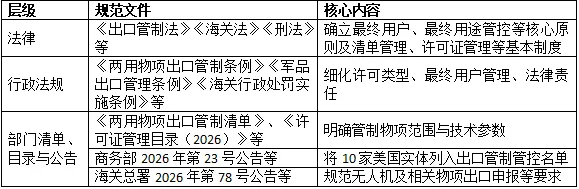
(2) Military Controls
Pursuant to Category VIII (“Military Aircraft and Their Equipment and Installations”) of the Military Export Control List, reconnaissance drones, electronic warfare drones, attack drones, and unmanned helicopters are categorized as military items. Military exports are subject to an exclusive operations system; only designated state-authorized military trade enterprises are permitted to export military items. Such exports require a three-tiered approval process (project initiation, contract approval, and license issuance) by the State Administration of Science, Technology and Industry for National Defense (SASTIND) rather than the Ministry of Commerce (MOFCOM).
(3) Dual-Use Item Controls
Under the Export Control List of Dual-Use Items and the Import and Export License Management Catalog (2026 Edition), exporters must obtain a Dual-Use Items and Technologies Export License from MOFCOM prior to shipment.
(4) Technology Export Controls
Pursuant to Item No. 203912X of the Catalog of Technologies Prohibited or Restricted from Export, key technologies such as autonomous navigation, adaptive control, sense-and-avoid capabilities, payload technologies, and flight control system algorithms and software are restricted. Cross-border technology transfers—whether via software copying, network transmission, cloud deployment, training foreign nationals, or providing technical consultation—require prior licensing from MOFCOM.
(5) Recent Regulatory Developments
Announcement No. 78 of 2026 issued by the General Administration of Customs (effective June 30, 2026) tightened customs declaration requirements:
- For controlled items, the “Remarks” column must state “Subject to Export Control” alongside the corresponding control code. Items with close characteristics but not subject to controls must be declared as “Not Subject to Export Control.”
- Cross-border e-commerce platforms are prohibited from using simplified customs declarations and must provide complete HS codes, full names of overseas consignees, and information regarding domestic manufacturers or sellers.
- Customs declarations must be accompanied by supporting contracts, invoices, and technical data sheets.
Furthermore, MOFCOM regularly updates its export control list. In June 2026, 10 U.S. entities, including Aveox, Inc., Red Cat Holdings, Inc., and Teal Drones, Inc., were added to the export control restriction list.
II. Scope of UAV Export Controls
The scope of export controls is determined strictly by technical specifications rather than product names, marketing descriptions, or Harmonized System (HS) codes.
.Dd4GZA0d_Ejd8E.webp)
III. Common Corporate Misconceptions and Pitfalls
Misconception 1: Relying on HS codes instead of technical parameters to assess control status
Exporters often assume that if an HS code lacks the regulatory indicator “3” (Dual-Use Items and Technologies Export License) in the Single Window declaration system, the product can be exported freely.
This is a common and critical error. While HS codes serve customs statistics and tariff collection, they are not designed to determine export control classifications. The sole basis for export control is whether the technical parameters of the item reach the thresholds specified in the Dual-Use Export Control List.
Attorney Chi Meng’s Advice: The correct approach is to first compare the technical specifications of the product with the Dual-Use Export Control List, and use HS codes only as a secondary reference for tariff classification, not the other way around.
Misconception 2: Treating MOFCOM’s inquiry reply as an export license
Some exporters obtain a written confirmation from MOFCOM stating that a product does not fall under current dual-use controls and assume this serves as a perpetual waiver.
However, these inquiry replies are valid for only six months and carry a duty of care: if the exporter later discovers or should know of a proliferation risk, they must still apply for a license. Additionally, Customs has independent authority to challenge declarations; a MOFCOM reply does not bind Customs.
Attorney Chi Meng’s Advice: MOFCOM’s reply is based solely on formal paper reviews and is not a guarantee of a customs waiver. Exporters must verify physical specifications prior to shipment; intentionally using a reply letter in place of a license constitutes non-compliant export or smuggling.
Misconception 3: Assuming a license permits unrestricted distribution
Some businesses assume that once a license is issued, the identity of the end-user or the final destination is irrelevant. Dual-use licenses strictly link “one contract, one end-user, and one specific use.” Providing false end-user details invalidates the license ab initio, converting the export into an unauthorized transaction subject to smuggling charges.
Attorney Chi Meng’s Advice: Any change in the end-user, end-use, or destination country requires a new license application. Shipping goods while knowing that the overseas buyer has changed the final destination is a major compliance violation.
Misconception 4: Assuming “civilian” or “consumer” labels guarantee safety from controls
Control status depends on performance parameters, not retail channels or branding. A popular consumer aerial photography drone with a flight time exceeding 30 minutes and beyond-visual-line-of-sight (BVLOS) capabilities may fall under Category 9A012.
Attorney Chi Meng’s Advice: Customs inspections analyze objective specifications rather than commercial packaging. Many high-performance civilian and consumer drones exceed the regulatory thresholds.
Misconception 5: Believing manufacturers bear no liability if they do not export directly
Manufacturers who supply traders despite red flags—such as requests to alter product parameters, remove labels, deliver to high-risk regions, disassemble complete units, or inflate prices significantly—can be held liable as accomplices to smuggling.
Attorney Chi Meng’s Advice: Criminal judicial practices apply a look-through approach. If a manufacturer supplies products while knowing of a distributor’s intent to smuggle, they may face prosecution as an accomplice.
Misconception 6: Assuming ignorance of the law or lack of intent guarantees exemption
Defendants often claim they were unaware of export controls or the technical classification of their products. However, judicial intent is established through objective circumstances. Under Chinese judicial guidelines, actions such as using concealed compartments, trading in non-designated areas, or repeating violations after prior warnings are sufficient to establish constructive knowledge.
Attorney Chi Meng’s Advice: In export control matters, ignorance of the law is not a viable defense. Exporters are legally presumed to know and comply with relevant regulations.
Misconception 7: Dismantling complete UAVs into parts to evade controls
Exporters sometimes ship frames, flight controllers, and payloads separately to bypass complete unit restrictions. If discovered, authorities treat this as deliberate evasion, establishing criminal intent.
Attorney Chi Meng’s Advice: Article 39 of the Regulations on Export Control of Dual-Use Items explicitly prohibits dismantling or modifying items to circumvent licensing. This practice is a major focus of Customs enforcement.
IV. Administrative Risks and Relevant Regulations
(1) Administrative Penalties for Violating Dual-Use Controls
Under Article 34 of the Export Control Law:
| Scenario | Penalty Standards |
|---|---|
| Transaction Value ≥ RMB 500,000 | Confiscation of illegal gains, and a fine of 5 to 10 times the transaction value |
| Transaction Value < RMB 500,000 | Confiscation of illegal gains, and a fine of RMB 500,000 to RMB 5 million |
| Serious Cases | Suspension of operations or revocation of export business qualifications |
Under Article 39: Exporters penalized under these provisions will not be granted export licenses for five years; directly responsible personnel will be barred from export operations for five years, or permanently if criminally convicted.
(2) Penalties under Customs Regulations
Under the Regulations on the Implementation of Customs Administrative Penalties:
| Violation Type | Legal Basis | Penalty Standards |
|---|---|---|
| Failure to submit license | Article 14 | Fine up to 30% of goods value |
| Inaccurate declaration affecting licensing | Article 15 | Fine of 5% to 30% of goods value |
| Smuggling without tax evasion | Article 9 | Confiscation of goods and illegal gains, with a fine up to the value of the smuggled items |
(3) Selected Case Examples
Case 1: Autel Robotics Co., Ltd. was fined RMB 570,000 by Wuhan Customs for exporting UAVs without dual-use licenses.
Case 2: Shanghai Changyan International Trade Co., Ltd. was fined RMB 320,000 by Pudong Customs for declaring 20-liter agricultural drones as standard multi-rotor agricultural equipment.
Case 3: Pingtan Airier Import and Export Trade Co., Ltd. was fined RMB 10,000 for concealing a DJI 3WWDZ-40B model drone (with a 40L tank, a controlled item under 9A501) via simplified e-commerce declaration (9610), with a transaction value of RMB 20,110.
Case 4: A Danyang-based trade company exported 17 agricultural drones (with a take-off weight of 47.75kg, autonomous flight systems, and 22L sprayers) using non-controlled HS codes despite warnings from their freight forwarder, resulting in an administrative fine of RMB 500,000.
V. Criminal Risks
(1) Applicable Criminal Charges
1. Crime of Smuggling Goods or Articles Prohibited from Import or Export by the State
Under Article 151(3) of the Criminal Law and Article 21 of the Supreme People’s Court and Supreme People’s Procuratorate Judicial Interpretation on Smuggling Cases: Exporting restricted dual-use items without a license constitutes the crime of smuggling prohibited goods.
| Scenario | Sentencing |
|---|---|
| Value of RMB 200,000 to RMB 1,000,000, or 20 to 100 tons | Up to 5 years of imprisonment or detention, and/or a fine |
| Value of RMB 1,000,000 or above, or 100 tons or above | Over 5 years of imprisonment and a fine |
| Corporate Liability | Fines for the corporation, and criminal liability for directly responsible management personnel |
2. Crime of Smuggling Weapons or Ammunition
Under Article 151(1) of the Criminal Law, if drones are classified as military items, weapon modifications, or meet firearms definitions, exporters face severe sentencing.
| Comparison | Smuggling Goods Prohibited by the State | Smuggling Weapons or Ammunition |
|---|---|---|
| Object | Controlled dual-use UAVs | UAVs classified as “weapons” |
| Legal Basis | Article 151(3) of the Criminal Law | Article 151(1) of the Criminal Law |
| Max Sentence | 15 years of imprisonment | Life imprisonment |
| Threshold | Value ≥ RMB 200,000 or weight ≥ 20 tons | No value threshold required |
3. Other Associated Crimes
Fraudulent export tax refunds, money laundering, forging state documents, or illegally providing state secrets abroad may lead to concurrent sentencing.
(2) Common Methods of Smuggling
| Method | Common Behavior | Judicial Assessment |
|---|---|---|
| Misdeclaration | Declaring controlled drones as toys or normal agricultural tools | Establishes criminal intent |
| Parameter Alteration | Falsifying range, load capacity, or battery life | Constitutes evasion of customs supervision |
| Dismantled Export | Shipping parts separately to reassemble abroad | Explicitly prohibited by export control regulations |
| Concealment | Hiding controlled UAVs within non-controlled shipments | Establishes intent to evade inspections |
| License Abuse | Purchasing, renting, or borrowing licenses from others | Prosecuted as smuggling under judicial guidelines |
| Transit Routing | Shipping to Country A to transfer to restricted destinations | Establishes knowledge of illicit flow |
| Falsifying End-User | Listing an unauthorized user to match an active license | Invalidates license; prosecuted as unlicensed export |
(3) Intersection with Military Control Risks
| Comparison | Dual-Use Controls | Military Controls |
|---|---|---|
| Authority | Ministry of Commerce (MOFCOM) | SASTIND / Central Military Commission |
| Licensing | Dual-Use Item Export License | Military Export License |
| Operator | No exclusive operation restrictions | Strict monopoly; non-military entities barred |
| Liability | Administrative fines or smuggling charges | Serious national security offense charges |
(4) Determination of Criminal Intent (Mens Rea)
In UAV exports, establishing intent is vital to distinguish general compliance errors from criminal smuggling. Intent is assessed based on objective evidence:
- Attitude & background: Professional knowledge or prior warnings.
- Procedural anomalies: Falsifying descriptions, dismantling components, or low-value declarations.
Direct intent indicators:
- Clear evidence that the exporter knew parameters exceeded limits but declared them as civilian.
- Falsifying parameters or dismantling parts to avoid licensing.
- Concealing controlled items in general cargo.
- Diverting shipments to bypass restricted end-user designations.
Constructive intent indicators:
- Exporting at prices significantly higher than normal market rates.
- Instructing freight forwarders to misdeclare HS codes to simplify clearance.
- Deleting communication or transaction records upon customs notice.
- Removing performance-enhancing modules for customs inspection, to be reinstalled post-export.
Absence of intent indicators:
- Genuine classification disputes without intent to deceive.
- Reliance on professional customs brokers or suppliers while maintaining reasonable care.
- First-time errors with transparent disclosures in normal trade.
(5) Factors Distinguishing Principal and Secondary Accomplices
In joint smuggling cases, the division of responsibility depends on:
- Origin of intent: Who initiated the smuggling plan and coordinated the transaction.
- Execution of declarations: Who handled falsifications, alterations, or arranged shipping.
- Roles and hierarchy: Group leadership vs. hired general labor.
- Process control: Who maintained decision-making authority over the transaction.
- Distribution of proceeds: Who received the majority of the profits.
(6) Liability of Different Entities
| Entity | Role | Liability Assessment |
|---|---|---|
| Manufacturer | Production | Liable as an accomplice if aware of smuggler’s intent; not liable if proper due diligence was performed |
| Distributor | Trading | Presumed to know export control regulations; often treated as a principal offender |
| Broker / Forwarder | Customs clearance | Liable as an accomplice if they knowingly assist in falsifying declarations |
| Logistics Provider | Transport | Liable if they transport goods while knowing of the smuggling activity |
| End-User | Application | Must provide verified end-use certificates; barred from unauthorized transfers |
VI. Operational Compliance Guidelines for UAV Exports
(1) Pre-export: Item Classification and Licensing
Step 1: Classification Analysis
- Review the Dual-Use Export Control List and current Import and Export License Management Catalog.
- Assess based strictly on physical technical specifications, not HS codes or marketing descriptions.
- Utilize the “Dual-Use Item Query” tool on China’s Export Control Information Network.
- Apply for a formal determination from MOFCOM if specifications are ambiguous.
Step 2: License Application Submit required documentation to MOFCOM: business license, export contract, detailed product parameters and testing reports, end-user and end-use certificates, and corporate compliance undertakings.
Processing time: MOFCOM typically completes reviews within 45 working days; sensitive items may require inter-departmental reviews.
(2) Declaration: Key Customs Compliance Points
Under Customs Announcement No. 78 of 2026:
- Remarks details: For controlled items, write “Subject to Export Control” and state the control code. For similar but non-controlled items, write “Not Subject to Export Control.”
- Customs elements: Enter correct information under “Restriction Control Code” and “Restriction Control Declaration Elements” in the Single Window.
- E-commerce rules: Use complete declarations; simplified methods are barred. Enter the full name of the overseas consignee and details of the domestic manufacturer.
- Supporting documents: Attach contracts, commercial invoices, and technical data sheets to the customs entry.
(3) Pre-transaction: End-user and End-use Verification
End-user verification: Screen all counterparties against UN sanctions, MOFCOM lists, and domestic export control databases. Track updates regularly and perform look-through checks on intermediaries.
End-use verification: Obtain written commitments from end-users specifying that items are strictly for civilian applications and will not be transferred or diverted without authorization.
(4) Post-export: Ongoing Compliance Obligations
- Transaction tracking: If you suspect an end-user intends to divert the item or change its application post-export, immediately suspend shipments and report to MOFCOM.
- Record-keeping: Retain all export contracts, invoices, shipping documents, and end-user certificates for at least five years.
- Amendments: Any changes to key terms require a new license application.
(5) Compliance Self-Checklist
| No. | Item | Verification Point |
|---|---|---|
| 1 | Technical Parameters | Check if specifications exceed thresholds under 9A012 or 9A501. |
| 2 | Engine Capacity | Check if maximum continuous power exceeds 16 kW. |
| 3 | Payload Features | Assess infrared, SAR, laser, or inertial measurement systems. |
| 4 | Communication Systems | Check if video range exceeds 50 km or multi-vehicle control exceeds 10 units. |
| 5 | Counter-UAV Systems | Assess if jammer range exceeds 5 km or laser power exceeds 1.5 kW. |
| 6 | End-User Screening | Verify the buyer is not on any restriction or unverified list. |
| 7 | End-Use Verification | Confirm there is no risk of military or unauthorized application. |
| 8 | Destination Country | Identify if the destination country is classified as high-risk. |
| 9 | License Status | Confirm a valid export license is active. |
| 10 | Customs Declaration | Ensure declaration details match physical cargo and supporting invoices. |
Conclusion
UAV export control has evolved from routine trade management into a crucial component of national security. Amid rising global geopolitical tensions, controls on drones and related items will continue to expand.
For exporters, compliance is not a barrier to growth but a safeguard for business continuity. Companies should establish robust internal compliance programs spanning item classification, client verification, and post-export tracking. When regulatory issues arise, management should consult experienced legal counsel promptly to assess and manage risks.
The boundary of smuggling must not be crossed. Adhering to regulatory standards is the only way to ensure long-term stability in complex global markets.
Contact Lawyer
Submit your contact details and consultation question. We will follow up ASAP.