
LiDAR Giant Hesai Technology Loses Lawsuit Against U.S. Government: Judgment Logic Raises Global Corporate Compliance Alarms
LiDAR Giant Hesai Technology Loses Lawsuit Against U.S. Government: Judgment Logic Raises Global Corporate Compliance Alarms
Attorneys OU Yingshi and PAN Yetong note that in July 2025, the U.S. District Court for the District of Columbia dismissed Hesai Technology's lawsuit against the U.S. Department of Defense (DoD), supporting the DoD's inclusion of Hesai Technology on the 1260H 'Chinese Military Companies' list and ruling that it did not violate the Administrative Procedure Act (APA). The court held that LiDAR technology possesses dual-use (military and civilian) attributes, and because the company is located in a government-recognized 'military-civil fusion' industrial park, it met the statutory criteria of being a 'military-civil fusion contributor' and a 'contributor to the defense industrial base.' The DoD's determination was supported by substantial evidence, and the procedures did not cause substantive prejudice to Hesai. Hesai Technology strongly opposed the judgment, emphasizing that its products are strictly for civilian use with no military ties, and has appealed to the Federal Court of Appeals. This ruling highlights the DoD's broad discretionary power in military-related determinations. Being added to the list subjects a company to severe consequences, including bans on U.S. defense contracts, OFAC sanction risks, Military End User (MEU) designation, and reputational damage. The article warns that this standard—substituting 'actual military supply facts' with 'potential military use'—could broadly affect multinational tech companies operating in China, advising relevant enterprises to closely monitor compliance developments and actively defend their rights through administrative petitions or judicial litigation.
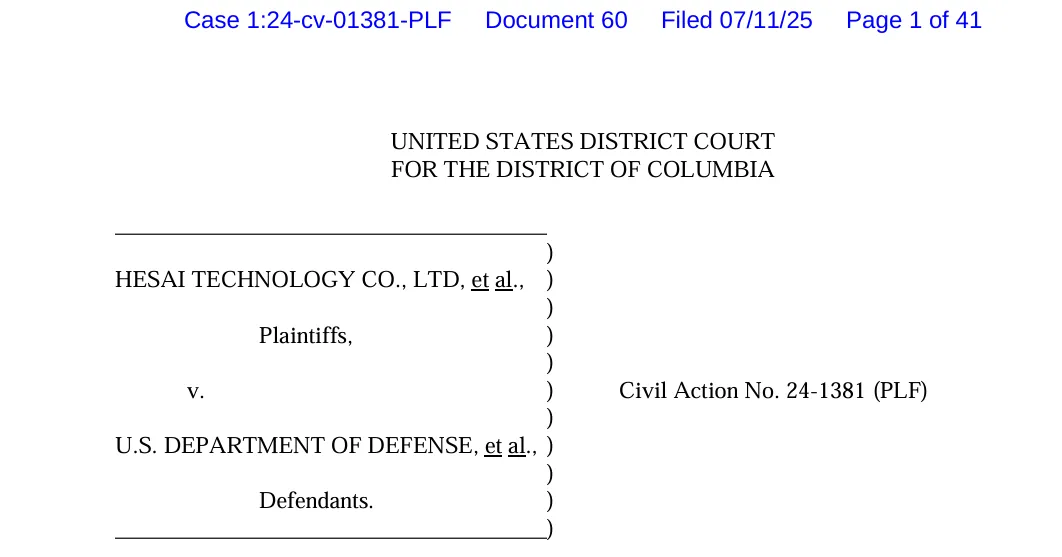
In July 2025, in the case of Hesai Technology Co., Ltd. (hereinafter “Hesai Technology”) vs. the U.S. Department of Defense (DoD), the U.S. District Court for the District of Columbia denied Hesai Technology’s motion for summary judgment and granted the DoD’s cross-motion for summary judgment. The court ruled that the DoD’s designation of Hesai Technology on the “Chinese Military Companies” list (hereinafter the “1260H List”) under Section 1260H of the National Defense Authorization Act (NDAA) for Fiscal Year 2021 did not violate the Administrative Procedure Act (APA). [1]
In response to this outcome, Hesai Technology explicitly expressed its opposition in a July 14 press release, arguing that the DoD’s determination lacked factual and legal basis. CEO Li Yifan emphasized that the DoD has from start to finish failed to find any evidence that Hesai Technology’s products are used for military purposes or that there is any direct or indirect connection with the Chinese military. This is entirely consistent with Hesai Technology’s long-standing insistence that its products are used exclusively in civilian and commercial sectors. Hesai Technology pointed out that the court’s judgment was based on merely two far-fetched reasons: first, the company’s R&D centers are located in areas identified as military-civil fusion industrial parks, such as the Chongqing Economic and Technological Development Zone and the Shanghai Jiading Industrial Zone; second, LiDAR technology possesses theoretical military application potential. However, these reasons could equally apply to countless enterprises operating in China, including American and international companies, falling far short of the actual contribution to the military standard required by law. Currently, Hesai Technology has filed an appeal with the U.S. Federal Court of Appeals, vowing to defend its reputation through legal channels.
If Hesai Technology ultimately loses, it means the company is deemed to meet the criteria of a “military-civil fusion contributor” and a “contributor to the Chinese defense industrial base,” which could subject the company’s operations in the United States to numerous restrictions or prohibitions.
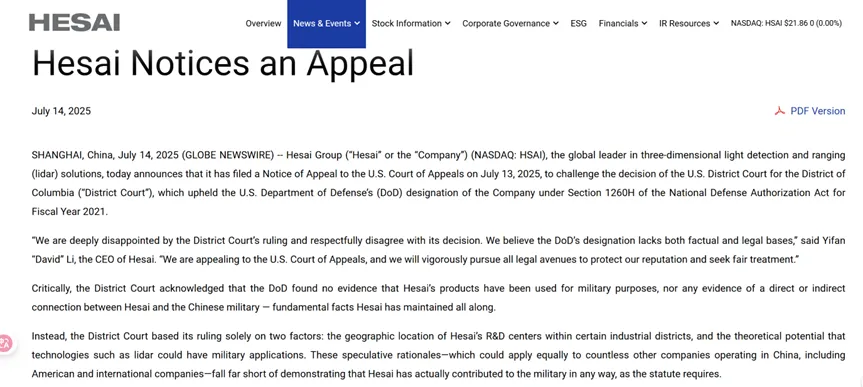 (Image Source: Hesai Group Official Website)
I. Introduction to the Parties and Case Timeline
(I) Parties to the Lawsuit
- Hesai Technology
Hesai Group is a holding company incorporated under the laws of the Cayman Islands and headquartered in Shanghai, China, with its shares listed and traded on Nasdaq. Hesai Group has branches in the United States, Germany, Japan, and South Korea, with business expanding across more than 40 countries globally. The plaintiff in this case, Hesai Technology, is a wholly-owned subsidiary of Hesai Group. Hesai Technology wholly owns Hesai Inc., which is incorporated in California and has offices in Palo Alto, California, and Detroit, Michigan.
According to its official website, Hesai Group is a global leader in LiDAR technology. Its business primarily focuses on the R&D, production, and sales of LiDAR, with products widely used in passenger and commercial vehicles equipped with advanced driver-assistance systems (ADAS), as well as autonomous vehicles, delivery robots, mobile robots, and other robotics applications. Numerous mainstream global automakers have adopted Hesai’s LiDAR products.
- U.S. Department of Defense (DoD)
The DoD is the federal executive department responsible for coordinating and supervising all agencies and functions of the government relating directly to national security and the military. Under Section 1260H of the FY2021 NDAA, the Secretary of Defense is authorized and obligated to identify and list Chinese military companies annually. It can be said that the DoD is not only the creator and gatekeeper of the 1260H List but also the critical initiating node in the U.S. chain of policies targeting “military-related” entities in China.
(II) Case Timeline
| Time | Situation |
|---|---|
| November 02, 2023 | The DoD issued a preliminary decision memorandum determining that Hesai Technology met the definition of a Chinese Military Company under Section 1260H of the FY2021 NDAA, on the grounds that it had ties with China’s Ministry of Industry and Information Technology (MIIT) and was a “military-civil fusion contributor.” |
| January 31, 2024 | The DoD added Hesai Technology to the 1260H List [2]. |
| March 08, 2024 | Hesai Technology sent a detailed letter and a sworn declaration from its CEO to the DoD, refuting the DoD’s determination. |
| May 13, 2024 | Hesai Technology filed a lawsuit in the U.S. District Court for the District of Columbia, requesting the court to declare the DoD’s determination unlawful and issue an injunction. |
| July 13, 2025 | The U.S. District Court for the District of Columbia issued its judgment: denying Hesai Technology’s motion for summary judgment and granting the DoD’s cross-motion, concluding it met the criteria for a “military-civil fusion contributor” and a “contributor to the Chinese defense industrial base.” |
| July 14, 2025 | Hesai Group issued a press release on its website, publicly opposing the court’s judgment, reiterating that its products are strictly for civilian use, and announcing it would defend its rights through legal channels. Hesai Technology submitted a notice of appeal to the U.S. Federal Court of Appeals on July 13 [3]. |
II. Core Disputes of the Case and Court’s Opinions
According to the opinion of the D.C. District Court, it primarily evaluated the summary judgment motions based on two core disputes: first, whether the DoD’s administrative action was arbitrary and capricious or otherwise in violation of the law; second, if there was an infringement of Hesai Technology’s due process rights, did such an infringement cause substantive prejudice to Hesai? To analyze these disputes and reach a conclusion, the court further explored core issues such as how “military-civil fusion contributor” and “contributor to the Chinese defense industrial base” should be defined, the definition of “dual-use,” and whether the DoD had sufficient critical evidence. Below, we summarize the viewpoints of Hesai Technology, the DoD, and the D.C. District Court on some noteworthy points of dispute.
(I) Were there issues with designating Hesai Technology as a “military-civil fusion contributor” under Section 1260H?
| Entity | Viewpoints / Arguments |
|---|---|
| Hesai Technology | 1. The DoD exceeded its congressional authorization and violated the law by broadly interpreting “contributing to the Chinese defense industrial base” to mean “any enterprise producing dual-use products” (i.e., constituting a contribution as long as the product “could be” used for military purposes). Additionally, the DoD’s factual basis is weak and contradictory (e.g., its initial determination stated the products were used for passenger vehicles, and it ignored Hesai’s rebuttal evidence). 2. The DoD’s designation of Hesai as a “military-civil fusion contributor” is unlawful because: (1) There is no evidence proving the MIIT “controls” Hesai; defining “affiliation” based merely on contact is overreach; (2) It determined Hesai “knowingly” violated the rule simply because it received government subsidies, participated in ministry projects, and was broadly labeled under “military-civil fusion”; (3) It provided no standard for what constitutes a “military-civil fusion industrial park,” and making a determination based solely on geographic location is absurd; (4) It wrongfully determined that Hesai “advertised on military platforms” based on unauthorized third-party resale information. |
| DoD | 1. Hesai’s LiDAR products are widely recognized as dual-use technologies that align with China’s “military-civil fusion” policy. The PLA uses such technologies in developing autonomous vehicles, therefore Hesai has contributed to the defense industrial base by developing these products. 2. The DoD has ample evidence and refutes Hesai’s claims: (1) “Affiliation” should be interpreted broadly and can be established through four factors: the “Little Giant” program, MIIT-supported projects, national standard setting, and administrative licensing; (2) “Knowingly” only requires knowing that assistance is being accepted; it does not require knowing it originated from military industrial planning; (3) The parks where Hesai established its R&D and manufacturing bases are explicitly designated by the Chinese government as strategic carriers for military-civil fusion; (4) Under Section 1260H (d)(2)(E), merely being located in a military-civil fusion industrial park is sufficient to designate it as a Chinese Military Company. |
| Court | 1. The DoD has provided “substantial evidence” showing that Hesai meets the provisions of 1260H(d)(2)(E) and that its LiDAR technology has “substantial military utility” to the “Chinese defense industrial base.” 2. Acknowledged the plain meaning of the definition of a military-civil fusion industrial park; being located within the park is sufficient for the designation without needing to prove actual supply to the military. 3. Once the 1260H(d)(2)(E) designation is established, the classification holds, so there is no need to review other clauses like (A), (B), (G), etc., one by one. 4. Agreed that an entity producing products or technologies that have substantial military utility, even if they have commercial uses, can be deemed as contributing to the “Chinese defense industrial base.” |
(II) To what extent does Section 1260H require the DoD to prove an entity has sufficient ties to the military to be designated as a Chinese Military Company?
1. Divergence on Entity Affiliation (Association)
| Entity | Viewpoint on “Affiliation” |
|---|---|
| Hesai Technology | Argued it must be proven that the entity has a “direct and sufficient” affiliation with the Chinese military or the defense industrial base, and asserted the DoD found no such evidence. |
| DoD | Argued that as long as an entity produces “dual-use” products that have “important applications” in the military, it is sufficient to establish a substantial affiliation with the military. |
| Court | Concluded there is no need to prove relationships like direct supply to the military; as long as its products or technologies have significant military application or utility, it fits the definition of a “Chinese Military Company.” In areas of national security, the DoD should be afforded high deference. |
2. Legality and Procedural Safeguards of the DoD’s Listing
A. Did it violate the APA’s “Arbitrary and Capricious” standard?
| Entity | Viewpoints / Arguments |
|---|---|
| Hesai Technology | 1. The DoD failed to articulate how the evidence fits the statutory elements, which constitutes being “arbitrary and capricious.” 2. The DoD did not define terms left undefined by Congress, merely listing scattered facts before declaring the standards met. 3. The DoD’s interpretation of relevant standards was excessively broad, its factual basis weak, and its evidence contradictory. |
| DoD | 1. Submitted sufficient evidence proving Hesai met the definition of a “military-civil fusion contributor” (e.g., MIIT affiliation, government tech assistance, park location, military platform advertising). 2. The determination is within statutory authority, and there is no need to independently prove the degree of contribution. 3. Using a “holistic assessment” and “delineating boundaries on a case-by-case basis” for statutory terms is a reasonable exercise of agency authority. |
| Court | Held that the DoD provided sufficient evidence indicating Hesai met the definition of a “Chinese Military Company,” and its actions did not violate relevant provisions of the APA. |
B. Was there an infringement of due process rights due to a lack of effective procedural safeguards?
| Entity | Viewpoints / Arguments |
|---|---|
| Hesai Technology | Believed it should have received adequate procedural safeguards (such as prior notice, an opportunity for a hearing, etc.) before being added to the list, and the DoD’s actions violated its due process rights. |
| DoD | Maintained the procedures were lawful. Hesai already had the opportunity to submit materials, and the DoD had fully considered Hesai’s rebuttal evidence when re-evaluating the decision. |
| Court | Hesai failed to prove it suffered prejudice due to procedural issues: 1. Hesai did not explain what critical evidence affecting the decision it could have presented had there been a hearing. 2. Hesai had, in fact, submitted evidence via letters in March-April 2024, which were included in the administrative record. 3. Conclusion: Since Hesai failed to point to any actual prejudice, the court could not find that it was deprived of due process rights. |
III. Introduction to the 1260H List
(I) What is the 1260H List?
The 1260H List emerged against the backdrop of Sino-U.S. technological competition. It is a “blacklist” created by the DoD pursuant to Section 1260H of the FY2021 NDAA, requiring the Secretary of Defense to publish annually—until December 31, 2030—a list of entities identified as Chinese military companies operating directly or indirectly in the United States or its territories [4]. Its purpose is to identify Chinese military enterprises operating directly or indirectly in the U.S. that have ties to the Chinese military.
Following amendments to the reporting requirements for Chinese military companies in the U.S. under Section 1346 of the FY2025 NDAA, the definition of a “Chinese Military Company” was expanded. According to the revised text, any entity is deemed to be “operating in the United States” if it sells goods, or procures goods or services in the U.S. or its territories, without needing a physical presence; and “affiliation” refers to close formal or informal relationships [5].
A Chinese Military Company includes entities with direct or indirect ties to the Chinese military, as well as those contributing to China’s military-civil fusion strategy. Hesai Technology was listed on the 1260H List because it was deemed to contribute to China’s military-civil fusion strategy. Specifically, entities contributing to this strategy include those engaged in the following activities:
① Strategic Support: Entities that knowingly accept funding from scientific research projects initiated by the Chinese government or the Communist Party through the military-industrial planning system, explicitly including official designation programs like “National Military-Civil Fusion Planning,” “Single Champion,” and “Little Giant.”
② Cooperative Enterprises: Entities having an “affiliation” (including research cooperation and projects) with the MIIT, SASAC, SASTIND, Ministry of State Security, PLA, Armed Police, Coast Guard, Border Defense, Public Security, or State Security.
③ Policy-Guided Operations: Entities receiving assistance, directives, or policy guidance from SASTIND.
④ State-Defined Defense Enterprises: Entities and their subsidiaries identified by the Chinese State Council as “military-industrial enterprises.”
⑤ Enterprise Parks: Entities located in military-civil fusion enterprise parks or receiving government support through such parks.
⑥ Licensed Military Production: Entities holding military production licenses issued by the government (e.g., licenses authorizing weapon research, production, or quality management).
⑦ Military Equipment Advertising: Entities placing advertisements on national, provincial, or civil military equipment procurement platforms.
⑧ Other Designations: Any entity the Secretary of Defense deems appropriate to designate.
Furthermore, the amendment to Section 1346 of the FY2025 NDAA introduced an equity penetration clause. This clause stipulates that if an entity itself qualifies as a Chinese Military Company under Section 1260H (d)(2)(B), its parent company or subsidiaries (if it owns or is owned by the entity with ≥50% equity control) can also be deemed a Chinese Military Company. This amendment provides the DoD with a stronger legal basis to effectively include affiliated entities on the 1260H List and impose corresponding restrictions.
(II) What are the potential impacts of being included on the 1260H List?
1. Restrictions on U.S. Defense Contracts
Entities and their affiliates on the 1260H List are prohibited from entering into, renewing, or extending contracts with the DoD for goods, services, or technology. Additionally, contracts with companies controlled by these listed entities are prohibited [6]. Furthermore, the Defense Federal Acquisition Regulation Supplement (DFARS) currently prohibits the DoD from procuring, directly or indirectly, any items covered by the United States Munitions List or the 600 series of the Commerce Control List from any “Communist Chinese Military Companies” [7]. Although the definition of “Communist Chinese Military Companies” is not explicitly tied to the 1260H List for “Chinese Military Companies,” the government is likely to reference the 1260H List when determining if an entity should be deemed a Communist Chinese Military Company.
2. Risk of Additional Designation by OFAC
Entities on the 1260H List face the risk of being added to the Non-SDN Chinese Military-Industrial Complex Companies List (“NS-CMIC List”) administered by the U.S. Department of the Treasury’s Office of Foreign Assets Control (OFAC).
3. Risk of Military End User (MEU) Designation
Being designated as a Chinese Military Company may increase the danger of the U.S. Department of Commerce’s Bureau of Industry and Security (BIS) viewing the entity as a Military End User. If certain items regulated under the Export Administration Regulations (EAR) are involved, this could lead companies seeking to transact with the entity to conduct extensive due diligence. Given these red flags, some commercial partners or financial institutions may be unwilling to engage in transactions involving Chinese companies on the 1260H List. If ultimately designated as a Military End User, the entity’s transactions involving EAR-restricted products would be limited.
4. Impact on International Market Reputation
Being placed on the list could negatively impact the company’s reputation in international markets, especially within the United States and its allied nations. This reputational damage could cause potential clients and commercial partners to harbor doubts about engaging in collaboration.
5. Increased Compliance Costs
Companies on the list may face higher compliance costs. They may need to invest significant resources to handle associated challenges and develop comprehensive risk mitigation strategies to address the long-term impacts of being listed.
IV. Summary
It is alarming that this case exposes the broad discretionary power possessed by the U.S. Department of Defense in relevant determinations, which may trigger a chain reaction. Under the logic of this judgment, even if a company does not actually participate in military activities, it could be labeled a military company simply by being located in a specific industrial park or because its civilian technology possesses potential military applications. This standard—substituting facts with possibilities—not only blurs the line between civilian and military activities but is also likely to plunge numerous multinational companies into a compliance trap. For instance, tech companies with R&D centers in China or international manufacturers cooperating with specific Chinese industrial parks could face sanctions for similar reasons. Such rulings may exacerbate the crisis of trust between U.S. and Chinese enterprises, disrupt the normal operations of global supply chains, and even force companies into overly conservative strategies regarding site selection and technological R&D, ultimately harming market innovation and fair competition.
For enterprises placed on the 1260H List, it is advisable, similar to Hesai Technology, to seek removal by applying through the administrative process explicitly outlined by the U.S. DoD in the Federal Register for entities petitioning for removal from the 1260H List, or to opt for litigation to defend their rights.
References and Notes:
[1] https://www.govinfo.gov/content/pkg/USCOURTS-dcd-1_24-cv-01381/pdf/USCOURTS-dcd-1_24-cv-01381-1.pdf
[2] https://media.defense.gov/2024/Jan/31/2003384819/-1/-1/0/1260H-LIST.PDF
[3] https://investor.hesaitech.com/news-releases/news-release-details/hesai-notices-appeal
[4] https://www.congress.gov/bill/116th-congress/house-bill/6395
[5] https://www.congress.gov/bill/118th-congress/house-bill/5009/text
[6] Section 805 of the FY 2024 NDAA (H.R. 2670) https://www.congress.gov/bill/118th-congress/house-bill/2670
Intern SHEN Zidan also contributed to this article.
Contact Lawyer
Submit your contact details and consultation question. We will follow up ASAP.