
A Summary of Judicial Practice on Corporate Dissolution Lawsuits for Breaking Corporate Deadlocks—Procedural Chapter
A Summary of Judicial Practice on Corporate Dissolution Lawsuits for Breaking Corporate Deadlocks—Procedural Chapter
Lawyers Jiao Chenglong and Wang Di systematically discuss the procedural rules for breaking corporate deadlocks through corporate dissolution lawsuits from a practical judicial perspective. Regarding the subjects of the litigation, the plaintiff must be a registered shareholder holding individually or in aggregate 10% or more of the company's voting rights, and defective capital contributions do not affect their right of action, as the proportion of voting rights is independent of the shareholding percentage. The company itself should be listed as the defendant. Other shareholders or interested parties can be listed as co-plaintiffs or third parties depending on their specific claims. The court's acceptance of the case requires strict examination of whether the company is in severe difficulty in operation and management and has exhausted other avenues of resolution. In terms of jurisdiction, territorial jurisdiction is determined by the place of the company's principal office, and level jurisdiction is determined by the level of the registration authority. Regarding preservation measures, although a dissolution lawsuit is an action for modification, the court may, upon application, adopt property or evidence preservation measures to safeguard shareholders' interests and facilitate subsequent liquidation. The preservation amount is proposed by the applicant after a comprehensive consideration of their own interest share, security capacity, and the company's business status, and is ultimately determined by the court within its discretion based on the case details.
With rapid economic development and strong support from national policies, establishing companies has become a new trend in the era of mass entrepreneurship. However, while public enthusiasm for establishing companies is high, the capability to operate and manage companies has not risen simultaneously. Due to the lack of professional legal guidance, many companies suffer from congenital deficiencies at their inception, such as unreasonable equity structures, incomplete articles of association, or chaotic agreements.
The shareholders’ meetings or directors of these companies can easily fail to make effective resolutions due to long-term unresolved differences, thereby throwing the company’s operation and management into predicament—a situation commonly known as a “corporate deadlock.”
There are many ways to resolve a “corporate deadlock.” This article, focusing primarily on practical judicial perspectives and covering both procedural and substantive aspects, discusses how to break a corporate deadlock by filing a company dissolution lawsuit.
I. Parties to Company Dissolution Litigation
(A) Plaintiff: Shareholders holding individually or in aggregate 10% or more of the voting rights of all shareholders of the company
1. How to determine shareholder status? Can a nominee/latent shareholder file a company dissolution lawsuit?
In judicial practice, whether a plaintiff possesses shareholder status is generally determined based on industrial and commercial registration records and the register of shareholders. For nominee (latent) shareholders who are neither recorded in the company’s register of shareholders nor registered with the industrial and commercial administration, although they enjoy investment returns, “investment returns” cannot be equated with “shareholders’ equity.” A nominee shareholder does not automatically enjoy shareholder status and cannot directly act as a qualified plaintiff to file a company dissolution lawsuit.
Nominee shareholders must first confirm their shareholder status through disclosure measures, such as separate litigation, before they can file a company dissolution lawsuit.
Case Link: The Case of Shen et al. v. A Certain Plastics Company, Liu et al. regarding a Corporate Dissolution Dispute
The court held that: Article 1 of the Provisions of the Supreme People’s Court on Several Issues Concerning the Application of the Company Law of the People’s Republic of China (II) stipulates, “Where shareholders holding individually or in aggregate 10% or more of the voting rights of all shareholders of a company file a company dissolution lawsuit based on one of the following grounds, and comply with the provisions of Article 182 of the Company Law, the people’s court shall accept the case…” The above provision indicates that the subject entitled to file a company dissolution lawsuit is a shareholder. According to general domestic legal theory, the connotation of “shareholder” in these provisions refers to a shareholder registered in the register of shareholders. Therefore, Shen and Ye, as the actual investors (also known as nominee shareholders) of the plastics company, were not registered in the company’s register of shareholders. Thus, Shen and Ye could not file a company dissolution lawsuit due to lack of standing. (Civil Ruling (2015) Shen Qian Fa She Wai Chu Zi No. 73; this case was upheld in the second instance).
2. Does a defective capital contribution affect a shareholder’s standing to sue?
First, under the subscribed capital system, whether a shareholder has fully performed their capital contribution obligations is not a prerequisite for obtaining shareholder status. Defective capital contributions, such as under-contribution or capital flight/withdrawal, do not affect the establishment and enjoyment of equity.
Second, the Provisions of the Supreme People’s Court on Several Issues Concerning the Application of the Company Law of the People’s Republic of China (II) (hereinafter referred to as “Judicial Interpretation (II) of the Company Law”) do not impose any restrictions other than voting rights on “shareholders holding individually or in aggregate 10% or more of the voting rights of all shareholders of the company” who are entitled to file a company dissolution lawsuit.
Third, Article 16 of the Provisions of the Supreme People’s Court on Several Issues Concerning the Application of the Company Law of the People’s Republic of China (III) (hereinafter referred to as “Judicial Interpretation (III) of the Company Law”) lists situations in which the rights of shareholders with defective capital contributions (such as failing to perform or fully perform contribution obligations, or withdrawing contributions) are restricted, which do not extend to the shareholder’s right to petition for company dissolution.
In conclusion, even if a shareholder has not actually contributed capital in full or paid the transfer price for the assigned equity, their standing to file a company dissolution lawsuit remains unaffected.
Case Link: Civil Ruling on Retrial Review of a Dispute over Company Dissolution between a certain Shaanxi Culture Communication Company and Chen
The court held that: The fact that Chen holds 49% of the shares of a certain company and has paid part of the capital contribution has been ascertained and determined by the first and second instance judgments based on the articles of association, industrial and commercial registration materials, and the effective judgment of another case. Furthermore, according to Article 16 of the Judicial Interpretation (III) of the Company Law, the shareholder rights restricted due to a shareholder’s failure to perform or fully perform capital contribution obligations do not include the right to file a company dissolution lawsuit. (Civil Ruling (2021) Zuigao Fa Min Shen No. 6453)
3. Does a shareholder holding 10% of the shares equal a shareholder holding 10% of the voting rights?
It should be noted that the shareholding percentage and the voting rights percentage are two different concepts. According to Article 42 of the Company Law of the People’s Republic of China (hereinafter referred to as the “Company Law”), shareholders of a limited liability company exercise their voting rights at shareholders’ meetings in proportion to their capital contributions, unless otherwise stipulated in the articles of association. This is what we often refer to as allowing “equal shares, different rights” (non-proportional voting rights) in limited liability companies established in China.
When determining the percentage of voting rights enjoyed by the plaintiff shareholder, attention must be paid to reviewing the articles of association of the company to be dissolved. That is, a shareholder holding less than 10% of the shares may enjoy more than 10% of the voting rights, and conversely, a shareholder holding more than 10% of the shares may enjoy less than 10% of the voting rights.
(B) Defendant: The company petitioned to be dissolved
According to Article 4 of the Judicial Interpretation (II) of the Company Law, a shareholder filing a company dissolution lawsuit shall list the company as the defendant. Even if other shareholders are considered responsible for the dissolution of the company, only the company can be listed as the defendant, so that the case can successfully pass review at the filing stage and save judicial costs.
We can understand the reasons for listing the “company” as the defendant in a company dissolution lawsuit from the following aspects:
First, a shareholder’s petition for a company dissolution lawsuit is in nature an action for modification (litigation for change), aimed at altering the legal relationship between the shareholders and the company.
Second, after a company is established pursuant to the capital contribution agreement among the shareholders, the rights and obligations regarding the establishment of the company among shareholders have been fully performed. A company dissolution lawsuit is not an action to rescind the capital contribution agreement among shareholders.
Third, the focus of the court’s review during the litigation is whether the company meets the criteria for judicial dissolution, and the judgment is also rendered against the company. The company remains the direct object bearing the legal consequences of the lawsuit.
(C) Third Parties: Other shareholders or relevant interested parties of the company to be dissolved
According to Article 4 of the Judicial Interpretation (II) of the Company Law, where a plaintiff files a lawsuit listing other shareholders as co-defendants, the people’s court shall advise the plaintiff to change the other shareholders to third parties. A plaintiff filing a company dissolution lawsuit shall inform the other shareholders, and the people’s court may also notify the other shareholders to participate in the litigation. Where other shareholders or relevant interested parties apply to participate in the litigation as co-plaintiffs or third parties, the people’s court shall permit it.
1. Why can the court take the initiative to list other shareholders as third parties?
On one hand, filing a company dissolution lawsuit is a significant event affecting the survival of the company, and the outcome of the case must have a legal interest relationship with the other shareholders. Therefore, according to Article 59 of the Civil Procedure Law of the People’s Republic of China, the people’s court may notify other shareholders to participate in the litigation as third parties.
On one hand, Article 5 of the Judicial Interpretation (II) of the Company Law stipulates that the people’s court, when hearing company dissolution lawsuits, should place emphasis on mediation. Mediation work inevitably requires the participation of other shareholders of the company. If a consensus can be reached during the mediation stage, resolving conflicts through mechanisms such as share buybacks by the company or shareholders, or capital reductions, the company may survive.
2. Under what circumstances are other shareholders or relevant interested parties co-plaintiffs, and when are they third parties?
Other Shareholders
Referring to the views of the Supreme People’s Court in the Understanding and Application of Judicial Interpretations of the Company Law, we should determine this based on the shareholders’ petitions:
(1) If other shareholders apply to participate in the litigation with the same petition as the plaintiff shareholder, they shall be listed as co-plaintiffs;
(2) If other shareholders believe they have an independent claim over the subject matter of the dispute between the plaintiff shareholder and the company, explicitly petition the people’s court that the company should not be dissolved, and pay the case acceptance fees in accordance with the law, such shareholders shall act as third parties with independent claims;
(3) If other shareholders only apply to participate in the litigation on the ground that the outcome of the case has a legal interest relationship with them, without presenting other independent petitions, they shall act as third parties without independent claims.
Relevant Interested Parties
Recalling what we mentioned above, the plaintiff in a company dissolution lawsuit must be a shareholder holding individually or in aggregate 10% or more of the voting rights of all shareholders of the company. However, “relevant interested parties” do not possess shareholder status and can only participate in the litigation as third parties.
II. Statutory Circumstances for Court Acceptance of Company Dissolution Lawsuits
According to Paragraph 1 of Article 1 of the Judicial Interpretation (II) of the Company Law and Article 182 of the Company Law, the statutory circumstances for the court to accept a company dissolution lawsuit are as follows:
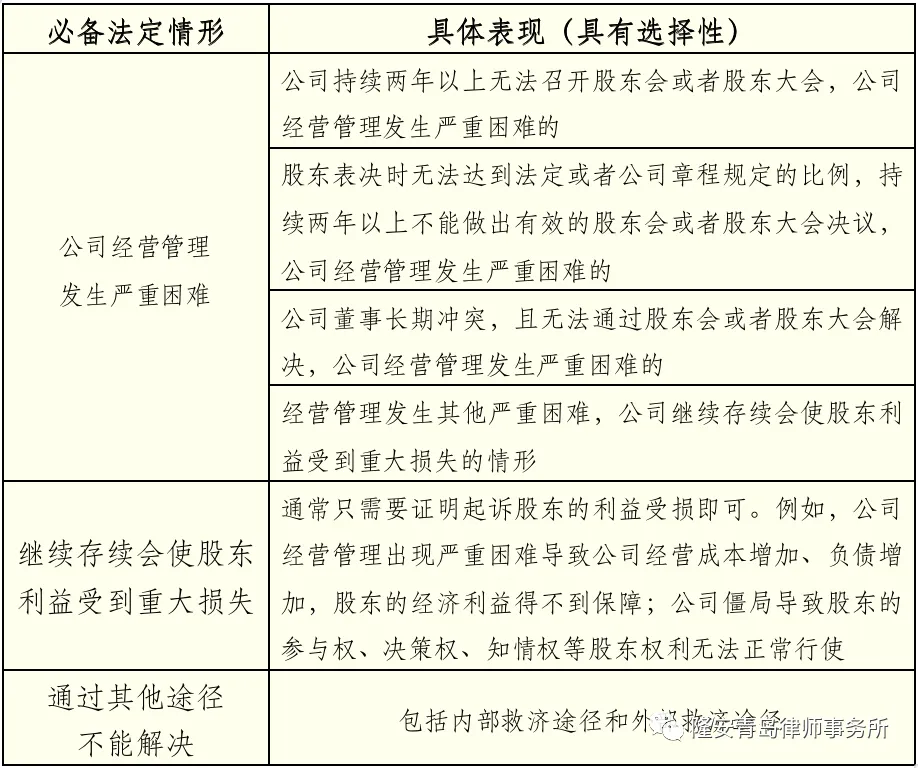
The key points can be summarized as follows:
First, the grounds on which shareholders file a company dissolution lawsuit must fall within the four situations of “severe difficulties in company operation and management” shown in the table, primarily reflecting that the company has experienced a shareholder deadlock or director deadlock, meaning the autonomous governance structure of the company has completely failed. If allowed to continue, it will cause damage to the interests of the shareholders.
Second, the prerequisite of “cannot be resolved through other avenues” must be met. According to the view of the head of the Second Civil Division of the Supreme People’s Court in Regulating the Trial of Company Dissolution and Liquidation Cases, when accepting company dissolution lawsuits, the people’s court usually conducts a formal review of the condition “cannot be resolved through other avenues.” Shareholders should demonstrate in their complaint and evidence that they have taken other measures available to them but have been unable to resolve the issue. What these “other avenues” typically include will be discussed in the Substantive Chapter.
III. Jurisdictional Court for Company Dissolution Lawsuits
The jurisdiction of court-ordered company dissolution lawsuits is determined in accordance with civil procedure principles.
(A) Territorial Jurisdiction
A company dissolution lawsuit shall be under the jurisdiction of the people’s court in the place of the company’s domicile. The company’s domicile refers to the place of the company’s principal office. If the place of the company’s principal office is unclear, it shall be under the jurisdiction of the people’s court in its place of registration.
(B) Level Jurisdiction
Dissolution lawsuits of companies registered and approved by company registration authorities at the level of counties, county-level cities, or districts shall be under the jurisdiction of primary people’s courts. Dissolution lawsuits of companies registered and approved by company registration authorities at or above the level of prefectures or prefecture-level cities shall be under the jurisdiction of intermediate people’s courts.
IV. Preservation in Company Dissolution Lawsuits
Article 3 of the Judicial Interpretation (II) of the Company Law stipulates that when filing a company dissolution lawsuit, if a shareholder applies to the people’s court for property preservation or evidence preservation, the people’s court may grant preservation under the circumstances that the shareholder provides security and the normal business operations of the company are not affected.
1. Since the nature of a company dissolution lawsuit is an action for modification, why can property preservation still be adopted?
We know that the purpose of property preservation is primarily to facilitate the execution of property in the future. Since the essence of a company dissolution lawsuit is an action for modification, once the court supports the plaintiff’s petition, it merely changes the survival status of the company, with no content regarding property payment. Why then does the law provide for property preservation measures?
According to the view of the Supreme People’s Court in the Understanding and Application of Judicial Interpretations of the Company Law, first, it is to substantively protect the interests of the plaintiff and others, preventing the company or other shareholders from transferring property, destroying or tampering with company accounts, etc., during the course of the dissolution lawsuit. Second, a compulsory liquidation procedure is highly likely to be initiated after the dissolution lawsuit. To ensure the smooth progress of the compulsory liquidation procedure, preservation is necessary. We know that shareholders file company dissolution lawsuits due to gridlocks and conflicts among shareholders or directors, making the probability of the company voluntary liquidating extremely low. In most cases, it enters compulsory liquidation proceedings presided over by the court.
2. How to determine the amount of property preservation?
Current laws and regulations do not make explicit provisions on the specific amount of property preservation in company dissolution lawsuits. Some views hold that the scope of property the plaintiff requests to preserve should be limited to the plaintiff’s capital contribution to the company or the company property corresponding to their actual shareholding percentage. Other views suggest that since preservation measures are adopted for the convenience of company liquidation, the amount of property preservation should be the entirety of the company’s property.
In judicial practice, the amount of property preservation is generally based on the amount applied for by the party, and the people’s court then makes a comprehensive decision based on the specific circumstances of the case. This article suggests that the plaintiff should comprehensively consider factors such as the share of property they can obtain after liquidation, their capacity to provide security for the preserved property, and the safety threshold for the company’s normal business operations after preservation to determine the amount in their application.
Contact Lawyer
Submit your contact details and consultation question. We will follow up ASAP.