
Analysis of Cross-Border E-commerce Foreign Exchange Compliance: Lessons from Shanghai Bank's 100 Million Yuan Fine
Analysis of Cross-Border E-commerce Foreign Exchange Compliance: Lessons from Shanghai Bank's 100 Million Yuan Fine
Recently, the Shanghai Branch of the State Administration of Foreign Exchange published an administrative penalty decision against a Shanghai bank, imposing a warning and fines of nearly 100 million yuan for violations in foreign exchange transactions including spot exchange, foreign currency wealth management, and guarantee-backed lending. This article examines compliance issues in cross-border e-commerce foreign exchange transactions.
I. Background
Recently, the Shanghai Branch of the State Administration of Foreign Exchange (SAFE) publicly issued an administrative penalty decision against a bank in Shanghai, imposing a warning and a fine of nearly RMB 100 million for certain illegal or non-compliant acts in the areas of foreign exchange settlement and sales, foreign currency wealth management products, outbound guarantees for onshore loans, and foreign exchange market transactions. At the same time, three relevant responsible individuals were separately issued warnings and fines.
In the above case, the penalized entity was a banking institution. However, this penalty event also has a direct impact on numerous merchants engaged in cross-border e-commerce export businesses (hereinafter referred to as “cross-border merchants”).
In the field of cross-border e-commerce (especially cross-border retail export), due to the large quantity and dispersion of exported goods, when cross-border merchants apply for foreign exchange settlement through domestic cooperative banks of third-party payment institutions, it is difficult for domestic banks to verify the authenticity of transactions using traditional methods. On the other hand, policies also allow banks to provide cross-border merchants with foreign exchange settlement and sales and related fund receipt and payment services based on transaction electronic information, provided that conditions such as transaction information collection and authenticity review are met. Therefore, before the penalty incident involving the Shanghai bank, some banks simply “gave up” and adopted very lenient review policies for cross-border e-commerce foreign exchange settlement.
However, after the penalty incident involving the Shanghai bank, numerous banks have successively tightened the review requirements for foreign exchange settlement. As the saying goes, “it is easy to go from frugality to luxury, but difficult to go from luxury to frugality.” The tightening of foreign exchange settlement requirements by banks is inevitably difficult for cross-border merchants who have become accustomed to lenient settlement review requirements to adapt to.
So, what are the common compliance pain points and key points for cross-border e-commerce foreign exchange receipts and payments?
II. Difficulties in Settlement of Export Income for Cross-Border Merchants
(A) Foreign Exchange Compliance Issues under the “Double Clearance and Tax-Inclusive” Model
Due to the relatively complex procedures for export customs declaration and export foreign exchange collection, many small and medium-sized cross-border merchants often adopt the “double clearance and tax-inclusive” model for export. The so-called “double clearance and tax-inclusive” refers to an arrangement where the cross-border merchant and a freight forwarding company, customs broker, or other institution agree that the freight forwarding company or customs broker will be responsible for transporting the goods to the consignee in the importing country at a lump-sum price that includes the export country customs clearance procedures, import country customs clearance procedures, import country customs duties, and freight.
The “double clearance and tax-inclusive” model is not recognized by customs or tax authorities. Leaving aside the risks of export tax fraud and deemed domestic sales subject to domestic VAT that this model may trigger, it is also not recognized at the level of foreign exchange supervision. That is to say, the consequence of this model at the foreign exchange supervision level is that cross-border merchants cannot legally receive foreign exchange.
The author explains this with reference to the following illustrative diagram of the “double clearance and tax-inclusive” transaction structure.
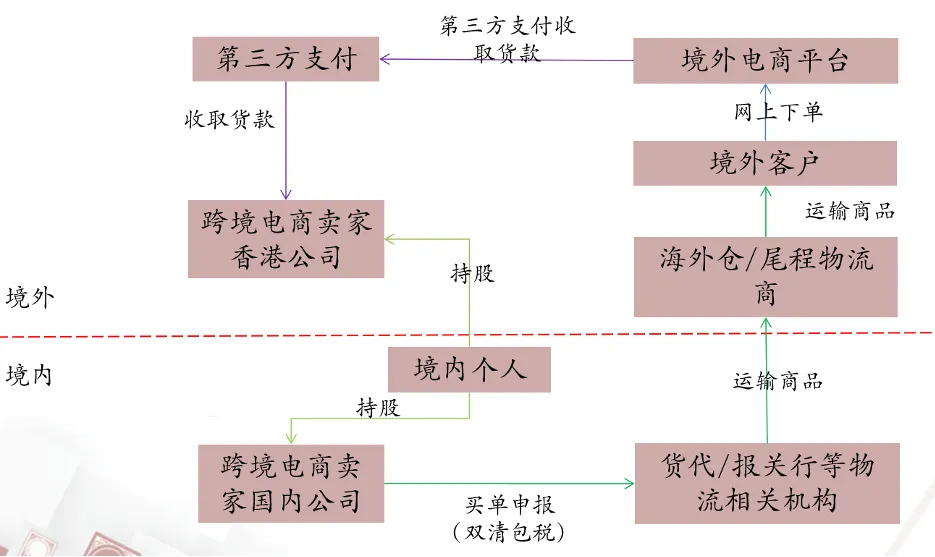
Illustrative Diagram of the “Double Clearance and Tax-Inclusive” Transaction Structure
As can be seen from the above transaction structure diagram, under the “double clearance and tax-inclusive” model, the cross-border merchant leaves no record of customs declaration for export goods in the customs supervision system; meanwhile, the cross-border merchant receives foreign exchange through its controlled offshore company account, and the offshore company account then arranges to remit the foreign exchange into China. As a result, there is an inconsistency between the flow of goods and the flow of funds.
According to the “Notice of the State Administration of Foreign Exchange on Issues Concerning the Implementation of Regulations on the Administration of Foreign Exchange in Goods Trade” (Huifa [2012] No. 38), under the above transaction structure, when funds from the offshore company account are remitted back to the cross-border merchant’s domestic foreign exchange account, such foreign exchange funds cannot be collected and settled. The reasons are:
(1) The cross-border merchant often has not completed the registration for the List of Enterprises Engaged in Trade Foreign Exchange Receipts and Payments, so the handling bank cannot process its foreign exchange receipt and payment business;
(2) Even if the cross-border merchant has completed the list registration, since the cross-border merchant cannot provide authentic supporting materials such as customs declarations and export contracts to prove the authenticity of the goods trade, the handling bank cannot process the foreign exchange settlement procedures for it;
(3) The foreign exchange administration collects trade receipts and payments (fund flow) and customs declaration import/export data from banks and customs respectively through the Goods Trade Foreign Exchange Monitoring System, and then compares the two sets of data. Under normal trade conditions, the difference between these two sets of data (“total net difference”) should be within a reasonable threshold range. Since the cross-border merchant has not declared the export with customs, the total net difference generally far exceeds the reasonable threshold range. This not only prevents normal foreign exchange settlement but also triggers the risk of on-site inspection by the foreign exchange administration.
(B) Analysis of Common Illegal Foreign Exchange Purchase and Sale Behaviors
Precisely because they cannot legally settle foreign exchange, some cross-border merchants resort to irregular methods of currency exchange, such as borrowing others’ facilitation quotas for foreign exchange, or engaging in “dual-currency matching” (swapping RMB and foreign currency between onshore and offshore entities). Of course, as times evolve and society progresses, some fancy methods of currency exchange have also emerged. For example, exchanging currency through virtual currency transactions.
However, these methods are without exception acts of illegal foreign exchange purchase and sale. Our country’s supervision over foreign exchange receipts, payments, and settlements is relatively strict. According to the current “Regulations of the People’s Republic of China on Foreign Exchange Administration,” “Measures for Individual Foreign Exchange Administration,” “Regulations on the Administration of Settlement, Sale, and Payment of Foreign Exchange,” and other foreign exchange supervision policies, domestic institutions or individuals can only handle foreign exchange settlements through financial institutions that are qualified to engage in foreign exchange settlement and sales. Otherwise, it constitutes illegal foreign exchange purchase and sale.
Therefore, when determining whether a currency exchange method is compliant, one only needs to grasp one point: no matter how beautiful the external appearance of the transaction, any purchase or payment of foreign currency not conducted through a financial institution qualified for foreign exchange settlement and sales is a soulless act of illegal foreign exchange purchase and sale.
In a large number of cross-border commercial transactions, illegal foreign exchange purchase and sale have long been common, and many cross-border merchants have become accustomed to it. This is because, although the above-mentioned foreign exchange purchase and sale behaviors are non-compliant, they are covert and not easily detected by regulatory authorities. However, judging from recent cases disclosed by foreign exchange regulatory authorities, the fines imposed by the foreign exchange regulatory authorities on individuals for illegal foreign exchange purchase and sale have repeatedly reached new highs, and the intensity of supervision over illegal foreign exchange purchase and sale by the foreign exchange regulatory authorities is showing a continuous upward trend.
For example, according to the penalty decision document Ping Hui Jian Fa [2023] No. 1, issued by the Pingxiang Central Sub-branch of SAFE on May 19, 2023, the foreign exchange administration found that Zhu had engaged in disguised foreign exchange purchase and sale and, pursuant to Article 45 of the “Regulations of the People’s Republic of China on Foreign Exchange Administration,” imposed a fine of RMB 20.7232 million on Zhu.
Furthermore, according to a penalty notice publicly displayed on the official website of the Henan Branch of SAFE on June 8, 2023, Huang was found to have privately purchased and sold foreign exchange, violating Article 30 of the “Measures for Individual Foreign Exchange Administration” (Order of the People’s Bank of China [2006] No. 3) and Article 32 of the “Regulations on the Administration of Settlement, Sale, and Payment of Foreign Exchange” (Yin Fa [1996] No. 210). The Hebi Central Sub-branch of SAFE, pursuant to Article 45 of the “Regulations of the People’s Republic of China on Foreign Exchange Administration,” issued a warning and imposed a fine of RMB 30.3945 million.
The disclosure of these two penalty announcements also caused considerable shock within the industry. This is because, while everyone more or less knew about the non-compliance of private or disguised foreign exchange purchase and sale, they had not anticipated such severe consequences.
Let us look at the original text of Article 45 of the “Regulations of the People’s Republic of China on Foreign Exchange Administration”: “Whoever privately purchases or sells foreign exchange, purchases or sells foreign exchange in a disguised manner, buys and sells foreign exchange for speculation, or illegally introduces the purchase or sale of foreign exchange, if the amount involved is relatively large, shall be given a warning by the foreign exchange administration, and the illegal gains shall be confiscated, and a fine of not more than 30% of the illegal amount shall be imposed; if the circumstances are serious, a fine of not less than 30% but not more than the equivalent amount of the illegal amount shall be imposed; if a crime is constituted, criminal liability shall be investigated according to law.” From this provision, it can be seen that the SAFE has considerable authority to impose penalties for illegal foreign exchange purchase and sale, and in theory, can confiscate up to 100% of the illegal foreign exchange purchase and sale amount. This is precisely why, after the disclosure of the above two penalty cases, numerous cross-border merchants accustomed to settling foreign exchange through irregular channels felt shaken and fearful.
(C) Compliance Issues with Return Investment Foreign Exchange
A cross-border merchant client previously conducted foreign trade export business through e-commerce platforms such as Alibaba in its early years. The client received foreign exchange income through its controlled Hong Kong company account. However, the substantial accumulated foreign exchange income in this Hong Kong company account could not be compliantly repatriated into China. When consulting the author, the client asked whether the Hong Kong company could establish a wholly foreign-owned enterprise (WFOE) in China, and then the Hong Kong company could remit foreign exchange into the WFOE in the form of foreign exchange capital, after which the WFOE would settle the foreign exchange for use? (As shown in the diagram below)
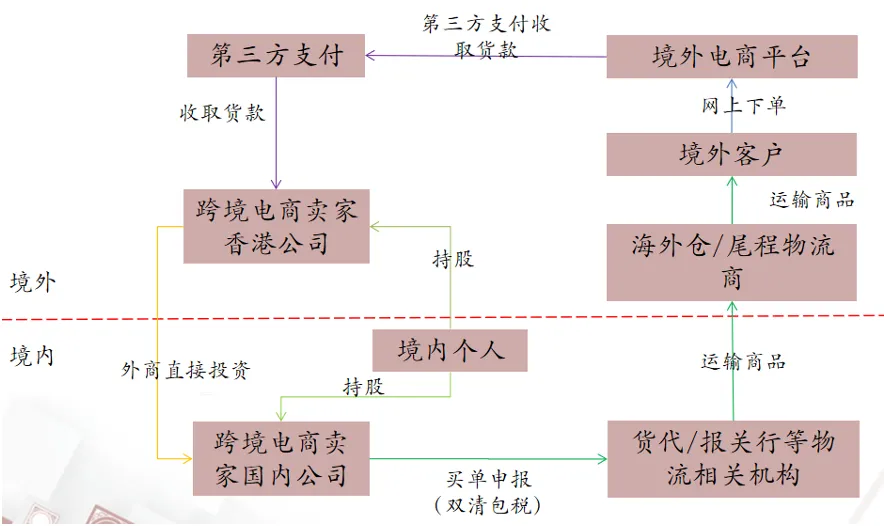
The answer is obviously no. The above investment structure constitutes return investment. According to the provisions of SAFE Document No. 37, if the Hong Kong company has not registered as a special purpose company in accordance with SAFE Document No. 37, the handling bank cannot process the capital settlement procedures for the funds invested by the Hong Kong company into the WFOE.
The client further asked: if the Hong Kong company registers as a special purpose company under SAFE Document No. 37, can the funds of the Hong Kong company be invested into the WFOE and settled? The answer is still no. The registration of a special purpose company under Document No. 37 is intended to facilitate domestic enterprises in absorbing funds from overseas investors. Therefore, when handling the foreign exchange registration for the Hong Kong company under Document No. 37, it is necessary to provide information such as the identity of the overseas investor, the investment amount, etc. Moreover, when the Hong Kong company’s funds are invested into the WFOE, the source of the funds must be explained. Only funds from overseas investors can be settled. That is to say, even if the above Hong Kong company has completed the Document No. 37 registration, the foreign exchange it earned from business operations prior to the Document No. 37 registration cannot be remitted into China and settled.
III. Analysis of Cross-Border E-Commerce Foreign Exchange Compliance Strategies
Rome was not built in a day, and compliance cannot be achieved overnight. Enterprise compliance needs to consider the cost of compliance; a “shock therapy” approach to compliance may instead have extremely adverse effects on the enterprise. Therefore, for many small and medium-sized cross-border e-commerce enterprises, attention should be paid to their specific circumstances when dealing with foreign exchange compliance, adopting a strategy of phased implementation and gradual compliance.
As mentioned earlier, the main reason why many cross-border e-commerce sellers cannot compliantly settle their export income is their failure to declare exports in a transparent manner. The reason they do not declare exports transparently is primarily for the purpose of concealing income and avoiding taxes.
Generally speaking, for enterprises that already have a certain scale of performance, the larger the scale of performance, the greater the risks and costs arising from non-compliant operations. Therefore, concealing income and avoiding taxes should no longer be the value orientation for such enterprises. Moreover, current national policies encourage cross-border e-commerce export businesses. Policies such as “tax exemption for goods without invoices” and “export tax rebates” can, to a considerable extent, offset the tax costs arising from transparent customs declarations. In other words, at this point, it is necessary for the enterprise to restructure its fund flow and goods flow and gradually achieve transparent customs declarations for exports. Transparent customs declarations will inevitably bring about transparent foreign exchange settlement, thereby reducing the operational risks caused by foreign exchange non-compliance for the enterprise.
Contact Lawyer
Submit your contact details and consultation question. We will follow up ASAP.