
Key Points and Analysis of the Third Draft of the Company Law from a Stakeholder Perspective
Key Points and Analysis of the Third Draft of the Company Law from a Stakeholder Perspective
Attorney Ke Cheng systematically reviews the background, direction, and core points of the third draft of China's Company Law revision. The revision aims to address practical difficulties, rationalize the legal system, balance corporate autonomy and necessary regulation, and focus on the four parties—shareholders, the company, directors/supervisors/senior management, and creditors—to achieve interest coordination and governance optimization. Regarding creditor protection, the third draft improves rules on accelerated maturity of capital contributions, supplementary liability for equity transfers before the contribution deadline, compensation for illegal capital reduction, horizontal piercing of the corporate veil, directors' liquidation liability, and liability for commitments in simplified deregistration. Regarding shareholder rights, the restrictions on one-person companies are relaxed, new forms of capital contribution (equity and claims) are added, a five-year paid-in period and shareholder forfeiture system are established, the scope of inspection rights (including accounting vouchers and access by intermediaries) is significantly expanded, the right to request share repurchase is extended, and a pro-rata capital reduction rule is added. Regarding the responsibilities and authority of directors, supervisors, and senior management, the board's powers are broadened (introduction of audit committees and authorized capital system), external supervision and accountability are strengthened (dismissal without cause, liability for intentional or grossly negligent acts toward third parties), and obligations regarding capital call, standards of fiduciary duty and duty of care, prevention of "shadow directors," and liability for illegal profit distribution and unlawful financial assistance are clarified. The overall revision establishes a more clearly defined and well-functioning institutional framework, which will profoundly affect the behavioral expectations and compliance arrangements of various commercial entities.
Introduction
✦
Company law is a foundational law in China’s civil and commercial field, playing a pivotal role under the socialist market economy system. Against the backdrop of the promulgation and implementation of the Civil Code, revising the Company Law has become a legislative priority. However, company law has its complexity: it has both public and private law attributes, combines organizational and behavioral characteristics, is substantive law yet contains procedural content, and it is difficult to distinguish between mandatory and permissive norms within it. The scope of regulation includes various types of companies such as limited liability companies, joint-stock companies, state-owned companies, and foreign-invested companies. This means that the revision of company law is a systematic project where one change affects the entire system. The current Company Law was enacted in 1993 and subsequently amended five times in 1999, 2004, 2005, 2013, and 2018. Since 2021, the sixth revision process of the Company Law commenced. The first and second drafts were reviewed by the Standing Committee of the National People’s Congress in December 2021 and December 2022 respectively, and the third draft was also reviewed and released for public comment on September 1, 2023. Against this backdrop, this article aims to systematically review the current round of company law revision, exploring why and how the revision is being undertaken, and examining, from a stakeholder perspective, the impact of the revised Company Law on various parties involved in commercial activities.
I. Reasons for the Revision of the Company Law
According to the official statement in Part I of the “Explanation on the ‘Company Law of the People’s Republic of China (Revision Draft)’” by the Standing Committee of the National People’s Congress regarding the necessity of the revision, the revision is needed to deepen the reform of state-owned enterprises and improve the modern enterprise system with Chinese characteristics; to continuously optimize the business environment and stimulate market innovation vitality; to improve the property rights protection system and strengthen property rights protection according to law; and to improve the basic systems of the capital market and promote its healthy development.
The official statement reveals the expected goals of the company law revision. From a practical perspective, the necessity of the revision also lies in the lag and inadequacies manifested in the operation of the current company law. It faces a series of issues, such as weakened protection for minority shareholders and creditors, rigid and dysfunctional corporate governance mechanisms, ineffective internal supervision, incomplete shareholder exit mechanisms, weak justiciability of company law norms, and lack of flexibility in the corporate capital system. It is essential to respond to the problems exposed in corporate practice through the revision of the Company Law.
II. Direction of the Company Law Revision
High expectations are placed on the company law revision. However, amending the Company Law is not merely about plugging institutional loopholes in a piecemeal manner. It should first rationalize the company law system, and based on a systematic and scientific institutional framework, then proceed to identify gaps and make orderly improvements. As mentioned earlier, company law has its complexity, but it also has a clear logical thread. The private law nature of company law requires the state to fully respect and encourage corporate autonomy to stimulate the enthusiasm and creativity of market entities. Thus, a clear line separates the state on one side—the realm of market freedom and corporate autonomy—from market entities on the other. On the market side, creditors interact with various parties involved in corporate autonomy, but the core concern is that creditors seek to realize their own commercial value through the company while striving to prevent their rights and interests from being infringed upon by those involved in corporate autonomy. Within the corporate autonomy system, the company, as a legal fiction, has an independent personality that is widely recognized. Based on the company’s independent personality, corporate autonomy should center around the company itself. Although directors, supervisors, and senior management (hereinafter collectively referred to as “directors, supervisors, and senior management,” except where specific distinctions are needed, they will be treated as a whole) derive directly or indirectly from shareholders and the shareholder meetings controlled by them, once appointed, they should belong to the company, not to the shareholders. Similarly, once shareholders make capital contributions, the contributed property becomes the company’s property, not the shareholders’ private property.
Understanding this makes it easier to grasp why all three drafts of the revision delete the phrase “the board of directors is responsible to the shareholders’ meeting” from Article 46 of the current Company Law. The intense debate over whether the Company Law should adopt “shareholder primacy” or “board primacy” is unnecessary. Both concepts were initially coined as convenient shorthand to facilitate communication but are not rigorous legal concepts, lacking absolute consensus on their connotations and extensions. It is inadvisable to retroactively apply such non-rigorous concepts—convenient for expression—to specific institutional provisions, thereby triggering conceptual disputes. We should oppose the distortion of the terms “shareholder primacy” and “board primacy” in company law. Both the shareholders’ meeting and the board of directors are components of corporate governance. The allocation of corporate power between the shareholders’ meeting and the board should be determined based on the effectiveness of corporate governance, governance costs, and the protection of the rights of all parties. The optimal outcome of corporate governance should be the formation of synergy among shareholders, between shareholders and directors/supervisors/senior management, and with creditors, jointly driving the company forward sustainably. If shareholder interests are not effectively protected, shareholders’ entrepreneurial and innovative motivation will be suppressed. If creditor interests are not effectively protected, the company will gradually lose access to capital market financing channels, becoming a source without water. If the responsibilities of directors, supervisors, and senior management are improperly designed (mismatch of rights and responsibilities), it will either cause them to act timidly or enable them to benefit themselves at the expense of the company, harming the interests of shareholders, the company, and others.
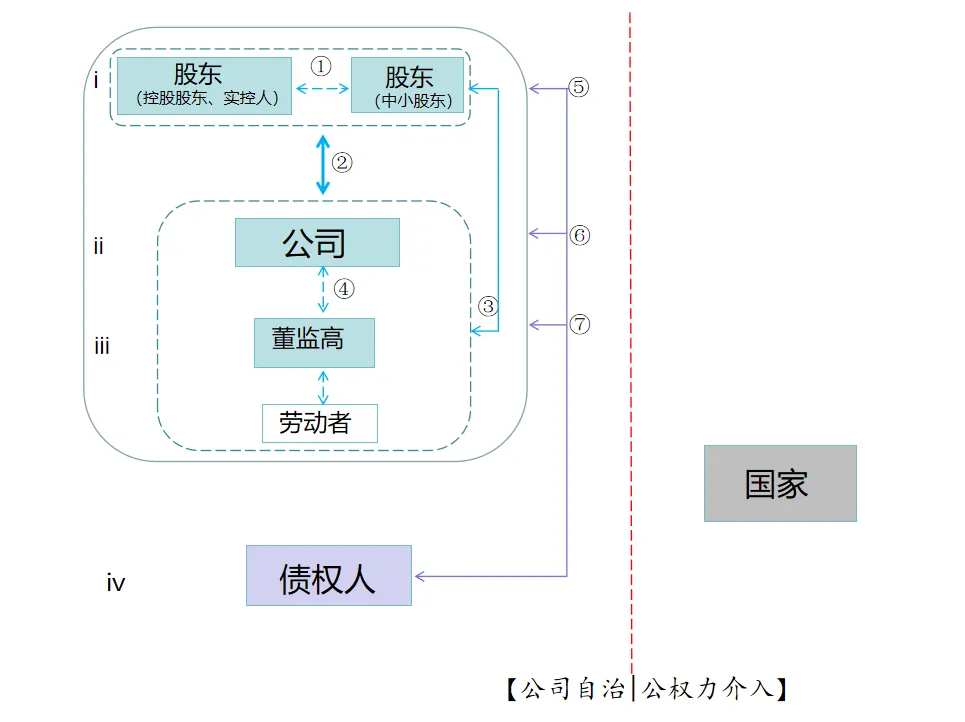
Therefore, the direction of the company law revision is to provide sufficient and high-quality institutional mechanisms. Through refined institutional design, it seeks to align the rights and responsibilities of all parties, achieving a balance and coordination of interests. Specifically, this involves grasping the boundary between public power intervention and corporate autonomy, strictly reviewing and clearly defining mandatory and permissive norms in company law to reduce identification disputes in practice; focusing on institutional design around four main entities: shareholders, the company, directors/supervisors/senior management, and creditors; and addressing the adjustment of seven groups of legal relationships: among shareholders, between shareholders and the company, between shareholders and directors/supervisors/senior management, between the company and directors/supervisors/senior management, between creditors and shareholders, between creditors and the company, and between creditors and directors/supervisors/senior management (see figure below). As for other entities and legal relationships, such as company employees, the third draft already addresses employee interests in Articles 17, 20, and 68, which are primarily regulated by labor law and are not the main focus of the company law revision.
III. Key Points and Analysis of the Third Draft from a Stakeholder Perspective
The normative functions of law include guidance, evaluation, prediction, education, and coercion. Once the revised content of the third draft of the Company Law is enacted into law, it will have a significant impact on the commercial field. It is worth fully understanding by different stakeholders so that they can make commercial arrangements in advance.
(A) Key Points and Analysis of the Third Draft from a Creditor’s Perspective
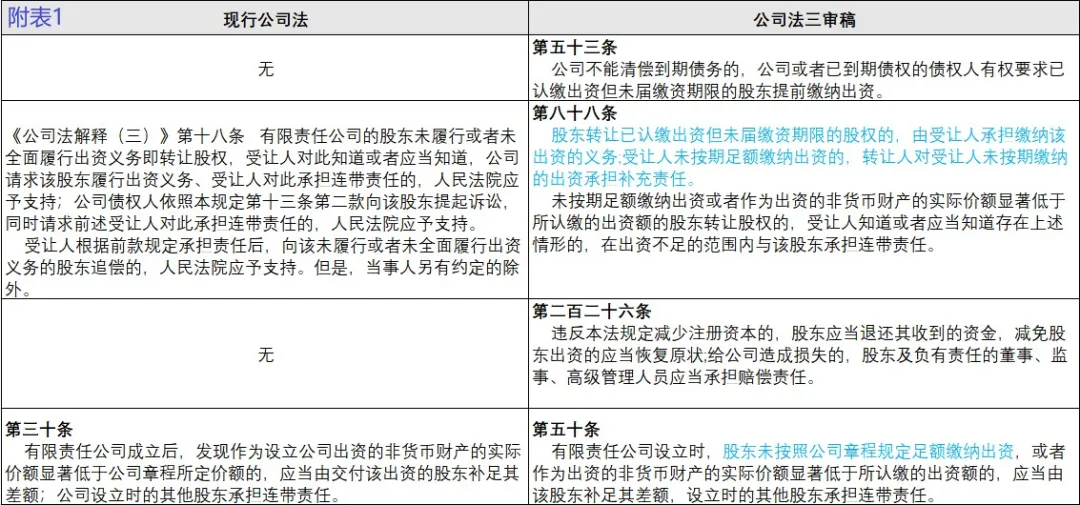
Shareholders are liable to the company only to the extent of their capital contributions. The company’s protection of creditors mainly depends on two aspects: first, the company’s initial capital formed by shareholders’ contributions; second, the company’s operating income generated from asset appreciation. The current Company Law has deficiencies in protecting both the initial capital and operating income. The third draft, drawing on practical experience, focuses on revising these two aspects. (For a comparison between the current Company Law and the third draft, see Appendix 1)
1. Revised Provisions Protecting the Company’s Initial Capital
The revised provisions of the third draft, centering on the company’s initial capital, further clarify the contribution period, contributing parties, capital reduction, withdrawal of capital contributions, and promoters’ liability. It addresses the stability of the total initial capital, the responsible parties when contributions are not made, and the rules for accelerating contributions, forming a relatively complete protection system.
(1) Improvement of the Accelerated Maturity System for Shareholder Capital Contributions
After the 2013 Company Law introduced the subscribed capital system, whether shareholder capital contributions could be accelerated became a hotly debated issue. Article 6 of the 2019 Minutes of the National Conference on Civil and Commercial Adjudication (hereinafter “Minutes”) clarified that shareholders have a right to the benefit of time, except in two scenarios: (i) when the company is the enforcement respondent, the court has exhausted enforcement measures, there is no property available for execution, the company satisfies the conditions for bankruptcy but has not filed for bankruptcy; and (ii) when after the company’s debt arises, the shareholders’ meeting or other means extend the shareholder’s capital contribution period. Based on the author’s experience handling relevant cases, it is difficult to get court support for naming shareholders who have not made paid-in contributions as co-defendants during the substantive trial stage. Even in cases where support is given, the court’s reasoning is often based on the shareholder having significant influence over decision-making on the matter and direct interactions between the creditor and the shareholder on the issue. Most cases pursuing shareholders’ paid-in contribution obligations require adding the non-contributing shareholders as enforcement respondents during the enforcement stage, but there are inconsistent approaches regarding whether substantive trial should precede enforcement, making the accelerated maturity system costly and ineffective. Article 53 of the third draft removes the restrictions in Article 6 of the Minutes, providing that as long as “the company is unable to pay its due debts,” the company or creditors with due claims have the right to demand that shareholders who have not yet made capital contributions make early payment. This revision makes it more feasible for creditors to pursue shareholders’ contribution obligations, facilitates the timely receipt of the company’s initial capital, and effectively protects creditors’ interests.
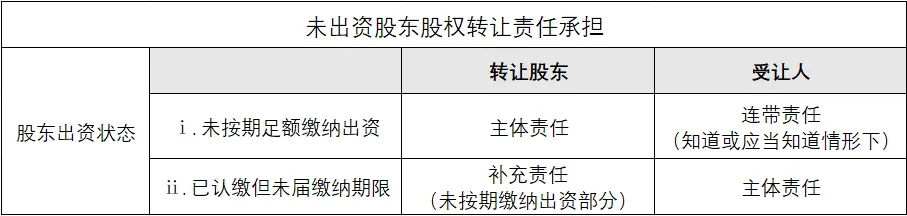
(2) New Rules on Transfer of Equity Before the Contribution Period Expires
When equity is transferred before the contribution period expires, it is easy for shareholders to transfer their equity to a third party with poor credit standing to evade their paid-in obligations, rendering the company’s initial capital unrealized. Creditors enter into transactions based on their confidence in the original shareholders’ creditworthiness, but shareholders escape through equity transfer, thereby harming the interests of the company’s creditors.
Regarding the transfer of equity when shareholders fail to make full capital contributions on time, Article 18 of the Judicial Interpretation III of Company Law already provides rules. Article 88 of the third draft, based on incorporating Judicial Interpretation III, further regulates the transfer of equity by shareholders who have subscribed but not yet reached the contribution deadline, clarifying that the transferee assumes the contribution obligation, and the transferor bears supplementary liability for the transferee’s failure to pay on time.
(3) New Compensation Liability for Illegal Capital Reduction
Capital reduction, i.e., reducing registered capital, will abruptly decrease the company’s initial capital expected by creditors, affecting the company’s creditworthiness and debt-servicing capacity. Therefore, the current Company Law imposes relatively strict procedures for capital reduction, but it does not provide for compensation liability in case of violation of these procedures, leading to insufficient regulation. Article 226 of the third draft explicitly states that if capital reduction results in a reduction of shareholder contributions, the funds shall be returned and the status quo restored; if the company suffers losses, shareholders and responsible directors, supervisors, and senior management shall bear compensation liability. This new provision, together with Article 57 of the third draft on liability for withdrawal of capital contributions, forms a set of norms to ensure the stability of the total amount of the company’s initial capital, whether shareholders have made contributions or not.
(4) Improvement of Promoters’ Liability for Shareholders’ Failure to Pay Full Contributions on Time
Company promoters have a special status and responsibility regarding the establishment and purposes of the company. Article 13(3) of Judicial Interpretation III of Company Law provides: “If a shareholder fails to perform or fully perform its capital contribution obligation at the time of the company’s establishment, and the plaintiff files a lawsuit under paragraph 1 or 2 of this Article, requesting that the company’s promoters bear joint and several liability with the defendant shareholder, the people’s court shall support such claim; after the promoters bear liability, they may seek recourse from the defendant shareholder.” According to Judicial Interpretation III, creditors may claim that the company’s promoters bear joint and several liability when shareholders fail to pay contributions on time and in full. Article 50 of the third draft provides that if a shareholder fails to pay contributions on time and in full, that shareholder shall make up the shortfall, and other shareholders at the time of incorporation shall bear joint and several liability. However, it is not clear to whom “other shareholders at the time of incorporation” bear “joint and several liability,” which needs further refinement to provide more comprehensive protection for the company’s initial capital.
2. Revised Provisions Protecting the Company’s Operating Income
Both shareholders and creditors expect the company to use its initial capital and creditor support to achieve stable operations, generate profits, and achieve continuous asset appreciation (i.e., the company’s operating income). The more operating income the company generates, the more dividends shareholders can receive, and the more secure creditors’ claims become. However, practice is far more complex than theory. Whether the company operates poorly or well, shareholders have the impulse and ability to appropriate the company’s operating income for themselves. Because creditors are further removed from company operations compared to shareholders, in the context of information asymmetry, creditors’ rights are vulnerable to infringement by “ill-intentioned” shareholders. Therefore, the third draft fills gaps in the protection of the company’s operating income through the following rules.
(1) Improvement of the Doctrine of Piercing the Corporate Veil
The independence of the company’s legal personality and shareholders’ limited liability are two cornerstones of company law. Generally, shareholders are only liable to the extent of their capital contributions. However, when shareholders abuse the company’s independent legal personality to evade debts, the company’s operating income, which should and could provide protection for creditors, becomes unavailable. The company’s independent personality effectively ceases to exist, and the shareholders’ limited liability based on that independent personality will be pierced to remedy the harm suffered by creditors. Article 23 of the third draft, building on the current Company Law, adds horizontal piercing of the corporate veil to address the practical situation where shareholders use two or more companies under their control to evade debts, which is a significant benefit for creditors. However, even with the typified provisions in Articles 10–12 of the Minutes, courts have been cautious in applying traditional veil piercing, often declining to do so. Whether horizontal piercing will achieve its expected effect and whether vertical piercing will be strengthened remains to be seen.
(2) Rules on Liability for Company Liquidation
Company liquidation is a necessary step for the company’s operations to end and its personality to be extinguished. At this stage, the company’s operating income needs to be centrally settled and distributed. Article 232 of the third draft, for the first time, explicitly designates directors as the liquidation obligors and adds a rule that if the liquidation obligor causes losses to the company or creditors, it shall bear compensation liability. Designating directors as liquidation obligors aligns with their management authority over the company’s operations and conforms to the principle of matching rights and responsibilities. Creditors who suffer losses due to the company’s liquidation now have a clear party to claim against and a legal basis for doing so.
(3) New Simplified Company Deregistration Rules
Article 240 of the third draft introduces a simplified company deregistration system, significantly reducing the difficulty of deregistration, which is beneficial for cleaning up zombie enterprises and improving resource utilization efficiency. However, it is also necessary to prevent enterprises from using simplified deregistration to eliminate the entity and evade debts. The third draft also provides that all shareholders must commit before deregistration that there are no debts or all debts have been paid; if they breach this commitment, they shall bear joint and several liability for the debts before deregistration. This addresses the awkward situation where creditors have no recourse after the company is deregistered.
(B) Key Points and Analysis of the Third Draft from a Shareholder’s Perspective
(For a comparison between the current Company Law and the third draft, see Appendix 2)
1. Changes to One-Person Company Rules
The third draft deletes the entire Section 3 of Chapter 2 of the current Company Law regarding special provisions on one-person limited liability companies. Specific provisions on one-person companies are only found in Articles 23(3), 60, 92, 112, and 218 of the third draft. After the revision, when shareholders choose to invest in a one-person company, they can establish either a one-person limited liability company or a one-person joint-stock company, and they can continue to establish multiple one-person companies, no longer subject to the many restrictions of the current Company Law. Shareholders have more institutional space for investment.
2. Addition of Equity and Claims as Forms of Capital Contribution
Regarding non-monetary capital contributions, Article 48 of the third draft adds “equity” and “claims” to the existing forms of “in-kind, intellectual property, and land-use rights” under the current Company Law, legally confirming these two forms of contribution and providing new forms for shareholder capital contributions. Combined with Article 11 of Judicial Interpretation III of Company Law and Article 13(3) of the Regulations for the Implementation of the Registration Administration of Market Entities, there are relatively complete rules for equity contributions. Although Article 13(3) of the Regulations for the Implementation of the Registration Administration of Market Entities also applies to contributions in the form of claims, the Measures for the Administration of the Registration of Debt-for-Equity Swaps of Companies have been invalidated without subsequent detailed rules, so specific operational guidelines for contributions in the form of claims are still needed.
3. Five-Year Paid-in Capital Requirement for Limited Liability Company Shareholders
The five-year paid-in capital requirement for shareholders of limited liability companies is likely the most discussed and controversial provision in this round of company law revision (not mentioned in the first or second drafts, but heavily introduced in Article 47 of the third draft). The 2013 Company Law changed from a paid-in registration system to a subscribed registration system, eliminating minimum registered capital requirements, monetary contribution ratios, initial contribution ratios, and entirely removing limits on contribution periods. The full subscription system facilitated company establishment, increased investment enthusiasm, stimulated entrepreneurial vitality, and rapidly increased the number of enterprises. However, it also caused an imbalance of interests among shareholders, the company, and creditors. The focus of the controversy is twofold: First, will setting a five-year subscription period severely dampen entrepreneurial enthusiasm? Second, given that Article 53 of the third draft already provides for accelerated maturity of capital contributions, is it still necessary to establish a five-year subscription period rule? Regarding the first point, it should first be clarified whether entrepreneurial enthusiasm is driven by the removal of subscription period limits or by the combined effect of eliminating minimum registered capital requirements, removing monetary contribution ratios, and broadening forms of capital contribution. The extent to which removing subscription period limits has influenced entrepreneurship, and the potential harm of appropriate limits, both require empirical analysis. The third draft’s choice of a five-year subscription period may refer to the reality that the average lifespan of Chinese enterprises is less than five years. Regarding the second point, although the accelerated maturity system exists, based on the author’s practical experience, pursuing shareholder liability involves a series of procedures, a long cycle, high costs, and uncertain outcomes depending on the standards of different courts, making creditor rights enforcement costly. The accelerated maturity system can serve as a reverse supervision mechanism for actual shareholder contributions, while the five-year paid-in period system can encourage shareholders to reasonably determine the amount of registered capital when establishing a company, considering their own and market realities, and can be an effective means to enhance social integrity.
4. New System of Shareholder Forfeiture for Refusing to Contribute Capital
The shareholder forfeiture system for refusing to contribute capital further perfects the capital contribution system based on the five-year subscription period. If there were no limit on the subscription period, shareholders could register the longest possible subscription period when establishing the company, and the prerequisite for the forfeiture system—“shareholder fails to pay contributions on time and in full”—would not exist because “on time” requires a foreseeable deadline. If shareholders register the longest subscription period, the company’s legal personality may be extinguished before the deadline arrives, making the concept of “on time” meaningless. Moreover, the rules on shareholder forfeiture in Article 52 of the third draft focus more on the perspective among shareholders. It should also consider the connection with provisions protecting creditors’ interests. For example, forfeited equity must be transferred or the registered capital reduced accordingly, which undoubtedly overlaps with Articles 88 and 226 of the third draft. How to coordinate these will affect the implementation effect of the forfeiture system.
5. Improvement of Shareholder Inspection Rights Rules
Article 4(2) of the third draft provides that “Shareholders of a company enjoy the rights to receive returns on assets, participate in major decisions, and select managers in accordance with the law.” In reality, controlling shareholders often dominate the company, make major decisions unilaterally, and select managers arbitrarily, leaving minority shareholders unable to exercise these basic rights. The current Company Law grants shareholders the right to inspect and copy the “articles of association, minutes of shareholders’ meetings, resolutions of the board of directors, resolutions of the board of supervisors (hereinafter collectively referred to as ‘meeting minutes and resolutions’), and financial accounting reports,” as well as the right to inspect the “account books” upon written request and with company consent. However, the effectiveness of this rule is unsatisfactory, mainly for the following reasons:
First, the scope of inspection permitted under the current Company Law is insufficient given the prevalence of financial fraud and the controlling shareholder’s ability to freely determine meeting minutes and resolutions.
Second, shareholders are often non-professionals. Even if the company allows inspection of account books, because only inspection (not copying) is permitted, non-professional shareholders cannot identify the controlling shareholder’s violations.
Third, to inspect account books, shareholders must submit a written request to the company, which can refuse. According to law, “if the company refuses, it shall provide a written reply to the shareholder within fifteen days from the date of the written request, stating the reasons.” In practice, companies may refuse to accept the request or provide a written reply, and the current law does not specify remedies.
Fourth, after being refused, shareholders cannot obtain a written refusal, so courts often refuse to accept the case. Moreover, disputes over inspection rights are subject to general civil procedure rules, making costs high for minority shareholders and consuming scarce judicial resources, leading courts to be reluctant to accept such cases.
Articles 56 and 110 of the third draft improve the shareholder inspection rights system. In terms of scope, they add the right to inspect and copy the “register of shareholders” and the right to inspect “accounting vouchers.” They also add the right for shareholders to entrust “accounting firms, law firms, and other intermediary institutions” to conduct inspections. For joint-stock companies, aside from restrictions on the shareholders entitled to inspect (shareholders must individually or collectively hold at least 3% of the shares for at least 180 consecutive days), other rules are consistent with limited liability companies. Some opposing views argue against allowing shareholders to inspect accounting vouchers, contending that accounting vouchers contain important company information. They suggest: setting a sequential order, allowing inspection of accounting vouchers only after inspection of account books is insufficient; inspection of accounting vouchers should be ordered by the court during litigation; and for joint-stock companies, shareholders should be limited to inspecting only account books.[1] This opposing view does not fully consider the current operational status of this system in practice, and its legal basis is relatively weak. The reasons are as follows:
First, why does the fact that accounting vouchers contain important company information justify denying shareholders access? As mentioned, minority shareholders, in particular, face severe obstacles in realizing their basic rights under Article 4(2) of the third draft, such as receiving returns on assets, participating in major decisions, and selecting managers. Given the reality of unequal shareholdings, forcibly granting minority shareholders the right to participate in major decisions and select managers would severely conflict with market laws and legal principles. Expecting controlling shareholders to voluntarily make concessions under corporate autonomy also contradicts practice and the rational economic actor assumption underlying corporate autonomy.
Second, the company is a projection of shareholder influence. Controlling shareholders, through the shareholders’ meeting, board of directors, and other institutional arrangements, can inevitably obtain the above information, while minority shareholders have no channel to access it. This violates the policy requirement of equal protection of property rights and creates substantive shareholder inequality.
Third, if minority shareholders cannot enjoy basic rights such as participating in major decisions and selecting managers, and if they also cannot obtain returns on assets, then their investment purpose will be frustrated. In cases handled by the author, some courts, based on Article 563 of the Civil Code on unilateral rescission, have supported returning minority shareholders’ investment funds, but this effectively bypasses the Company Law, which should take precedence, and there is no uniform standard among courts.
Fourth, as noted, even if the third draft is enacted, it still does not resolve practical issues such as the company not providing a written refusal, courts being relatively reluctant (using general procedures that require the same trial process with no litigation subject matter), and minority shareholders having no access or facing high costs (courts refuse to file cases without a written refusal, or the process is lengthy). The opposing view’s suggestions would not achieve the desired effect; instead, they might further hinder minority shareholders’ already difficult-to-achieve inspection rights. The realization of minority shareholders’ basic right to asset returns depends on their knowledge of the company’s actual operating conditions. If the inspection rights rules cannot enable shareholders to obtain true operating information, how can they initiate lawsuits for damages for harm to the company’s interests based on that information?
6. Improvement of the Shareholder Right to Request Share Repurchase
Compared to Article 74 of the current Company Law, Article 89 of the third draft further improves the system for shareholders of limited liability companies to request share repurchase. Additionally, Article 161 of the third draft independently establishes a system for shareholders of non-publicly issued joint-stock companies to request share repurchase. Specifically, under the third draft, there will be two scenarios for the shareholder right to request repurchase: first, the dissenting shareholder’s right to request repurchase; second, where a controlling shareholder abuses shareholder rights, seriously harming the company or other shareholders, the other shareholders’ right to request repurchase. Both Article 74 of the current Company Law and Article 89(1) and (2) of the third draft only provide rules for dissenting shareholders’ repurchase requests. The requesting shareholders are not limited to minority shareholders, but the threshold for exercising the right is high, and only shareholders who voted against the shareholders’ meeting resolution are eligible.
Article 89(3) of the third draft adds a new type: the right of other shareholders to request repurchase when a controlling shareholder abuses its rights. This undoubtedly provides other shareholders with an effective remedy path. To exercise this right, they only need to prove that “the controlling shareholder has abused shareholder rights, seriously harming the company or other shareholders.” This significantly lowers the threshold for minority shareholders to request repurchase. Article 161 of the third draft, concerning the right of shareholders of non-publicly issued joint-stock companies to request repurchase, differs from Article 89(1), (2), and (4) in only one substantive aspect: it deletes the circumstances of “merger, division” in Article 89(1)(ii); additionally, it completely deletes Article 89(3). Therefore, the new type of repurchase right for other shareholders added in Article 89(3) only applies to limited liability companies.
7. New Pro-Rata Capital Reduction Rule
Article 224(3) of the third draft provides that during capital reduction, the company shall reduce the capital contribution amount or shares in proportion to the shareholders’ capital contribution ratio or shareholding ratio, i.e., a pro-rata capital reduction rule. This provision has generated significant controversy and opposition. Opponents argue that this mandatory norm directly negates the validity of selective capital reduction, regardless of whether it is a minority shareholder voluntarily exiting in a deadlock scenario or an investment institution exiting the target company under a valuation adjustment mechanism (VAM). Both scenarios rely on selective capital reduction routes. Proponents mainly argue from the perspective of protecting minority shareholders, contending that selective capital reduction can easily become a means for controlling shareholders to harm minority shareholders’ interests. When the company is thriving, the controlling shareholder may selectively reduce capital to squeeze out minority shareholders early; when the company is struggling, the controlling shareholder may exit selectively. Both proponents and opponents have reasonable arguments from different perspectives. However, proponents must address the legitimate concerns of opponents. If this provision is passed without further modification, how to resolve the practical issues raised by opponents remains to be carefully considered. Creditors can rely on paragraph 2 of this article to demand guarantees or early repayment, so their interests are adequately protected. Therefore, the legislative purpose of this provision is mainly to regulate the relationship between controlling shareholders and minority shareholders, preventing controlling shareholders from harming minority shareholders’ interests. In light of this, adding an exception within this provision—“selective capital reduction requires unanimous consent of all shareholders”—seems feasible. Minority shareholders would thus obtain a veto power. Using this veto power, they could either negotiate an acceptable compensation agreement with the controlling shareholder or directly veto the selective capital reduction, returning to the pro-rata reduction model set by the rule. This would not harm minority shareholders’ interests; instead, it would give them choice and initiative. In this way, the concerns of both proponents and opponents can be addressed.
(C) Key Points and Analysis of the Third Draft from the Perspective of Directors, Supervisors, and Senior Management
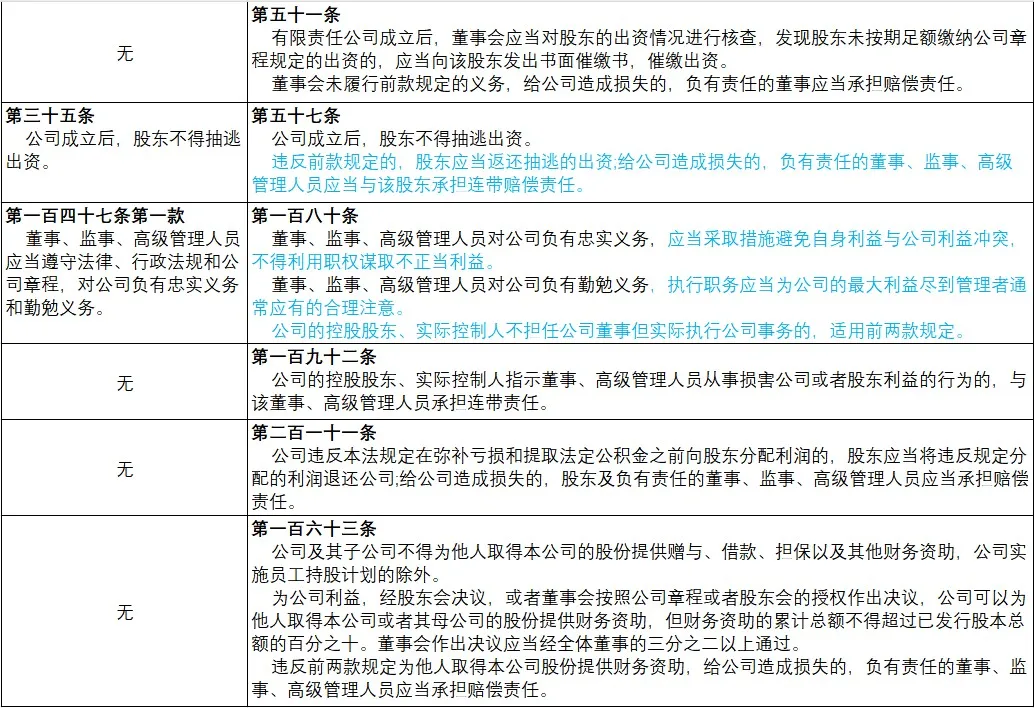
Compared to creditors, who are far removed from company operations, and shareholders, who can only indirectly manage the company through the shareholders’ meeting or by electing and replacing directors and supervisors, directors, supervisors, and senior management are undoubtedly the direct subjects of company management. The third draft broadens the powers of the board of directors but also increases the responsibilities of directors, supervisors, and senior management, strengthening oversight of directors and senior officers. According to the principle of matching rights and responsibilities, the duties of directors, supervisors, and senior management include: first, ensuring that the company’s initial capital is paid in full and on time and does not improperly leak; second, fulfilling management duties to, from a positive perspective, promote efficient company operations and generate as much operating income as possible, and from a negative perspective, prevent improper reduction of the company’s interests. (For a comparison between the current Company Law and the third draft, see Appendix 3)
1. Provisions Expanding Board Authority
(1) Audit Committee May Be Established Within the Board of Directors
Establishing an audit committee composed of directors within the board to exercise the powers of the board of supervisors is an alternative solution proposed in the third draft based on the current state of China’s board of supervisors system. An audit committee composed of directors undoubtedly has more voice and influence, enabling effective checks on other directors and senior officers. Article 69 of the third draft provides that limited liability companies may establish an audit committee; Article 121, for joint-stock companies, adds paragraphs 2 and 3, detailing the composition and personnel requirements for the audit committee and further providing that other committees may also be established within the board; Article 137, for listed companies, additionally requires that certain board resolution matters be first submitted to the audit committee for resolution, further expanding the audit committee’s authority.
(2) Creation of Authorized Capital System
Article 152 of the third draft creates an authorized capital system. The board of directors may, in accordance with the company’s articles of association or authorization from the shareholders’ meeting, decide on the issuance of shares based on the company’s operating conditions, simplifying the share issuance process and improving efficiency. However, to prevent abuse of this rule by the board, the provision also sets limits: shares issued within three years cannot exceed 50% of the issued shares, and if the consideration for shares is non-cash, it must be approved by a shareholders’ meeting resolution.
Additionally, combined with Articles 59 and 112 of the third draft, the powers of the shareholders’ meeting of joint-stock companies are almost identical to those of limited liability companies, and both add the power of the shareholders’ meeting to authorize the board to make resolutions on issuing corporate bonds. The board’s decision-making power is unprecedentedly strengthened.
2. Provisions Strengthening Oversight of Directors and Senior Officers
(1) System of Dismissal of Directors Without Cause
From the perspective of shareholder oversight of directors, Article 71 of the third draft provides that the shareholders’ meeting may resolve to dismiss a director, and the dismissal takes effect from the date of the resolution. It is clear that although the third draft significantly expands the board’s authority, shareholders still exercise strong oversight over directors through the shareholders’ meeting. If directors can be dismissed without cause at any time, it is necessary to design more detailed rules to prevent controlling shareholders from abusing their voting rights to dismiss directors appointed by other shareholders.
(2) External Liability System for Directors and Senior Officers
Ordinarily, if directors or senior officers cause harm to others while performing their duties, the company bears compensation liability. Article 191 of the third draft externalizes director liability, providing that if a director or senior officer acts with intent or gross negligence, they shall also bear compensation liability to others, thereby strengthening external oversight of directors and senior officers.
3. Improvement of Provisions on Duties of Directors, Supervisors, and Senior Management
(1) Duty to Call for Capital Contributions and Prevent Capital Flight
Shareholders paying contributions in full and on time and ensuring that contributions are used by the company are the foundation for shareholders to enjoy their rights and a necessary requirement for ensuring the company’s initial capital is in place and operations can proceed effectively. To this end, the third draft clarifies responsibilities in the following three aspects:
First, to address difficulties in shareholder capital contributions, Article 51 designates the board of directors as the obligor to demand contributions. If the board fails to fulfill this call duty, causing losses to the company, the responsible directors shall bear compensation liability.
Second, if a shareholder withdraws capital after contributing, causing losses to the company, Article 57 provides that responsible directors, supervisors, and senior management shall bear joint and several compensation liability with the shareholder.
Third, if illegal capital reduction causes losses to the company, Article 226 provides that shareholders and responsible directors, supervisors, and senior management shall bear compensation liability.
(2) Improvement of the Duty of Loyalty and Duty of Care of Directors, Supervisors, and Senior Management
Article 147 of the current Company Law provides that directors, supervisors, and senior management owe a duty of loyalty and a duty of care to the company but does not define these duties, leading to inconsistent judicial standards. Article 180(1) of the third draft clarifies the core content of the duty of loyalty: “they shall take measures to avoid conflicts between their own interests and the company’s interests and shall not use their positions to obtain improper benefits.” Regarding the core judgment principle for the duty of care, Article 180(2) provides: “when performing duties, they shall exercise the reasonable care that a manager would ordinarily exercise in the best interests of the company.” The improvement of the duties of loyalty and care provides relatively clear behavioral standards for directors, supervisors, and senior management, making it more operational for the company to hold them liable.
(3) Liability of “Shadow Directors and Senior Officers”
Directors and senior officers, as part of the company’s management, are an important pole in corporate governance and have relative independence. If directors and senior officers completely lose their independence, the effectiveness of corporate governance will be greatly diminished. To enhance their independence, Article 192 of the third draft provides: “If a controlling shareholder or actual controller of a company instructs a director or senior officer to engage in conduct that harms the company or shareholders’ interests, they shall bear joint and several liability with the director or senior officer.” This provision has two guiding functions for directors and senior officers: First, when a director or senior officer receives an instruction from a controlling shareholder or actual controller to engage in harmful conduct, they can cite this provision, informing the instructing party of the potential legal consequences, thereby dissuading or resisting the instruction and maintaining their independence. Second, this provision directly warns directors and senior officers that they cannot become tools for controlling shareholders or actual controllers to harm the company or shareholders; they must maintain their independence, otherwise they will bear joint and several liability with the controlling shareholder or actual controller.
(4) Compensation Liability for Illegal Distribution of Company Profits
After company profits are used to pay taxes, cover losses, and set aside 10% of the profits as statutory reserve fund, the shareholders’ meeting may resolve to set aside discretionary reserve funds and resolve to distribute profits. The board of directors shall distribute profits within six months from the date of the shareholders’ meeting resolution to distribute profits. If profits are distributed to shareholders before covering losses and setting aside the statutory reserve fund, causing losses to the company, Article 211 of the third draft provides that responsible directors, supervisors, and senior management shall bear compensation liability together with the shareholders. This provision clarifies the liable parties for illegal profit distribution but does not specify the scope of parties entitled to claim compensation. Based on the text, profit distribution necessarily involves both the shareholders’ meeting and the board of directors. In cases where both the shareholders’ meeting and the board illegally distribute, the parties entitled to claim compensation need further clarification.
(5) Liability for Illegal Financial Assistance
The current Company Law has no provisions on financial assistance. The third draft introduces new rules on financial assistance. According to Article 163 of the third draft:
First, forms of financial assistance include gifts, loans, and guarantees;
Second, the purpose of financial assistance is to enable others to acquire shares of the company;
Third, the entities providing financial assistance are the company and its subsidiaries;
Fourth, financial assistance is generally prohibited, with two exceptions: (i) when the company implements an employee stock ownership plan; (ii) when financial assistance is provided in the company’s interest pursuant to a resolution of the shareholders’ meeting (or an authorized board resolution). In the latter case, the restriction is that the total cumulative amount of financial assistance for others to acquire shares of the company or its parent company shall not exceed 10% of the total issued share capital, and a board resolution requires approval by at least two-thirds of all directors.
When making a resolution on financial assistance, the authorized board must ensure that it falls within one of the two exceptions and complies with the restrictive conditions. Otherwise, if losses are caused to the company, responsible directors, supervisors, and senior management shall bear compensation liability.
Notes:
[1] Zhou You, “Analysis of Controversial Clauses in the Third Draft of the Company Law Revision and Proposed Amendments,” China Civil and Commercial Law Website, September 19, 2023.
Contact Lawyer
Submit your contact details and consultation question. We will follow up ASAP.