
A Brief Discussion on the Impact of U.S. Export Controls and Sanctions on Enterprises in China's Low-Altitude Economy Sector
A Brief Discussion on the Impact of U.S. Export Controls and Sanctions on Enterprises in China's Low-Altitude Economy Sector
Attorney PAN Yetong notes that in recent years, citing 'national security' and other reasons, the U.S. Department of Commerce's Bureau of Industry and Security (BIS) has continuously strengthened export controls and sanctions on China's low-altitude economy sector (including drones, eVTOLs, and related components and software). Key measures include adding multiple major enterprises to the Entity List with a presumption of denial for license reviews, imposing massive fines on violating companies, and introducing new rules to tighten control over the drone supply chain. These control measures exercise long-arm jurisdiction through the 'De Minimis Rule' and the 'Foreign Direct Product (FDP) Rule,' causing Chinese enterprises to face severe challenges such as the risk of broken core component supply chains, hindered product upgrades, restricted access to specific markets, and significantly increased compliance costs. In response, the article suggests that enterprises strengthen component screening and supply chain management, strictly screen customer backgrounds and end-uses, enhance overall compliance awareness, and dynamically track regulatory changes. Concurrently, leveraging professional legal teams to navigate export control risks is recommended to ensure robust business development.
As products in the low-altitude economy sector are gradually implemented and applied in real-world scenarios, the United States has also tightened export controls on related items year by year. The primary methods include the U.S. Department of Commerce Bureau of Industry and Security (“BIS”) adding relevant enterprises to the Entity List under the Export Administration Regulations (“EAR”), expanding the scope of controlled items, and intensifying penalties for entities violating export controls. These actions restrict China from obtaining U.S. technology and components and prohibit U.S. persons from transacting with them. The sanctioned enterprises are mainly concentrated in the fields of drones, eVTOLs (electric vertical takeoff and landing aircraft), and related components, software, and technologies. The justifications for sanctions are predominantly “national security” and “military end-use.” Furthermore, geopolitical conflicts and shifting international landscapes have led to stricter controls over the flow of controlled items (including foreign-made products containing U.S. controlled items) to places like Russia, Syria, and Venezuela. To a certain extent, this also restricts the development of overseas markets for enterprises in China’s low-altitude economy sector.
This article provides examples of recent BIS control and sanction measures targeting items and entities in the low-altitude economy sector, briefly discusses the impact of these controls and sanctions on Chinese enterprises in this sector, and offers suggestions on how enterprises should respond.
I. Selected Recent BIS Sanctions Involving China’s Low-Altitude Economy Sector
1. Adding Drone Companies Represented by DJI and Their Suppliers to the Entity List, Restricting Their Access to Controlled Items
On December 22, 2020, BIS added Shenzhen DJI Sciences and Technologies Ltd. (“DJI”) to the Entity List, restricting DJI from acquiring the vast majority of U.S. controlled items. Under the current Entity List, with the exception of drone operators disclosing drone operation, maintenance, or repair technology designated under EAR99 to DJI, all other controlled items under the EAR require a license before being provided to DJI, and most items are subject to a license review policy of a presumption of denial.
In June 2024, BIS added Autel Robotics Co., Ltd. (“Autel Robotics”) to the Entity List, specifying that Autel Robotics must obtain a license to acquire any item subject to the EAR, and the license review for Autel Robotics is subject to a policy of a presumption of denial. Prior to BIS adding Autel Robotics to the Entity List, according to Reuters, members of the U.S. House of Representatives had requested the Biden administration to investigate Autel Robotics, arguing that it posed a direct threat to U.S. national security and could potentially expose sensitive data nationwide [1].
In addition, in May 2024, BIS added Shenzhen AEE Aviation Technology Co., Ltd. (“AEE”), Beijing Zhongshang Dingsheng Mechanical and Electrical Equipment Co., Ltd. (“Zhongshang Dingsheng”), Chengdu JOUAV Automation Tech Co., Ltd. (“Chengdu JOUAV”), and Shenzhen Yidian Technology Co., Ltd. to the Entity List. The rationale was that the aforementioned enterprises acquired or attempted to acquire U.S.-origin controlled items for use by Chinese military entities, and these items are applicable to unmanned aerial vehicles (UAVs). Among them, Zhongshang Dingsheng’s products include thermal imaging detectors, night vision devices, laser rangefinders, drone thermal imaging modules, fiber optic guidance, and photoelectric pods. Chengdu JOUAV’s products include oblique cameras, photoelectric pods, LiDAR and other mission equipment, ground stations and hangar products, software products, and drone products. AEE’s products include drone airborne equipment, image transmission systems, counter-detection systems, civilian drones, and large drones.
2. Imposing Severe Penalties on Entities Violating EAR Provisions
According to the EAR, violations of the EAR may result in administrative penalties for the violating entities, such as civil fines, revocation of licenses, and denial of export privileges. Those who willfully commit illegal acts may also face steep criminal fines and imprisonment [2]. Below are examples of some penalty cases related to the low-altitude economy sector.
(1) Massive Fines
On August 15, 2024, BIS announced a $5.8 million civil penalty against TE Connectivity Corporation (“TE Connectivity”) located in Pennsylvania, U.S., and TE Connectivity HK Limited located in Kwai Chung, New Territories, Hong Kong. The reason was that these two companies, without obtaining BIS licenses, shipped low-level controlled items to parties related to China’s hypersonic technology, drone, and military electronics programs, including the China Aerodynamics Research and Development Center and Northwestern Polytechnical University. BIS determined that TE Connectivity, between December 2015 and October 2019, through its business units and distributors in China, violated the EAR 79 times without BIS licenses by exporting $1.74 million worth of EAR99 items to Chinese entities on the Entity List and/or for restricted drone end-uses. These low-level controlled items included wires, printed circuit board connectors, and pressure and temperature scanners.
(2) Addition to the Entity List
On April 11, 2024, Jiangxi Xintuo Enterprise Co., Ltd. was added to the Entity List because the company supported the Russian military through the procurement, development, and proliferation of Russian drones, violating U.S. national security and foreign policy interests. After being added to the Entity List, the enterprise must obtain a prior license to acquire any controlled items under the EAR. Except for food and medicine falling under the EAR99 category, the license review for other controlled items is subject to a policy of a presumption of denial.
On October 23, 2024, DITAI Technology (Hong Kong) Co., Ltd., L-Tong Electronic Technology Company, and Shenzhen Jiachuang Weiye Technology Co., Ltd. were added to the Entity List because they had procured or attempted to procure U.S.-origin controlled items for Iran’s weapons of mass destruction and drone programs. The aforementioned entities must obtain a prior license to acquire any controlled items under the EAR, and all license reviews are subject to a policy of a presumption of denial.
3. Strengthening Controls by Issuing New Rules
In early January 2025, BIS published the proposed rule Securing the Information and Communications Technology and Services Supply Chain: Unmanned Aircraft Systems [3] to address the undue or unacceptable risks posed by transactions involving Information and Communications Technology and Services (“ICTS”) integrated into unmanned aircraft systems (UAS), seeking public comments. In this proposed rule seeking public comments, the ICTS referred to may include, but is not limited to: (1) onboard computers responsible for processing data and controlling UAS flight; (2) communication systems, including but not limited to flight controllers, transceiver/receiver equipment, proximity links (e.g., Global Navigation Satellite System sensors), and flight termination equipment; (3) flight control systems responsible for takeoff, landing, and navigation, including but not limited to exteroceptive sensors and proprioceptive sensors; (4) ground control stations or systems, including but not limited to handheld flight controllers; (5) operational software, including but not limited to network management software; (6) mission planning software; (7) smart battery power systems; (8) local and external data storage devices and services; and (9) artificial intelligence software or applications. The proposed rule seeks public comments on aspects such as the definitional scope of UAS and its components, security risk assessments, potential regulatory measures, authorization and certification mechanisms, and potential economic impacts.
Although this proposed rule has just ended its public comment period and no formal control rules have been issued yet, the release of this proposed rule demonstrates the U.S. government’s high level of concern regarding the security of the drone supply chain. As products in the low-altitude economy sector develop, upgrade, and are increasingly utilized in various application scenarios, the controls on products related to the low-altitude economy sector may evolve in a stricter and more comprehensive direction.
II. The Impact of BIS Export Controls and Sanctions on Enterprises in the Low-Altitude Economy Sector
The U.S. export control and sanctions system is centered around BIS, which implements controls and sanctions based on the EAR. This includes issuing relevant rules to continuously adjust and tighten controls on specific controlled items, adding specific entities to the Entity List, and penalizing enterprises that violate EAR provisions. In addition, it involves multiple departments, such as the Department of the Treasury and the Department of State, which form multiple sanction lists other than the Entity List based on other regulations. This article briefly discusses the impact of EAR-related controls and sanctions on enterprises in the low-altitude economy sector.
1. Restrictions on Controlled Items Lead to Supply Chain Instability and Hinder Product Upgrades and Iterations
(1) Controlled Items
Controlled items refer to items with specific Export Control Classification Numbers (ECCNs) on the Commerce Control List (“CCL”), as well as items not listed on the CCL but within the jurisdiction of the U.S. Department of Commerce. The former, if meeting control conditions, requires a license application prior to export or reexport; the latter is classified as EAR99 and, in most cases, can be exported or reexported without a license.
The above controlled items include not only those located in the U.S. or originating from the U.S. but also items containing a certain proportion of controlled U.S. content. The latter refers to foreign-made products that do not meet the De Minimis Rule [4] or foreign-made products subject to the Foreign Direct Product (FDP) [5] Rule. Notably, regarding semiconductors and chips, which have been subject to gradually strengthened controls in recent years, BIS added a “0% De Minimis Rule” [6] in an interim final rule issued in December 2024. In January of this year, BIS issued an interim final decision, Implementation of Additional Due Diligence Measures for Advanced Computing Integrated Circuits, requiring fabs and Outourced Semiconductor Assembly and Test (OSAT) companies to comply with relevant provisions under the EAR regarding advanced computing integrated circuits in the supply chain.
(2) Commerce Control List (CCL)
To determine whether a product, software, or technology is a controlled item with a specific ECCN code, one must query the relevant classification of the item on the CCL. The CCL classifies controlled items into ten categories, each further subdivided into five product groups. Among them, the controlled items relevant to enterprises in the low-altitude economy sector mainly include Category 3 (Electronics), Category 4 (Computers), Category 5 (Telecommunications and Information Security), Category 7 (Navigation and Avionics), and Category 9 (Aerospace and Propulsion). For example, the 3A090 high-performance computing chips in Category 3 can be applied to the flight control systems, sensors, and communication modules of drones and eVTOLs; the 7A101 high-accuracy accelerometers and their specially designed components, and 7A103 instrumentation, navigation equipment, and systems in Category 7 can be applied to the navigation systems of drones and eVTOLs; the 9A012 non-military unmanned aerial vehicles and associated systems, equipment, and components in Category 9 can be used for the production and manufacturing of drones. The above categories of controlled items cover multiple aspects from core components and flight control systems to navigation and communication modules.
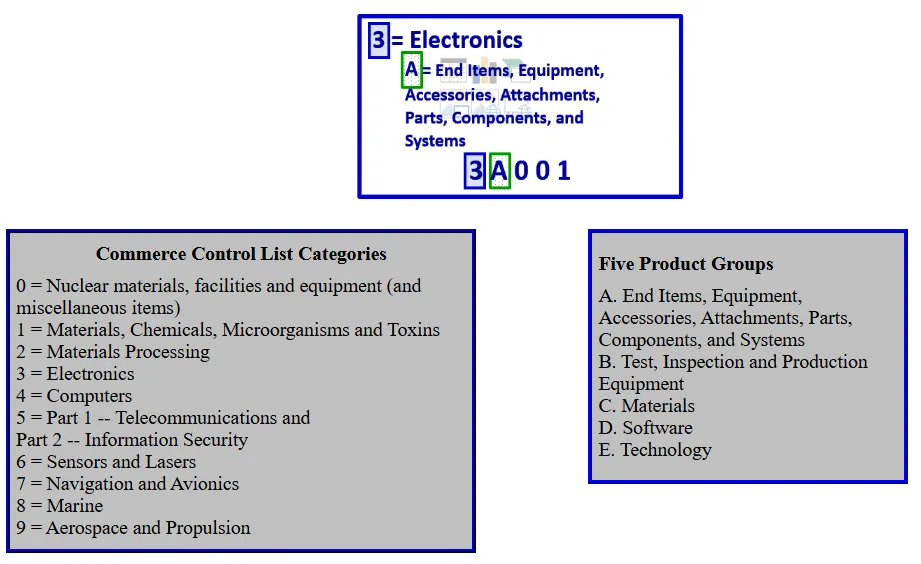 Chart 1: The CCL controlled items are divided into ten categories, with each category further subdivided into five product groups.
(3) Impact
Based on the above, even if an enterprise has no or very few instances of directly purchasing components, software, or technology from the U.S., if the purchased components, software, or technology contain U.S. controlled items, there is still a risk of falling within the scope of EAR controls and thus being restricted from acquisition.
The aforementioned restrictions on controlled items and the continuous tightening of U.S. controls may make it difficult for domestic drone products to obtain U.S. controlled items, including aero-engines, infrared imaging equipment, and high-accuracy inertial measurement equipment, creating a risk of supply chain rupture for product components. Once the supply chain breaks, it may lead to production interruptions and force companies to seek alternative products, further triggering risks related to product quality control and rising costs.
In addition, as flight application scenarios in agriculture, chemical industries, physical infrastructure and transportation, emergency response, and other fields are implemented and developed in depth in an orderly manner, the industry’s requirements for the accuracy, intelligence, and stability of products and supporting facilities will gradually increase. The demand for and reliance on high-performance components and related software and technologies will correspondingly increase. For enterprises that have not achieved technological autonomy and rely on the U.S. for certain key components (such as high-performance chips), there will also be the risk of increased difficulty in product updates and iterations due to restricted supply of controlled items.
2. Long-Arm Jurisdiction Restricts Product Supply to Specific Customer Groups, Thereby Affecting Market Share
As mentioned earlier, the creation of the De Minimis Rule and the Foreign Direct Product Rule within the EAR enables the U.S. to continue exercising jurisdiction over transactions of foreign products by foreign entities, which is also a concern for many domestic enterprises. Especially during the Russia-Ukraine war, the author frequently received inquiries from clients asking whether selling their manufactured products to specific countries/regions or entities might violate EAR provisions. If a product is a foreign product subject to EAR jurisdiction, the enterprise must pay attention to the end-user and end-use of the transaction. Determining the end-user involves the use of the Country Chart and the Entity List.
(1) Country Chart
The Country Chart refers to the Country Groups listed in the EAR, which divides countries into different groups such as A, B, D, and E. The export control policies from Group A to Group E go from loose to strict, and the reasons for control applicable to different countries/regions vary (see Chart 2). The chart is used to determine whether the export or reexport of controlled items to that country/region requires a license, as well as the applicable license exception policies, and needs to be used in conjunction with the CCL. In the CCL, every controlled item with an ECCN code explicitly lists the reasons for control (e.g., Anti-Terrorism, Nuclear Nonproliferation). If the applicable reason for control matches the destination country/region for the intended export or reexport of the controlled item, and no license exception applies or is met, the export or reexport of the item requires an advance license application.
In recent years, with the continuous changes and development of the international situation, BIS has also continuously adjusted the country groupings in the Country Chart. A major adjustment was the reclassification of Russia in 2020 from the relatively loosely controlled Group A to the strictly controlled Group D. Moreover, due to geopolitical factors and U.S. concerns about Russia using relevant technologies and components for military purposes, exports of drone-related technologies and components to Russia are also subject to stricter controls. This includes expanding the scope of the Russia/Belarus Foreign Direct Product Rule and imposing restrictions on Russian military end-uses and end-users, encompassing relevant items used for drone manufacturing.
In addition, Section 744.3 of the EAR clarifies that for countries/regions listed in Country Group D:4, if there is knowledge that the controlled items will be used in the design, development, production, operation, installation, maintenance, repair, overhaul, or refurbishing of unmanned aerial vehicles with a range of at least 300 kilometers, or for the delivery of chemical, biological, or nuclear weapons, the export, reexport, or in-country transfer of drone-related controlled items is restricted. If it is impossible to determine the range capability of the end-use product or whether it is used for chemical, biological, or nuclear weapons, as long as the controlled item is shipped to a Country Group D:4 country, an advance license must be obtained before export, reexport, or in-country transfer. Currently, Country Group D:4 countries include China (including Macau), Russia, Iran, North Korea, Syria, Venezuela, etc.
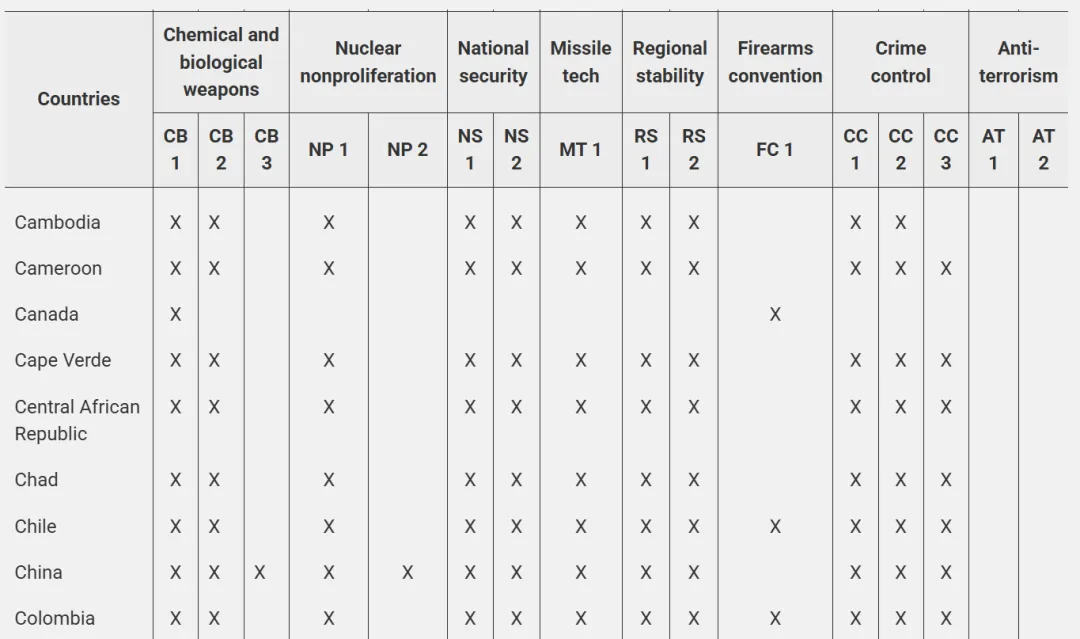 Chart 2: As shown, an “X” indicates the reason for control applicable to that country/region. For example, if the reason for control of a controlled item on the CCL is National Security (NS), an advance license is required when exporting the item to China, but no license is required when exporting to Canada.
(2) Entity List
The Entity List is formulated and managed by BIS and contains foreign enterprises, research institutions, government and private organizations, individuals, and other types of legal persons deemed to pose a threat to U.S. national security or foreign policy. The purpose is to restrict specific entities from acquiring technologies and products that the U.S. believes may harm its national security or violate its foreign policy interests. Entities on the Entity List often face stricter control measures than those imposed on the region where the entity is located. Taking DJI as an example, to maintain the basic functionality and maintenance of DJI’s existing products and ensure its civilian drones can continue to serve existing U.S. consumers, the U.S. allows DJI to acquire extremely limited parts of EAR99-category controlled items. All other controlled items under the EAR require a license before being provided to DJI, and most items are subject to a license review policy of a presumption of denial, thereby blocking DJI from acquiring U.S. controlled items.
Therefore, whether it is a supplier of drone products or related components, software systems, and other accessories, especially for transactions of low-level items like EAR99 that generally do not require a license, if the transaction counterparty or end-user is an entity on the Entity List, the transaction may still violate EAR provisions.
(3) Impact
As mentioned above, the creation of the De Minimis Rule and the Foreign Direct Product Rule within the EAR allows the U.S. to continue utilizing the principle of “long-arm jurisdiction” to extend the scope of export controls into the global supply chain. The continuous U.S. controls on China have led to many domestic enterprises being added to the Entity List. Coupled with the impact of geopolitical conflicts, the U.S. has also tightened its control policies on specific countries/regions. If an enterprise exports or transfers products containing U.S. components to sanctioned countries/regions or entities on the Entity List, the products may be subject to the EAR because they meet the provisions for foreign products under the De Minimis Rule or the Foreign Direct Product Rule. Without obtaining a license and not qualifying for a license exception, the transaction carries the risk of violating EAR provisions and facing severe penalties such as massive fines or being added to the Entity List. To avoid violating EAR provisions, enterprises may have to abandon specific country/region markets or terminate transactions with entities on the Entity List, which will lead to a certain degree of decline in the product’s market share.
3. Increased Compliance Costs
To ensure the stability of the product supply chain and prevent the manufactured products from falling under the EAR’s controlled items category, enterprises may need to adjust their existing product production lines, conduct necessary R&D for their products, or seek alternative components, application software, and technologies. These operations will lead to an increase in direct costs for the enterprises.
III. Recommendations for Enterprises
1. Strengthen Screening of Product Components and Supply Chain Management
Enterprises can screen the components involved in product production and assembly to determine whether there are products involving U.S.-origin components, software, and technology, as well as “foreign products” that might be identified as EAR-controlled items, and control the percentage of U.S. controlled items within the product. For components, software, and technology with high technical requirements, enterprises should promptly develop them or seek alternative supplier products.
2. Emphasize Customer Background Investigations and Focus on End-Users and End-Uses
When conducting business, enterprises must pay attention to the control policies of the region/country to which the transaction counterparty belongs and whether the counterparty falls on the Entity List. They should strengthen the screening of end-users and end-uses, watch for “Red Flags” listed in the EAR regarding the transaction counterparty, and continuously track whether the end-user and end-use change.
3. Enhance Corporate Compliance Awareness and Continuously Monitor Legal Changes
Enterprises can regularly conduct training on export control regulations for employees to ensure they have a certain understanding of export control and sanctions systems, enabling them to proactively identify and report potential compliance risks during business operations. At the same time, they need to pay attention to dynamic changes in laws and regulations, promptly update their understanding of relevant market access restrictions, and plan alternative solutions in advance for markets that may be restricted.
4. Engage a Professional Legal Services Team for Assistance
Against the backdrop of an increasingly complex global trade landscape and continuously tightening export control and sanctions measures, enterprises in the low-altitude economy sector are facing increasingly severe compliance challenges. Addressing complex export licensing requirements necessitates professional and precise legal support to ensure compliant operations. Through professional legal services, enterprises can better cope with the challenges brought by export controls, reduce the risk of non-compliance, and ensure the smooth conduct of business.
References & Notes:
[1] Reuters News Report
[2] EAR Section 764.3
[4] A rule calculating the value percentage of controlled U.S.-origin content in a foreign-made product. If it is below a specified percentage, the foreign-made product is not a controlled item subject to the EAR; conversely, it may be a controlled item falling within EAR jurisdiction.
[5] Refers to the direct product of U.S.-origin technology or software, or the foreign product produced by a plant where the plant or major component of a plant is a direct product of U.S.-origin technology or software, provided that it meets the conditions of General Prohibition Three in EAR Section 736.2(b)(3).
[6] For commodities specified in ECCN 3B001.a.4, c, d, f.1, f.5, f.6, k through n, p.2, p.4, r, or 3B002.c, if the commodity is incorporated into a U.S.-origin integrated circuit layout, or incorporates a U.S.-origin integrated circuit layout specified under CCL Categories 3, 4, or 5, and the destination of the commodity is Macau or a destination specified in Country Group D:5, there is no de minimis threshold for U.S. controlled content, unless the commodity is excluded from national security or regional stability license requirements; for items meeting the ECCN parameters specified in CCL Category 3B in Supplement No. 1 to EAR Part 774 (except 3B001.a.4, c, d, f.1, f.5, k through n, p.2, p.4, r, or 3B002.c), and the commodity is incorporated into a U.S.-origin integrated circuit or incorporates a U.S.-origin integrated circuit specified in CCL Categories 3, 4, or 5, and the destination of the commodity is an entity designated with Footnote 5 on the Entity List, there is no de minimis threshold.
Contact Lawyer
Submit your contact details and consultation question. We will follow up ASAP.