
Facing the Recent U.S. Tariff Policies, How Can Chinese Cross-Border E-Commerce Break Through?
Facing the Recent U.S. Tariff Policies, How Can Chinese Cross-Border E-Commerce Break Through?
Attorney Ye Peng argues that the recent U.S. cancellation of duty-free treatment for low-value parcels from China, the abolition of the T86 customs clearance procedure, and the substantial imposition of 'reciprocal tariffs'—with cumulative rates once reaching as high as 145%—have subjected Chinese cross-border e-commerce enterprises to severe challenges, including soaring costs, compressed profits, declining competitiveness, and forced market exit. In response, enterprises should actively leverage policy benefits such as the national overseas warehouse construction, export tax rebates, and tax incentives under comprehensive pilot zones while accelerating cooperation with domestic platforms like JD.com and Hema to expand domestic sales channels. Strategically, it is recommended to negotiate tariff cost sharing with U.S. firms, implement market-differentiated pricing, shift production to Southeast Asia to optimize supply chains, diversify into European, American, and emerging markets to mitigate single-market risk, while intensifying product innovation and environmentally differentiated R&D, and deeply applying big data and artificial intelligence technologies to optimize marketing and customer service processes—thereby achieving a breakthrough and sustainable growth amidst the complex international trade environment.
In recent years, China’s cross-border e-commerce industry has flourished, becoming a vital force driving international trade growth. However, with changes in the international landscape, the U.S. tariff policies recently implemented have posed severe challenges to the operations of Chinese cross-border e-commerce enterprises in the U.S. market. This article will conduct an in-depth analysis of the core content of U.S. tariff policies and their impact on Chinese e-commerce enterprises, and propose countermeasures to help Chinese cross-border e-commerce enterprises achieve a breakthrough and development in the U.S. market.
I. Core Content of U.S. Tariff Policies
(I) Cancellation of Duty-Free Treatment for Low-Value Parcels
The U.S. duty-free policy for low-value parcels began in the 1930s, originally designed to facilitate American tourists bringing travel souvenirs back to the U.S. duty-free. The policy allowed duty-free entry for parcels valued at no more than $5 (equivalent to approximately $106 today). Over time, this duty-free threshold was repeatedly raised, reaching $800 by 2016.
However, on April 2, 2025, U.S. President Trump signed an executive order announcing that effective at 12:01 a.m. Eastern Daylight Time on May 2, 2025, duty-free treatment for low-value imports from mainland China and Hong Kong would be revoked. This means parcels valued under $800 will no longer be eligible for duty-free entry into the United States. According to the executive order, after the cancellation of duty-free treatment:
- From May 2, 2025, low-value parcels imported from China are subject to a 30% tariff or $25 per item.
- After June 1, 2025, the tariff will increase to $50 per item.
(II) Changes in Customs Clearance Procedures
In 2016, when the duty-free threshold for low-value parcels was raised to $800, the T86 customs clearance procedure was introduced to simplify the process. Due to the policy adjustment, the T86 procedure has been abolished, and importers must now shift to other clearance procedures (such as T11 and T01).
(III) Implementation of “Reciprocal Tariffs”
On April 2, 2025, U.S. President Trump signed an executive order announcing the imposition of so-called “reciprocal tariffs” on imported goods from countries worldwide. The policy consists of two parts:
- Starting April 5, 2025, a baseline 10% tariff will be imposed on all countries and regions.
- For approximately 60 countries and regions, goods entering the United States will be subject to “reciprocal tariffs” ranging from a minimum of 11% to a maximum of 50%, effective at 12:01 a.m. EDT on April 9, 2025.
Major economies with higher “reciprocal tariff rates” include China (34%), the European Union, Japan, and India. Under this “reciprocal tariff” plan, 59 countries are subject to high tariffs, with China facing a 34% tariff, while the EU, Vietnam, Taiwan (China), Japan, India, South Korea, and others are subject to varying degrees of tariff increases.
On April 8, President Trump issued another executive order, amending the “reciprocal tariffs” on China and tariffs on low-value imported goods in response to China’s countermeasures. The order provides that, effective 12:01 a.m. EDT on April 9, 2025, the reciprocal tariff rate on China shall be increased to 84%.
On April 10, the U.S. government announced a further increase in the “reciprocal tariff” rate on Chinese goods imported into the United States to 125%. According to the Trump administration’s explanation, the cumulative tariff rate on all Chinese goods imported into the United States has thus reached 145%.
On the evening of April 11, 2025, at 10:36 p.m. EDT, U.S. Customs and Border Protection (CBP) issued a tariff update guideline. The guideline states that, based on the memorandum signed by President Trump that day—Clarifying Exceptions to Executive Order 14257 of April 2, 2025 (as amended)—all products classified under the following tariff headings of the Harmonized Tariff Schedule of the United States (HTSUS) are exempt from the “reciprocal tariffs” under Executive Order 14257. This means that the 125% “reciprocal tariff” will no longer apply to 20 categories of products originating from China, including smartphones, routers, and certain computers and notebooks.
II. Specific Impact of U.S. Tariffs on Chinese E-Commerce Enterprises in the U.S. Market
1. Cost Increases and Profit Compression
The tariff hikes have directly led to a substantial increase in costs for Chinese e-commerce enterprises. Tariffs not only raise the import cost of goods but also significantly increase customs clearance costs (e.g., switching from T86 to T11/T01 procedures extends clearance time from 10–15 days to 15–25 days) and logistics costs, squeezing the profit margins of small and medium-sized sellers. In the short term, they may be forced to raise prices or exit the market. This has a major impact on small enterprises and manufacturers in China.
2. Price Adjustments and Declining Market Competitiveness
Currently, many Chinese e-commerce enterprises, in order to cope with rising costs, have had to raise product prices in the U.S. market. Some sellers have already increased their U.S. market prices by 30% and plan to reduce inventory levels and advertising expenditures. While this may partially alleviate cost pressures, price adjustments may weaken their market competitiveness, especially for small and medium-sized sellers that rely on low-price advantages.
3. Operational Model Changes and Market Exit
Because the tariff policies have dealt a significant blow to the entire e-commerce business model, many e-commerce enterprises find it difficult to continue operating in the U.S. market and have directly chosen to exit the U.S. market.
4. Shifts in Market Strategy
The adjustment of U.S. tariff policies has forced Chinese cross-border e-commerce enterprises to actively respond to challenges by optimizing supply chains and operations, seeking new development paths, and even accelerating the strategy of diversinto multiple markets.
III. Recommendations for Chinese E-Commerce Enterprises to Break Through
1. Opinions on Expanding Cross-Border E-Commerce Exports and Promoting Overseas Warehouse Construction, jointly issued by the Ministry of Commerce and eight other departments [Shang Mao Fa (2024) No. 125] (hereinafter referred to as the “Opinions”).
The Opinions focus on the following areas:
Cultivation of Market Players:
- Support cross-border e-commerce to empower industrial development, cultivate “cross-border e-commerce empowered industrial belts,” and support enterprises to “exhibit overseas,” among other measures. Eligible e-commerce technology enterprises may apply for recognition as high-tech enterprises or technology-advanced service enterprises in accordance with regulations, and a number of leading technology enterprises will be cultivated and expanded.
Financial Support:
- The Opinions clearly state that financing channels for cross-border e-commerce enterprises should be unblocked, cross-border fund settlement services optimized, supply chain costs reduced and efficiency improved, and enterprise financing facilitated.
Infrastructure Construction:
- Promote the high-quality development of cross-border e-commerce overseas warehouses and enhance logistics support capabilities. The Opinions also indicate that country-specific cooperation guides will be updated and released, guidance for cross-border e-commerce enterprises “going global” and overseas registration will be strengthened, compliant and orderly operations guided, mutual benefit and win-win results achieved, and cross-border e-commerce enterprises assisted in “going global.”
Optimization of Regulatory Services:
- Optimize cross-border e-commerce export supervision and improve cross-border data management and service levels.
Standard and Rule Construction:
- Accelerate the construction of standards in the cross-border e-commerce field, enhance enterprises’ compliant operation levels, and deepen international cooperation.
2. Announcement on Supporting the Development of Cross-Border E-Commerce Overseas Warehouse Exports and Related Export Tax Rebate (Exemption) Policies, issued by the State Taxation Administration in January 2025.
To thoroughly implement the decisions and deployments of the Central Committee of the Communist Party and the State Council and to support the development of new business models such as cross-border e-commerce overseas warehouse exports, the State Taxation Administration has decided to implement a policy of “tax rebate upon departure” for goods exported by taxpayers via cross-border e-commerce overseas warehouses (hereinafter referred to as “export overseas warehouses”). The policy clearly states that for goods exported by taxpayers via the export overseas warehouse method (Customs supervision code “9810”), after the goods are customs cleared and leave the country, taxpayers may apply for export tax rebates (exemptions). It further notes that after the goods are customs cleared and leave the country, taxpayers may pre-submit applications for export tax rebates (exemptions), and later settle the tax calculation based on the actual sales of the goods. This policy greatly simplifies the export tax rebate process and improves capital turnover efficiency.
3. Announcement on Issues Concerning the Assessed Collection of Corporate Income Tax for Retail Exports from Cross-Border E-Commerce Comprehensive Pilot Zones (hereinafter referred to as the “Announcement”), issued by the State Taxation Administration.
Effective from January 1, 2020, for cross-border e-commerce enterprises within comprehensive pilot zones that apply the “tax-free without invoice” policy, corporate income tax will be assessed and collected using the taxable income ratio method, with the taxable income ratio uniformly set at 4%. This policy significantly reduces the tax burden on enterprises and enhances the competitiveness of cross-border e-commerce.
The Announcement also states that cross-border e-commerce enterprises within comprehensive pilot zones that are subject to assessed collection and meet the preferential conditions for small and micro-profit enterprises may enjoy the preferential corporate income tax policies for small and micro-profit enterprises. If their income falls under tax-exempt income as specified in Article 26 of the Enterprise Income Tax Law of the People’s Republic of China, they may enjoy the tax-exempt income preferential policy. This policy further reduces the tax burden on small and micro cross-border e-commerce enterprises and promotes their development.
According to information from the Ministry of Commerce’s Institute of International Trade, as of November 2022, the State Council has established 132 cross-border e-commerce comprehensive pilot zones in six batches, covering 30 provinces, autonomous regions, and municipalities directly under the central government. E-commerce enterprises may choose suitable pilot zones based on their own operational conditions to promote their development.
(II) Understand Industry Dynamics and Rapidly Expand Domestic Sales Markets
On April 10, Ministry of Commerce spokesperson He Yongqian stated at a press conference that the Ministry of Commerce had recently organized discussions with relevant industry associations, large supermarket chains, and distribution enterprises to study how to better leverage their respective advantages to help foreign trade enterprises broaden domestic sales channels. Some enterprises have responded quickly to the policy call:
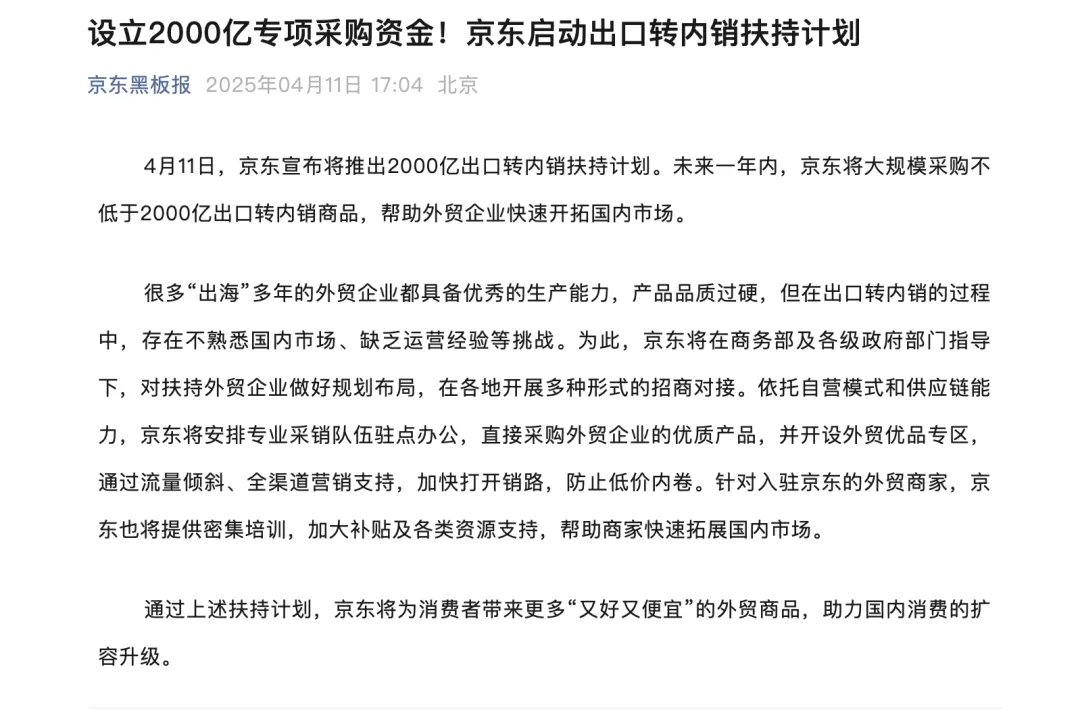
1. JD.com Invests 200 Billion Yuan to Support Export-to-Domestic Sales Conversion
According to the “JD Blackboard” official WeChat account, on April 11, JD.com announced the launch of a 200 billion yuan export-to-domestic sales support plan. Over the next year, JD.com will procure no less than 200 billion yuan worth of goods originally intended for export and convert them to domestic sales, helping foreign trade enterprises quickly explore the domestic market.
A textile enterprise leveraged JD.com’s foreign trade special zone to market home textile products originally exported to Europe and the United States under the “China-Chic” concept, resulting in a 300% sales increase. This transformation not only alleviates export pressure but also drives the upgrade from “Made in China” to “Chinese Brands.”
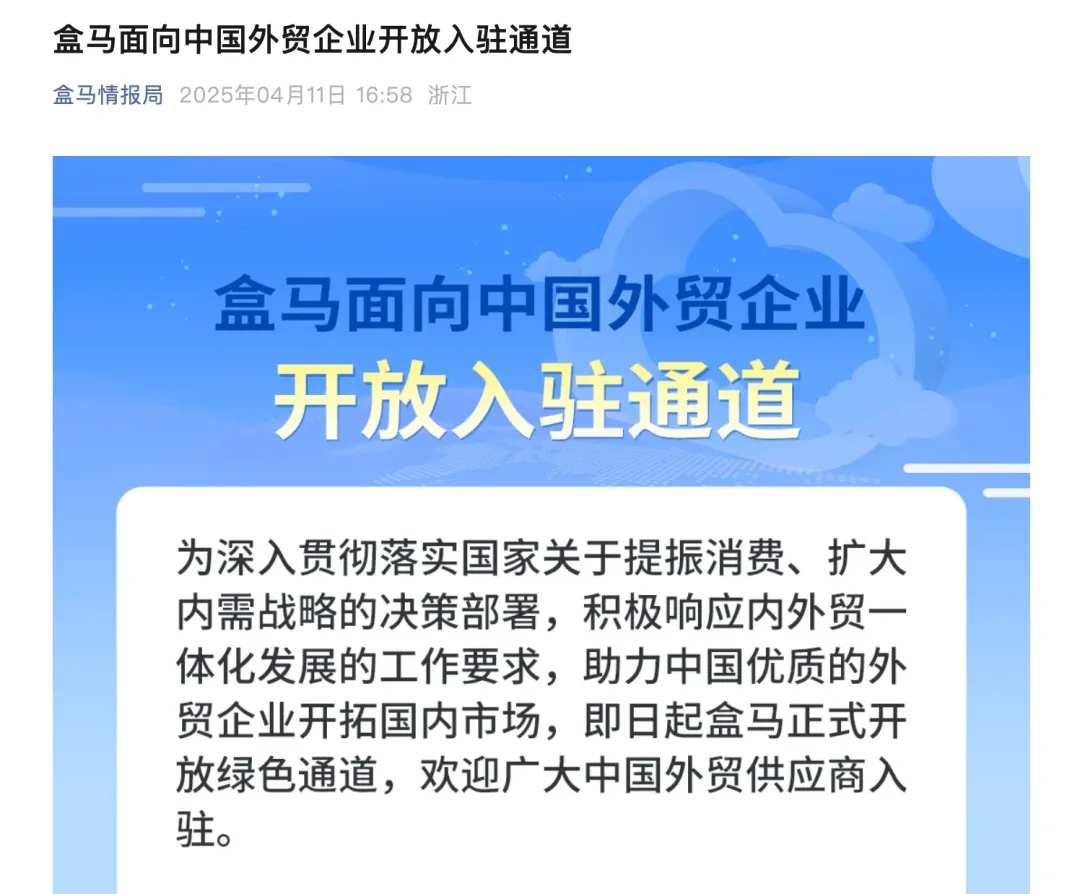
2. Hema Opens Access for Chinese Foreign Trade Enterprises
According to the “Hema Intelligence Bureau” official WeChat account, on April 11, Hema announced that it would open its access channel to Chinese foreign trade enterprises immediately.
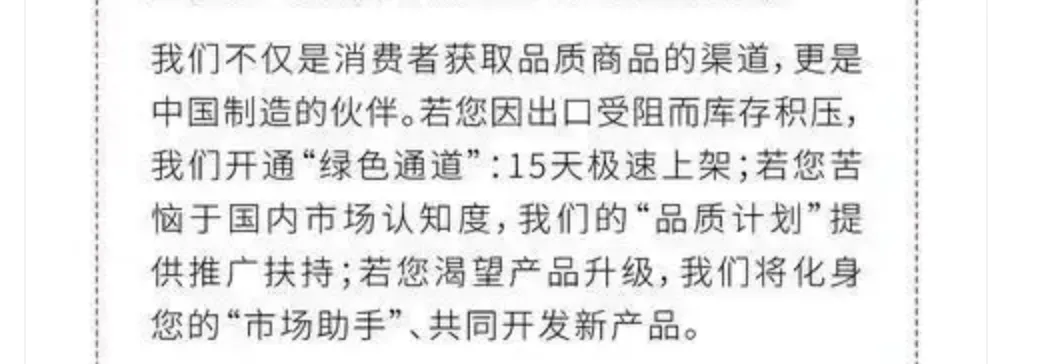
3. Yonghui Supermarket’s “15-Day” Rapid Shelving
On April 7, Yonghui Supermarket issued an open letter to high-quality Chinese supply chains. In the open letter, Yonghui stated that it is not only a channel for consumers to obtain quality goods but also a partner of Chinese manufacturing. If inventory accumulates due to export obstacles, Yonghui will open a “green channel” to complete rapid shelving within 15 days. For foreign trade products struggling with domestic market recognition, Yonghui will provide promotion support. For supply chain enterprises eager for product upgrades, Yonghui will act as a “market assistant” to jointly develop new products.
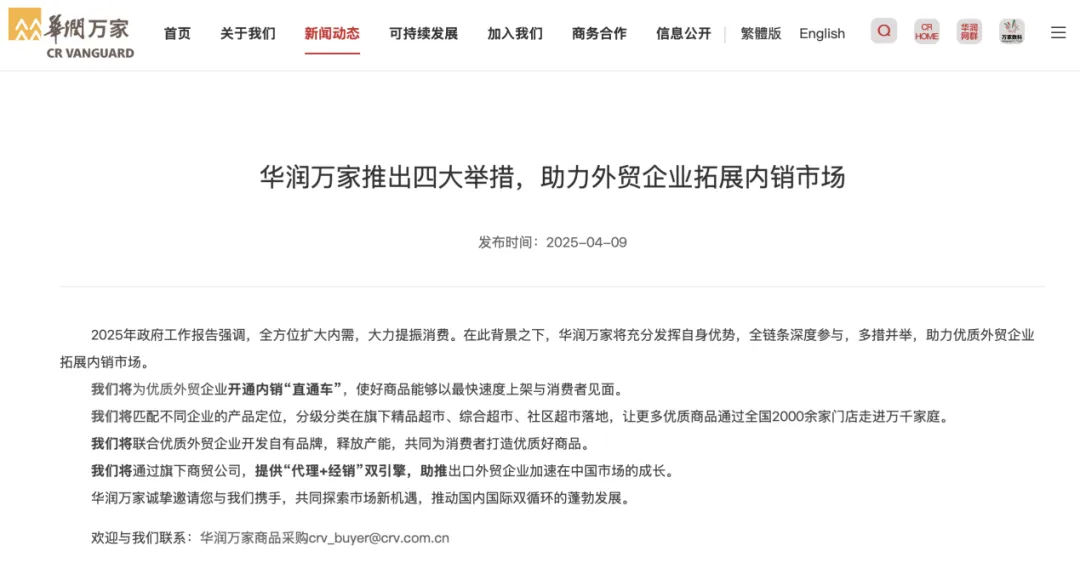
4. China Resources Vanguard’s Four Major Measures to Support Domestic Sales
On April 9, China Resources Vanguard officially launched four major measures to assist foreign trade enterprises in expanding their domestic sales markets.
5. Lianhua Supermarket and Wushang Group, in conjunction with the China General Chamber of Commerce and others, have undertaken a series of actions.
Lianhua Supermarket announced that it will provide multiple support measures, including “special access discounts” and “marketing resource tilts,” to help return excellent Chinese products to the domestic market.
Wushang Group, in conjunction with the China General Chamber of Commerce, initiated a proposal to expand sales channels, provide data support, optimize supply chain management, and accelerate the circulation of foreign trade goods through promotional activities.
(III) Adjust Pricing Strategies
1. Negotiate Cost Sharing with U.S. Partners
Facing tariff increases, Chinese e-commerce enterprises can negotiate with their U.S. partners to share tariff costs. For example, some enterprises are coordinating with U.S. business partners to discuss methods of bearing tariff costs, in an effort to offset the impact of tariff policies.
2. Implement Differentiated Pricing Strategies Based on Consumer Payment Capability and Price Sensitivity in Different Markets
In the U.S. market, where tariffs are high, prices can be appropriately raised to pass part of the tariff costs to consumers. In emerging markets such as Europe and Southeast Asia, relatively lower prices can be maintained to enhance market competitiveness.
(IV) Market Diversification
Reduce dependence on the U.S. market and explore other international markets, such as Europe, Southeast Asia, and the Middle East, leveraging the growth potential of emerging markets to diversify trade risks. Comparative analysis of e-commerce markets in three major regions:
1. Comparison of Market Size and Growth Rate
2. Comparison of Major E-Commerce Platforms
3. Comparison of Consumer Characteristics
4. Compliance Recommendations
(V) Supply Chain Optimization
1. Optimize Supply Chain and Production Layout
Establishing production bases in Southeast Asia can effectively circumvent tariff barriers and reduce logistics costs. Southeast Asian countries typically offer favorable tax policies and lower labor costs, making them suitable for Chinese e-commerce enterprises to set up production facilities. Through localized production, enterprises can reduce costs associated with direct exports from China to the U.S. or other markets, mitigating the impact of tariffs.
2. Optimize Supply Chain Management
Chinese e-commerce enterprises should conduct in-depth research on suppliers to find high-quality, low-cost, and stable sources of goods. They should negotiate with suppliers to establish long-term cooperative relationships, leverage bulk purchases to secure more favorable prices, and directly reduce the procurement cost of goods.
(VI) Product Innovation and Differentiation
1. Develop Specialty Products
Chinese e-commerce enterprises should invest in R&D to develop beauty products with Chinese characteristics and cultural elements, creating differentiated competitive advantages. For example, combining traditional Chinese medicine concepts with modern beauty techniques to develop beauty products with unique efficacy may make them more competitive in the international market.
2. Improve Product Quality
As consumers become increasingly concerned about environmental protection and pure natural ingredients, Chinese e-commerce enterprises should follow this trend and develop more environmentally friendly, pure natural beauty products. Data from Mintel shows that 66% of Japanese consumers are interested in purchasing beauty products claiming to be environmentally friendly, while in the U.S., 61% of consumers expect brands to take more responsibility for environmental issues.
(VII) Technological Innovation and Efficiency Improvement
Utilize big data, artificial intelligence, and other technologies to optimize operational processes, improve production efficiency, and reduce costs.
1. Application of Big Data Analysis
- Market Trend Forecasting: Use big data to analyze consumer behavior, market trends, and competitor dynamics, helping enterprises accurately predict market demand, adjust product strategies and inventory management promptly, and reduce the risk of inventory overstock.
- Precision Marketing: Through analysis of consumer data, achieve precision marketing, increase the conversion rate of advertising, and reduce marketing costs.
- Personalized Recommendations: Based on consumers’ purchase history and preferences, provide personalized product recommendations to enhance user experience and purchase conversion rates.
2. Application of Artificial Intelligence Technology
- Intelligent Customer Service: Use AI technology to build intelligent customer service systems, providing 24-hour online service to improve customer service efficiency and reduce labor costs.
- Intelligent Translation: Apply machine translation technology to achieve automatic multilingual translation, facilitating communication with consumers from different countries and regions.
By comprehensively applying these strategies and measures, Chinese e-commerce enterprises can achieve a breakthrough and sustainable growth in the complex and ever-changing international environment.
Contact Lawyer
Submit your contact details and consultation question. We will follow up ASAP.