
Zhou Hongyi's 9 Billion Breakup Fee Sparks Controversy! Is it a 'Divorce Cash-Out' or a Family Governance Arrangement?
Zhou Hongyi's 9 Billion Breakup Fee Sparks Controversy! Is it a 'Divorce Cash-Out' or a Family Governance Arrangement?
Lawyer Zhang Jun believes that the divorce of Zhou Hongyi, the actual controller of 360, and his wife Hu Huan—in which Hu Huan acquired a 6.25% stake (market value nearly RMB 9 billion)—has triggered market skepticism over 'divorce cash-out.' While the company's announcement states that the control remains unchanged and Hu Huan has promised not to reduce her holdings in the short term, the author's analysis points out that Hu Huan gave up her equity in the holding company, holds Singapore permanent residency, and does not hold any position in 360. This indicates that the event is actually a pre-planned asset segregation and family governance arrangement by the Zhou Hongyi family, rather than a simple cash-out. This case serves as an important reference for family governance and equity stability in listed companies.
First, there was the “palace drama” between a 10-billion-RMB wealthy family’s crown prince and his stepmother at the shareholders’ meeting; now, the major shareholders of a company with a 100-billion-RMB market value are splitting up, sparking skepticism over a “divorce cash-out”?
After the close of trading on April 4, 360 (SH601360) released an Indicative Announcement on Changes in Shareholders’ Equity. The company’s actual controller, Zhou Hongyi, and Hu Huan have completed their divorce procedures after friendly consultations and made relevant arrangements for share division. Zhou Hongyi intends to divide his directly held 6.25% stake in the company to Hu Huan. This change in equity will not lead to changes in the company’s controlling shareholder or actual controller, and does not involve a change of control of the company.
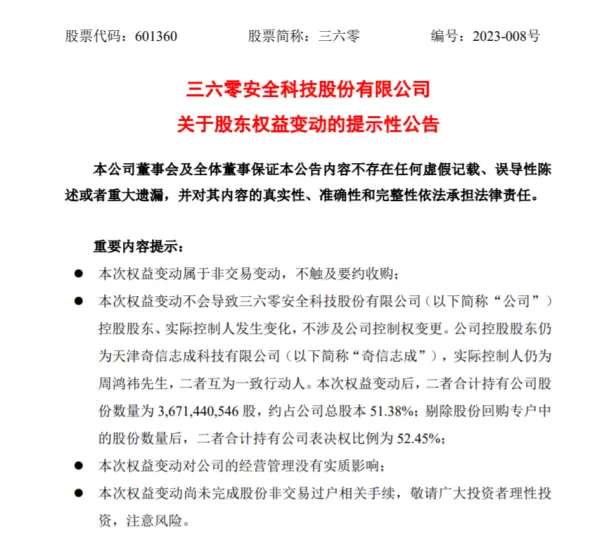
Figure: Indicative Announcement on Changes in Shareholders’ Equity
Fueled by the hype surrounding the ChatGPT concept, 360’s stock price has soared, tripling in just over two months. On April 4, the stock price hit a two-year high, closing at RMB 20.08, bringing its market value to RMB 143.5 billion. The shares distributed to Hu Huan this time have a market value of nearly RMB 9 billion.
I. The Sudden Divorce of a Model Couple Sparks Market Speculation
The sudden news of the major shareholder’s divorce after the close of trading made minority shareholders and netizens uneasy, and they posted their thoughts and vented their frustrations on stock forums: “To cut you off, they even got divorced,” “Cashing out via reducing shares; morality is worth nothing in the domestic market,” “There used to be fake divorces to sell houses; now there are naturally fake divorces to sell stocks”…
Facing market skepticism, Zhao Luming, the Board Secretary of 360, could not sit still and posted on WeChat Moments: “If anyone says I proposed this cash-out strategy to the boss, I will fight them; you are insulting my professional capability.”
Zhou Hongyi and Hu Huan are original spouses. Their relationship has always been relatively stable with no scandals, and they could be considered a “model couple” among listed companies. Whether this divorce is due to a genuine breakdown of affection or other reasons remains unknown to minority shareholders and netizens, and even the Board Secretary might not be entirely clear. In fact, whether Zhou Hongyi’s divorce is a “divorce cash-out” is not that important; why his divorce has caused such a big impact is a question more worthy of our reflection, as the market has already taught investors many lessons.
II. Frequent Cases of Divorce Cash-outs in A-Share Listed Companies
In recent years, divorce cases among shareholders of A-share listed companies have occurred frequently. Except for a tiny minority that were court-ordered divorces—such as the divorce of Zeng Hui and Sun Feng of Saiteng (SH603283) and the divorce of Shen Dongjun and Ma Xiao of Leysen Jewellery (SH603900)—the vast majority of divorce cases were amicable splits where the two parties reached a divorce agreement and divided the listed company’s equity through the agreement. This includes Kunlun Tech’s (SZ300418) RMB 7 billion breakup, Mengjie’s (SZ002397) RMB 1 billion breakup fee, Yixintang’s (SZ002727) RMB 2 billion breakup fee, and Kangtai Biological’s (SZ300601) RMB 23.5 billion breakup fee—all resolved through divorce agreements.
Following the division of shares through divorce, cases where one or both parties cash out by reducing their holdings occur frequently, with Yuan Liping’s cash-out in Kangtai Biological being the most classic: In May 2020, Kangtai Biological announced that the actual controller, Du Weimin, and his Canadian wife, Yuan Liping, had divorced. Du Weimin transferred 161 million directly held company shares to Yuan Liping, with a market value of about RMB 23 billion, which instantly set a record for the highest-value divorce in A-shares, shocking the market. Half a year after the divorce, as Kangtai Biological’s stock price inflated under the COVID-19 vaccine concept, Yuan Liping began her cash-out journey. She intensively reduced her holdings of Kangtai Biological shares through block trades, centralized bidding, and negotiated transfers, with the highest reduction price reaching RMB 194.28 per share. By the end of 2022, Yuan Liping’s cumulative cash-out amount exceeded RMB 3 billion. Accompanied by Yuan Liping’s frequent share reductions and the subsequent share reductions of other executives, Kangtai Biological’s stock price plunged to a closing price of RMB 31.57 on April 4, leaving a market value of only RMB 35.2 billion.
III. Several Issues to Note in the RMB 9 Billion Breakup Case
1. Hu Huan only took a portion of 360’s tradable shares, while renouncing equity in Qixin Zhicheng.
Relevant announcements and data show that the largest shareholder of 360 is Tianjin Qixin Zhicheng Technology Co., Ltd., holding 3.297 billion shares with a market value of over RMB 60 billion. The largest shareholder and actual controller of Qixin Zhicheng is Zhou Hongyi, who holds a 17.39% stake in the company. When Zhou Hongyi and Hu Huan divorced, they should have distributed this part of the equity. Public information shows that Hu Huan renounced her rights in this part of the assets.
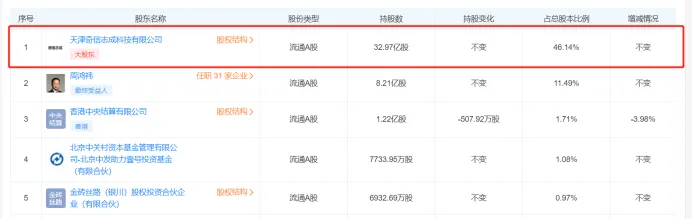 Figure: Major Shareholders of 360 Security Technology Co., Ltd.
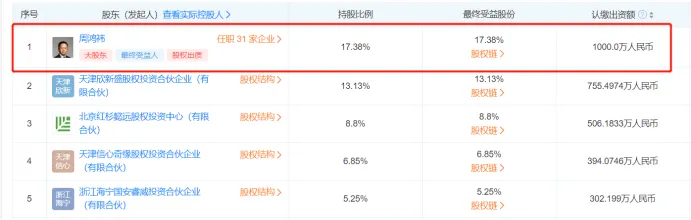 Figure: Major Shareholders of Tianjin Qixin Zhicheng Technology Co., Ltd.
2. Hu Huan has already obtained Singapore permanent residency.
On April 5, 360 Group released an Indicative Announcement on Changes in Shareholders’ Equity and the Simplified Report on Changes in Shareholding of Zhou Hongyi and Hu Huan. Their respective reports show that Zhou Hongyi was born in 1970, and Hu Huan is one year younger than Zhou. Hu Huan’s report indicates that she holds permanent offshore residency in Singapore.
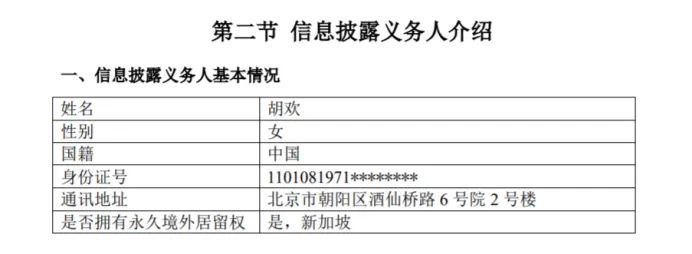 Figure: Simplified Report on Changes in Shareholding (Hu Huan)
3. Hu Huan has no plan to reduce her holdings of the listed company’s shares in the next 6 months.
Relevant announcements show that Ms. Hu Huan has no plan to increase her holdings of the listed company’s shares in the next 12 months, and has no plan to reduce her holdings of the listed company’s shares in the next 6 months. If there are subsequent plans or changes in relevant equity, she will strictly fulfill relevant approval procedures and disclosure obligations in accordance with the requirements of relevant laws and regulations.
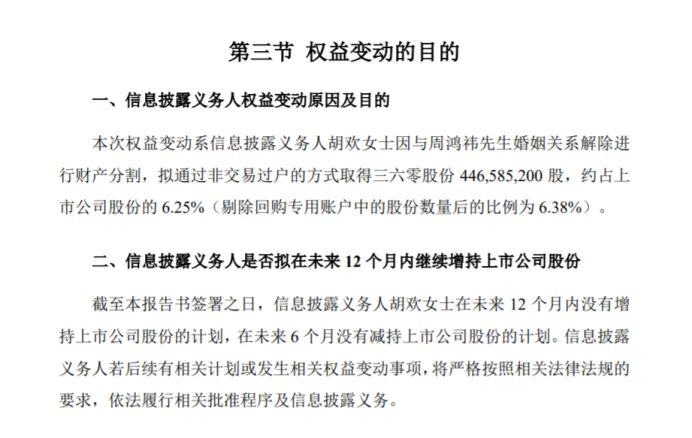 Figure: Simplified Report on Changes in Shareholding (Hu Huan)
Hu Huan holds about a 6.25% stake in 360. If she intends to reduce her holdings ahead of schedule, pre-disclosure is required. If Hu Huan changes her plans in the future and wishes to reduce her shares as soon as possible, she can do so simply by fulfilling the relevant procedures and making a pre-disclosure.
IV. Viewpoints of the GONGWEI Family Governance Center
We believe that the RMB 9 billion divorce case of Zhou Hongyi and Hu Huan may be a classic family governance case worthy of our study and reference. While everyone is focused on whether it is a “fake divorce to cash out,” Zhou Hongyi was likely already making layouts and arrangements for family governance. This divorce is just one step in his family governance structural adjustment and wealth arrangement, primarily reflected in the following aspects:
Hu Huan previously co-founded 3721 with Zhou Hongyi, but she has never appeared on the list of key personnel of 360. The announcement also shows that Ms. Hu Huan does not hold any position in 360 Group and its subsidiaries. Such a clean relationship between Hu Huan and 360 was likely arranged well before 360 was listed. Meanwhile, there is no cross-holding or affiliation between the enterprises controlled respectively by Zhou Hongyi and Hu Huan. Hu Huan is primarily engaged in the investment business and is highly active in capital markets, cooperating with top-tier capital firms such as Sequoia, CDH, and Gaorong, and achieving great success in the investment of Xunlei (SZ300476). Clear equity, explicit control, and complete risk isolation mechanisms are the core elements of family business governance, and the Zhou Hongyi family’s practice of planning ahead is commendable.
Hu Huan’s Singapore status also shows that the Zhou Hongyi family has already prepared identity planning for family governance arrangements in recent years. Singapore is currently the most popular destination for ultra-high-net-worth individuals, and its immigration threshold rises year by year. Without hundreds of millions in net worth, one cannot even consider migrating to Singapore. We do not know when Hu Huan obtained her Singapore status, but public information shows that she obtained it after December 2017. Could she have obtained it recently, and is it related to this divorce?
Family governance is the foundation of family succession. Whether family relationships are handled properly relates to the rise and fall of the family and the family business. If the divorce of a controlling shareholder of a listed company, especially the division of property, is not handled well, it can easily trigger a prolonged marital war, and the division of equity is the core issue of divorce property handling. Whether this RMB 9 billion divorce case of Zhou Hongyi and Hu Huan is a classic and successful case of family governance, as we have analyzed, remains to be verified by time. We shall wait and see.
Contact Lawyer
Submit your contact details and consultation question. We will follow up ASAP.